What are HIPAA security standards? A simple guide for healthcare organizations
When people talk about HIPAA, they often think of privacy policies, patient consent forms, or breach disclosures. But there’s another side to HIPAA that’s equally critical — and often misunderstood or under-prioritized: the HIPAA security standards.
These standards aren’t just about ticking off checkboxes. They’re about making sure that your systems, people, and practices can actually protect sensitive health data in real-world scenarios.
So, what do HIPAA’s security standards really require? And how can organizations go beyond policy-writing and actually implement those requirements in a way that protects patient data and keeps regulators satisfied?
Let’s break it down.
What are HIPAA security standards?
HIPAA security standards refer specifically to the Security Rule — a section of HIPAA that focuses on safeguarding electronic protected health information (ePHI).
While the HIPAA Privacy Rule governs who can access health data and why, the Security Rule governs how that data is protected from unauthorized access, tampering, or loss. especially when it’s stored or transmitted digitally.
These standards apply to:
- Covered entities like healthcare providers, insurers, and clearinghouses.
- Business associates, like billing services, cloud vendors, or data processors handling ePHI.
The three pillars of HIPAA security
HIPAA security standards are built on three categories of safeguards: administrative, physical, and technical. Think of them as different layers that work together to protect digital health information.
1. Administrative safeguards
These are the policies and procedures that govern your organization’s approach to security. But they aren’t just paperwork — they require actual actions behind them. Key elements include:
- Risk analysis and management: Identify where ePHI lives, assess potential threats, and develop a mitigation plan.
- Workforce training: Staff must be trained to recognize threats like phishing and understand secure data handling.
- Access control policies: Define who can access what data and under what circumstances.
- Incident response planning: Have a plan in place for breaches or security failures.
Example: A small clinic may train its front-desk staff on how to handle suspicious emails or what to do if a laptop is stolen, both actions tied to administrative safeguards.
2. Physical safeguards
These focus on the physical protection of devices and facilities that store or access ePHI. Key components:
- Facility access controls: Limit access to server rooms or secure areas.
- Workstation security: Position monitors away from public view; auto-lock after inactivity.
- Device and media controls: Properly dispose of hard drives, USBs, or backup tapes.
Tip: Even cloud-based healthcare organizations need to ensure laptops, tablets, or staff devices are physically protected, especially in hybrid or remote work setups.
3. Technical safeguards
This is where IT teams come in. Technical safeguards are the digital controls that protect ePHI. These include:
- Access controls: Require login credentials, use role-based permissions, and enforce session timeouts.
- Audit controls: Implement logging to track who accessed data and when.
- Data integrity: Ensure ePHI isn’t altered or destroyed without authorization.
- Transmission security: Use encryption for emails, APIs, or any method of transmitting ePHI.
Example: If your team sends lab results via a secure portal instead of plain email, that’s a transmission safeguard in action.
Common gaps in HIPAA security implementation
Most organizations intend to follow HIPAA security standards. But in practice, several gaps often appear:
- Lack of continuous risk assessments: Some organizations conduct a risk analysis once and never update it, even as their tech stacks change.
- Generic or outdated policies: Templates are used, but they are not tailored to the actual business operations.
- No centralized compliance tracking: Especially in larger teams, different departments may assume others are handling compliance tasks.
- Shadow IT risks: Employees use personal devices or unapproved tools without proper controls.
These gaps don’t just increase breach risk; they also make audits and investigations much harder, especially if there’s no paper trail or real-time compliance visibility.
How to implement HIPAA security standards effectively
To really meet HIPAA’s security requirements, compliance has to be part of your daily operations. Here’s how:
1. Start with a real risk assessment
Look at your entire environment: systems, vendors, devices, and user behaviors. Identify weak points, prioritize high-risk areas, and document everything.
2. Build safeguards into your workflows
Security should be invisible where possible. Auto-logout features, SSO access, and encryption at rest; these controls should be embedded, not left to manual decisions.
3. Educate your workforce, not just your IT team
HIPAA violations often come from human error, not hackers. Make security part of onboarding, training refreshers, and incident simulations.
4. Automate evidence collection and tracking
Documenting compliance is just as important as doing it. Use compliance automation tools that automatically log access, generate audit trails, and maintain up-to-date records for regulators.
5. Monitor and update continuously
HIPAA compliance isn’t one-and-done. As your tech changes, your safeguards need to adapt, and your documentation needs to stay up to date.
Why compliance automation is a game-changer for HIPAA compliance
Traditionally, HIPAA compliance was managed through spreadsheets, policy binders, and long email threads with IT teams. But modern security threats and the complexity of today’s digital infrastructure demand a smarter approach.
This is where compliance automation platforms like CyberArrow make a real difference.
Stay ahead of HIPAA compliance risks with CyberArrow
Instead of relying on disconnected processes, CyberArrow allows you to:
- Run continuous HIPAA-aligned risk assessments.
- Automate the implementation and tracking of safeguards.
- Centralize documentation, audit logs, and access records.
- Train employees and track completion from a single dashboard.
- Prepare for audits with pre-built templates and evidence collection.
Whether you’re a healthcare provider or a vendor working with ePHI, CyberArrow helps you turn HIPAA security from a headache into a streamlined, auditable process.
With CyberArrow, you can simplify your compliance process, reduce manual effort, and gain real confidence in your HIPAA posture.
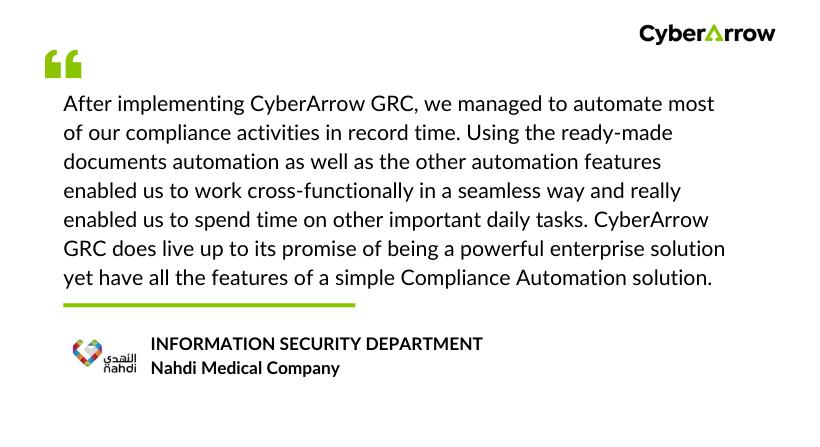
Here’s what companies like Nahdi Medical Company say about CyberArrow: