A complete guide to ISO 22316: Requirements & implementation
Organizations face many unexpected risks like cyberattacks, natural disasters, or market shifts. To stay strong, they need to build something called organizational resilience. And that’s where organizations need to implement ISO 22316.
This international standard helps companies prepare for disruptions, recover faster, and continue working smoothly. In this guide, we’ll explain what ISO 22316 is, its key requirements, how to implement it, and how a tool like CyberArrow GRC can automate the whole process for you.
- What is ISO 22316?
- Why organizational resilience matter?
- ISO 22316 requirements
- Benefits of implementing ISO 22316
- Steps to implement ISO 22316
- Challenges in manual ISO 22316 implementation
- How CyberArrow GRC helps with ISO 22316
- Cross-mapping across ISO and NIST frameworks
- Who should use ISO 22316?
- Common myths about ISO 22316
- Final Thoughts
What is ISO 22316?
ISO 22316 is the international standard for organizational resilience. It helps businesses build strength and flexibility to handle change, risk, or crises. The goal is not just to survive challenges but to grow from them.
This standard doesn’t give you a checklist. Instead, it gives principles and guidance. These help organizations of all sizes and industries improve their ability to adapt and respond.
Whether you are a small business or a large enterprise, ISO 22316 can help you protect your people, assets, and brand.
Why organizational resilience matter?
Let’s look at some real-life examples:
- A hospital needs to keep running during a power outage.
- An e-commerce company must stay online even if one of its data centers goes down.
- A school must protect its students and continue learning during a public health crisis.
In all these cases, resilience is key. ISO 22316 helps build that resilience into your everyday work, so you don’t wait for a disaster to start reacting.
ISO 22316 requirements
ISO 22316 outlines guiding principles, not fixed rules. It focuses on improving 3 main areas:
1. Leadership and culture
Leaders must support resilience. They need to create a culture where people feel safe, informed, and ready to take action during tough times.
2. Shared vision and purpose
Everyone in the company should understand your mission and what resilience means in their role.
3. Supporting resources
Resilience needs people, systems, data, and equipment. You must have the right tools and training in place.
4. Information and knowledge
You must gather, manage, and use information quickly especially during disruptions.
5. Learning and change
Companies should learn from past incidents and use that knowledge to improve.
6. Coordination
All parts of your business people, processes, and partners must work together during crises.
Benefits of implementing ISO 22316
Here’s why more companies are turning to ISO 22316:
- Faster recovery: Get back to business quickly after a problem.
- Stronger brand trust: Customers trust companies that are prepared.
- Fewer losses: Prevent financial, reputational, and operational damage.
- Compliance boost: Support other standards like ISO 27001 and ISO 31000.
- Smarter decisions: Make informed choices with strong data and planning.
Steps to implement ISO 22316
You don’t have to start big. Here’s a simple step-by-step plan:
Step 1: Understand your organization
Know your goals, risks, and current abilities. Do a gap analysis to see where you are now and where you want to be.
Step 2: Get leadership support
Make sure top-level leaders understand the value of resilience and support the project.
Step 3: Create a resilience strategy
Develop a plan that covers all parts of your organization. This includes people, processes, technology, and partners.
Step 4: Train your team
Help your staff understand their roles in resilience. Give them the tools and knowledge they need.
Step 5: Monitor and improve
Keep tracking your resilience efforts. Update your plans based on new risks, incidents, or lessons learned.
Challenges in manual ISO 22316 implementation
Manual work can slow down your progress. Some common issues include:
- Keeping up with multiple frameworks and documents.
- Missing links between risk, compliance, and resilience tasks.
- Trouble showing proof of compliance during audits.
- Not knowing which teams are falling behind.
- Poor coordination between departments.
How CyberArrow GRC helps with ISO 22316
Implementing ISO 22316 manually takes time and effort. But with CyberArrow GRC, the entire process becomes smoother, faster, and more accurate.
Here’s how it helps:
1. Automation: CyberArrow automates tasks like risk assessments, documentation, reporting, and audit trails. This saves time and reduces errors.
2. Centralized platform: Everything you need, including policies, reports, workflows, and evidence is in one place. No need to search through folders or spreadsheets.
3. Real-time tracking: Stay updated on your progress with live dashboards. See where your company stands on compliance at any time.
4. Team collaboration: Assign tasks, track actions, and ensure everyone knows their part in building resilience.
Cross-mapping across ISO and NIST frameworks
One of the most powerful features of CyberArrow GRC is its cross-mapping capability.
Let’s say you’re working with more than one framework like:
- ISO 22316 (Resilience)
- ISO 27001 (Information Security)
- ISO 31000 (Risk Management)
- NIST Cybersecurity Framework
CyberArrow automatically maps controls across all these frameworks.
This means:
- You don’t have to repeat tasks.
- You reduce duplicate documentation.
- You improve efficiency across compliance efforts.
This is especially helpful for teams managing multiple frameworks at once. CyberArrow makes it simple, clear, and connected.
Who should use ISO 22316?
This standard is for everyone from private companies to public organizations. It’s especially useful for:
- IT and tech companies: Need to keep operations running 24/7.
- Healthcare: Must be ready for emergencies and patient safety.
- Finance: Handle risk, regulation, and customer trust.
- Government agencies: Protect people and services.
- Education: Maintain learning during disruptions.
No matter your size or industry, ISO 22316 helps you stay ready for the unexpected.
Common myths about ISO 22316
Let’s clear up a few misunderstandings:
Myth 1: It’s only for big companies.
Truth: Any organization can use ISO 22316. It’s flexible and scalable.
Myth 2: It’s a one-time project.
Truth: Resilience is ongoing. You need to update and improve regularly.
Myth 3: It’s only for disasters.
Truth: ISO 22316 helps with all types of change market shifts, tech failures, staff shortages, and more.
Final Thoughts
ISO 22316 is a powerful standard for building organizational resilience. In a world filled with uncertainty, it helps you stay strong, recover fast, and keep serving your customers no matter what.
But trying to do everything manually can slow you down. With CyberArrow GRC, you can:
- Automate ISO 22316 tasks and policies.
- Link controls across multiple standards.
- Stay audit-ready and always up-to-date.
- Save time, cut errors, and focus on what matters.
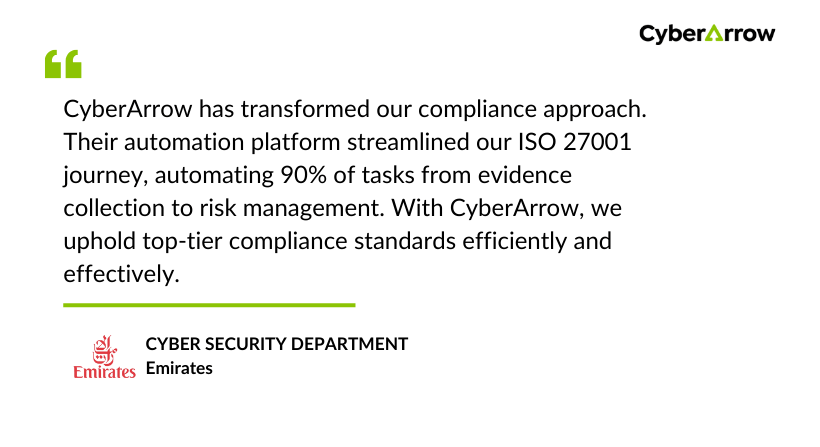
Read how Emirates enhanced Information Security by automating ISO 27001 with CyberArrow GRC.
See what Emirates has to say about CyberArrow GRC: