Cyber security compliance frameworks: What they are and why they matter
Cyber security is no longer just an IT concern; it’s a business necessity. With cyber threats evolving, organizations must follow strict compliance requirements to protect sensitive data and maintain trust using cyber security compliance frameworks.
A cyber security compliance framework is a set of guidelines, policies, and best practices that organizations follow to ensure data security and regulatory compliance. Different industries and regions have their own frameworks, each with unique requirements.
This guide will explore six widely recognized cyber security compliance frameworks: GDPR, HIPAA, NIST, SOC 2, ISO 27001, and PCI DSS. We’ll break down their key requirements, who needs to comply, and how they compare.
Why cyber security compliance matters
Ignoring cyber security compliance isn’t just risky; it’s costly. Data breaches, legal penalties, and reputational damage can have severe consequences. Compliance frameworks help organizations:
- Protect sensitive data from cyber threats.
- Avoid legal and financial penalties for non-compliance.
- Establish trust with customers, partners, and stakeholders.
- Improve security posture by following industry best practices.
Let’s look at the major cyber security compliance frameworks and what they entail.
Major cyber security compliance frameworks
Below is a comparison table for a quick overview of key cyber security frameworks:
| Framework | Industry focus | Key requirements | Who needs to comply |
| GDPR | General data protection (EU) | Data privacy, user consent, right to erasure, breach reporting | Any business processing EU citizens’ data |
| HIPAA | Healthcare | Data encryption, access control, security risk assessments | Healthcare providers, insurers, business associates |
| NIST | Government & general cyber security | Risk management, incident response, access control | U.S. federal agencies, businesses following best practices |
| SOC 2 | Cloud & service providers | Data security, confidentiality, integrity, privacy | SaaS and cloud service providers handling customer data |
| ISO 27001 | Information security management | Risk assessment, security policies, continuous monitoring | Organizations needing a global security certification |
| PCI DSS | Payment card security | Cardholder data protection, encryption, network monitoring | Businesses handling credit card transactions |
Now, let’s dive into each framework in detail.
1. GDPR (General Data Protection Regulation)
The General Data Protection Regulation (GDPR) is one of the world’s strictest data privacy laws. Enforced by the European Union, it focuses on protecting individuals’ personal data.
Key requirements:
- Organizations must obtain clear user consent before collecting personal data.
- Users have the right to access, correct, or delete their data.
- Companies must implement data protection measures like encryption and access control.
- Data breaches must be reported within 72 hours.
Who it applies to: Any company handling data of EU citizens.
Non-compliance penalties: Fines can go up to €20 million or 4% of global annual revenue.
2. HIPAA (Health Insurance Portability and Accountability Act)
HIPAA is a U.S. regulation designed to secure protected health information (PHI) and prevent unauthorized access.
Key requirements:
- PHI must be encrypted both in transit and at rest.
- Organizations must perform regular security risk assessments.
- Only authorized personnel should have access control to PHI.
- A Business Associate Agreement (BAA) is required when sharing data with third parties.
Who it applies to: Healthcare providers, insurers, and their business associates.
Non-compliance penalties: Fines range from $100 to $50,000 per violation, depending on severity.
3. NIST (National Institute of Standards and Technology) Cybersecurity Framework
NIST provides a voluntary framework to help organizations manage cyber security risks. It’s widely used by both public and private sector entities.
Key requirements:
- Organizations must assess risks using the five core functions: Identify, Protect, Detect, Respond, and Recover.
- Implement strong access control measures.
- Establish an incident response plan.
- Continuously monitor and improve security measures.
Who it applies to: U.S. federal agencies and businesses following cyber security best practices
Why it’s important: While not mandatory for private companies, adopting NIST best practices can significantly strengthen security.
4. SOC 2 (Service Organization Control 2)
SOC 2 is an auditing standard that evaluates how well a company secures customer data. It is based on five Trust Service Criteria (TSC): Security, Availability, Processing Integrity, Confidentiality, and Privacy.
Key requirements:
- Implement security controls to protect customer data.
- Conduct third-party audits to verify compliance.
- Maintain a detailed incident response plan.
- Ensure continuous monitoring of security systems.
Who it applies to: SaaS companies and cloud service providers.
Why it’s important: Many businesses require SOC 2 compliance before working with SaaS providers.
5. ISO 27001 (International Organization for Standardization 27001)
ISO 27001 is an internationally recognized Information Security Management System (ISMS) standard. It outlines best practices for securing sensitive information.
Key requirements:
- Organizations must identify and mitigate security risks.
- Define a formal security policy and train employees.
- Implement access control, encryption, and monitoring measures.
- Conduct regular audits to maintain certification.
Who it applies to: Organizations seeking a globally recognized cyber security standard.
Why it’s important: ISO 27001 certification helps build trust with customers and partners globally.
6. PCI DSS (Payment Card Industry Data Security Standard)
PCI DSS is a security standard developed by major credit card companies to protect payment data.
Key requirements:
- Encrypt cardholder data during storage and transmission.
- Maintain a firewall to protect sensitive data.
- Conduct regular security testing.
- Implement multi-factor authentication (MFA) for system access.
Who it applies to: Businesses handling credit card transactions.
Non-compliance penalties: Companies may face fines or restrictions from payment processors.
Choosing the right compliance framework
The best framework for your organization depends on your industry and security needs:
- If you handle EU citizen data, GDPR compliance is a must.
- Healthcare organizations need to comply with HIPAA.
- SaaS providers and cloud companies should prioritize SOC 2.
- Government agencies and security-conscious businesses benefit from NIST.
- Companies seeking global security certification should aim for ISO 27001.
- Businesses processing credit card transactions must follow PCI DSS.
Simplify cyber security compliance with CyberArrow
Compliance with cyber security compliance frameworks can be complex and time-consuming, but CyberArrow makes it easier. CyberArrow GRC helps businesses achieve and maintain compliance with frameworks like ISO 27001, SOC 2, GDPR, HIPAA, and more, all in one place.
How CyberArrow helps:
- Automated evidence collection: Reduce manual work by automatically gathering compliance data.
- Real-time compliance monitoring: Stay ahead with instant insights into your security posture.
- Security awareness training: Educate employees with built-in training modules.
- Risk assessment and management: Identify, assess, and mitigate risks efficiently.
- Third-party security management: Automate vendor risk assessments and ensure compliance.
- Dedicated compliance support: Get expert guidance tailored to your needs.
With CyberArrow, you can streamline compliance, reduce risk, and confidently pass audits.
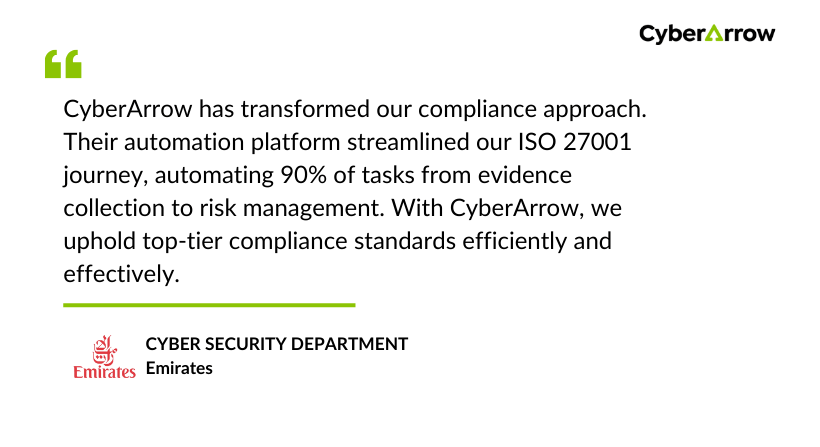
See what companies like Emirates say about CyberArrow: