What is remote browser isolation? A must-have for cyber security compliance
In the age of ever-evolving cyber threats, protecting sensitive data and maintaining compliance are top priorities for organizations. One of the most effective solutions for minimizing web-based threats is remote browser isolation (RBI). This technology ensures that internet browsing is conducted in a secure environment, away from the user’s local system. By isolating browser activity, RBI plays a critical role in safeguarding sensitive information and meeting cyber security compliance standards.
In this blog, we’ll dive into the concept of remote browser isolation, why it’s essential, and the compliance standards that emphasize its adoption.
- What is remote browser isolation?
- How remote browser isolation works
- Why is remote browser isolation important?
- Compliance standards that prioritize remote browser isolation
- Real-world applications of remote browser isolation
- Challenges in implementing remote browser isolation
- The role of CyberArrow GRC in cyber security compliance
What is remote browser isolation?
Remote browser isolation (RBI) is a cyber security technique that separates a user’s browser activity from their local network and endpoint devices. Instead of accessing websites directly on a user’s computer, browsing sessions are run in an isolated environment usually on a secure cloud server or a virtual machine. The session is rendered remotely, and only a safe visual stream is transmitted to the user.
This process ensures that any malicious content, such as malware, ransomware, or phishing links, remains contained within the isolated environment, protecting the user and the organization’s network.
How remote browser isolation works
- Request handling: When a user clicks on a web link, the browser session is initiated in a remote environment.
- Content rendering: The website is loaded and rendered on a virtual server or cloud platform.
- Visual stream transmission: The browser transmits only a sanitized version (a safe visual stream) of the website to the user’s device.
- User interaction: Users can browse as usual without downloading or executing any content locally.
With this approach, harmful scripts or malicious software are blocked from infecting the user’s computer or the organization’s network.
Why is remote browser isolation important?
1. Protection against web-based threats
Websites are one of the most common entry points for cyberattacks. RBI ensures that any malicious content, such as drive-by downloads or exploits, is contained in the isolated browser environment.
2. Zero Trust security model
RBI aligns with the Zero Trust security model, which assumes that every user, device, or session could be a potential threat. By isolating browsing sessions, organizations reduce the attack surface significantly.
3. Enhanced user productivity
Unlike traditional methods that block websites entirely, RBI allows users to access potentially risky websites in a controlled environment. This balance ensures both security and productivity.
4. Compliance with cyber security standards
Many regulations and frameworks require robust measures to protect sensitive data and prevent breaches. RBI not only strengthens an organization’s security posture but also helps meet compliance requirements.
Compliance standards that prioritize remote browser isolation
1. ISO/IEC 27001
This international standard for information security management emphasizes risk mitigation and control measures. RBI supports ISO 27001 by minimizing web-based risks and enhancing data security.
2. NIST Cybersecurity Framework (CSF)
The NIST CSF provides guidelines for managing and reducing cyber security risks. Its emphasis on protective technologies makes RBI a recommended solution for organizations aiming to follow its guidelines.
3. General Data Protection Regulation (GDPR)
GDPR requires organizations to protect personal data from unauthorized access and breaches. RBI plays a crucial role by isolating browser sessions and reducing the risk of data exposure through malicious websites.
4. Payment Card Industry Data Security Standard (PCI DSS)
For businesses handling payment data, PCI DSS mandates strong security controls. RBI helps secure online transactions and prevents attacks targeting sensitive payment information.
5. Health Insurance Portability and Accountability Act (HIPAA)
Healthcare organizations under HIPAA are required to safeguard electronic protected health information (ePHI). RBI ensures that web-based threats do not compromise patient data.
6. Cyber security Maturity Model Certification (CMMC)
A standard for government contractors, CMMC prioritizes secure access to sensitive systems. RBI helps organizations meet these requirements by isolating browsing activities from critical infrastructure.
Real-world applications of remote browser isolation
1. Financial services
Banks and financial institutions handle large volumes of sensitive data. RBI ensures secure access to web-based portals, protecting customer information from phishing and malware.
2. Healthcare organizations
Hospitals and clinics use RBI to protect patient data while accessing online resources. This reduces the risk of ransomware and other cyber threats.
3. Government agencies
Government networks are frequent targets of cyberattacks. RBI provides an additional layer of security to prevent unauthorized access and data breaches.
4. Educational institutions
With students and staff accessing diverse online content, RBI ensures safe browsing without compromising network security.
Challenges in implementing remote browser isolation
While RBI is highly effective, it comes with certain challenges:
- Cost: Implementing RBI can be expensive for smaller organizations.
- Latency Issues: Some users may experience delays in browsing due to remote rendering.
- Adoption resistance: Employees may resist using isolated browsers due to unfamiliarity.
To overcome these challenges, organizations need solutions that are user-friendly, scalable, and cost-effective.
The role of CyberArrow GRC in cyber security compliance
If you’re aiming to enhance your cyber security compliance efforts, CyberArrow GRC can be your ideal partner.
CyberArrow GRC helps organizations:
- Align with Compliance Standards: Simplify the process of meeting requirements from ISO 27001, NIST CSF, GDPR, and more.
- Centralize compliance management: Track policies, controls, and risk mitigation measures in one platform.
- Enhance security awareness: Educate employees about emerging threats like web-based attacks.
- Streamline reporting: Generate reports effortlessly to demonstrate compliance during audits.
While CyberArrow GRC does not directly provide remote browser isolation, it ensures that your organization is well-aligned with cyber security standards and stays prepared to adopt advanced solutions like RBI.
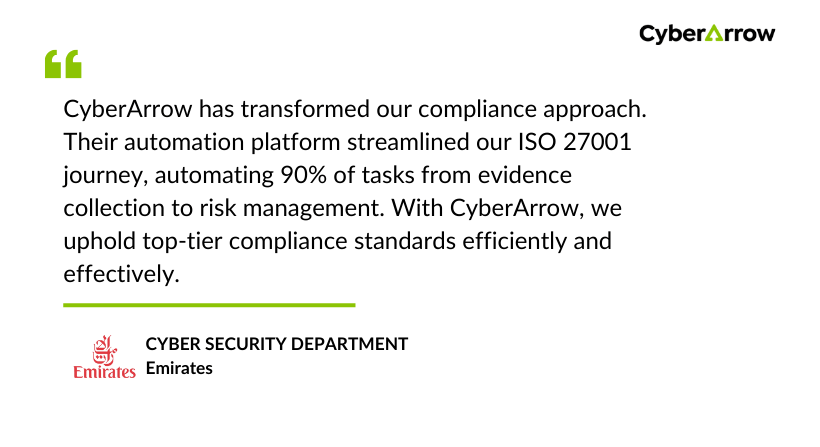
Read how Emirates enhanced Information Security by automating ISO 27001 with CyberArrow GRC.
See what Emirates has to say about CyberArrow GRC: