What is DFIR (Digital Forensics and Incident Response)?
Are you ready to tackle the growing threat of cyberattacks?
The average cost of a data breach in 2023 was a staggering $4.45 million globally. With cybercriminals launching attacks every 39 seconds, no business can afford to be unprepared. This is where DFIR, or Digital Forensics and Incident Response, becomes essential.
In this blog, we’ll explore what DFIR is, why it’s important, its key components, and how businesses can strengthen their cyber security strategy using automated tools like CyberArrow GRC.
What is DFIR?
DFIR, short for Digital Forensics and Incident Response, is the process of investigating, mitigating, and recovering from cyber security incidents. It merges two critical fields:
- Digital forensics: Involves gathering, preserving, and analyzing electronic evidence to uncover the root cause of an attack.
- Incident response: Focuses on detecting, containing, and resolving security breaches to minimize damage.
Together, these practices form a comprehensive approach to combating cyber threats.
Why is DFIR critical for businesses?
Cyberattacks are more frequent and damaging than ever. According to a report by Accenture, 43% of cyberattacks target small businesses, yet only 14% are prepared to defend themselves.
Here’s why DFIR is essential:
- Protects sensitive data: DFIR helps businesses safeguard confidential information and prevent unauthorized access.
- Reduces downtime: Effective incident response minimizes disruption to business operations.
- Ensures compliance: Frameworks like GDPR, HIPAA, and ISO 27001 require organizations to have robust incident response plans.
- Maintains customer trust: A quick and professional response to cyber incidents helps preserve a company’s reputation.
Key components of DFIR
A successful DFIR process involves six key steps:
1. Preparation
Preparation is the foundation of DFIR. It includes:
- Creating an incident response plan.
- Training employees on cyber security best practices.
- Setting up monitoring tools to detect threats.
2. Detection and analysis
The faster an incident is detected, the less damage it causes. During this phase, DFIR teams:
- Monitor systems for unusual behavior.
- Analyze logs, traffic, and endpoints.
- Identify the type and scope of the attack.
3. Containment
Once an incident is identified, it’s crucial to stop the attack from spreading. Containment strategies include:
- Isolating affected systems.
- Blocking malicious IP addresses.
- Deploying patches to fix vulnerabilities.
4. Eradication
After containing the threat, DFIR teams work to eliminate it entirely. This step often involves:
- Removing malware or unauthorized access.
- Deleting compromised accounts or files.
5. Recovery
Recovery ensures that systems are secure and operational. Steps include:
- Restoring data from backups.
- Testing systems for vulnerabilities.
- Monitoring for lingering threats.
6. Post-incident review
The final step involves analyzing the incident to improve future responses. This includes:
- Reviewing what went wrong and what worked.
- Updating the incident response plan.
Quick link: What is Open-Source Intelligence (OSINT)?
Tools and techniques used in DFIR
DFIR professionals rely on a variety of tools and techniques to uncover and address cyber security threats:
Digital forensic tools
- EnCase: Used for analyzing and recovering digital evidence.
- Autopsy: An open-source tool for digital investigations.
Incident response tools
- SIEM (Security Information and Event Management): Aggregates and analyzes logs from multiple sources.
- SOAR (Security Orchestration, Automation, and Response): Automates incident response processes.
Network analysis tools
- Wireshark: Examines network traffic for anomalies.
- Zeek: Monitors network activity to detect suspicious behavior.
Endpoint detection tools
- Tools like CrowdStrike and SentinelOne provide visibility into endpoint activities, helping detect threats early.
Challenges in DFIR
DFIR is not without its challenges. Organizations often face:
- Data overload: With countless logs and alerts, it can be overwhelming to pinpoint the root cause of an attack.
- Time sensitivity: Quick detection and response are critical to minimize damage.
- Evolving threats: Cybercriminals constantly develop new tactics, making it hard to keep up.
- Skill shortages: DFIR requires expertise in forensic analysis, malware investigation, and more.
Why automation is key in DFIR
Automation is revolutionizing DFIR by addressing many of its challenges. Here’s how:
- Faster detection: Automated systems can analyze logs and alerts in real time, identifying threats faster than human analysts.
- Consistent response: Pre-defined workflows ensure incidents are handled systematically.
- Reduced human error: Automation minimizes the chances of overlooking critical details.
Quick link: What is remote browser isolation?
The role of CyberArrow GRC in DFIR
When it comes to improving your organization’s approach to cyber security, CyberArrow GRC plays a crucial role in aligning your practices with governance, risk, and compliance (GRC) standards. While CyberArrow GRC isn’t designed to automate incident response workflows, it ensures your organization is well-prepared by focusing on robust compliance and risk management processes.
CyberArrow GRC helps your DFIR strategy by:
- Aligning with GRC standards: Stay compliant with regulations like GDPR, ISO 27001, and other cyber security frameworks, reducing the risk of regulatory fines.
- Streamlining compliance processes: Simplify the creation, management, and monitoring of compliance reports, ensuring you always meet industry requirements.
- Enhancing security posture: Identify vulnerabilities in your compliance practices to strengthen overall cyber security defenses.
- Supporting proactive risk management: Gain insights into potential risks and take action before they escalate into incidents.
With CyberArrow GRC, you can build a solid foundation for your cyber security strategy, ensuring that your organization is well-prepared to handle incidents while maintaining compliance with critical standards.
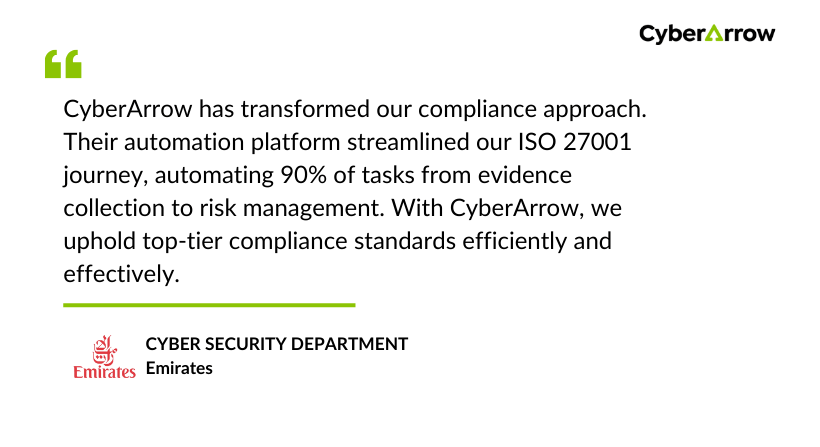
Read how Emirates enhanced Information Security by automating ISO 27001 with CyberArrow GRC.
See what Emirates has to say about CyberArrow GRC: