Why GRC software is essential for financial institutions
Financial institutions operate in one of the most regulated industries in the world. Whether managing customer data, ensuring compliance with PCI DSS, or staying ahead of cyber threats, the risks they face are complex and constantly evolving. A compliance failure or data breach can result in hefty fines, reputational damage, and loss of customer trust.
Financial institutions can no longer rely on manual processes or fragmented systems to meet regulatory requirements. This is where GRC automation can help. GRC software helps financial institutions streamline compliance processes, mitigate risks, and maintain operational efficiency—all in a centralized platform.
In this article, we’ll explore why GRC software is essential for financial institutions, discuss its importance, highlight its benefits, and examine how it addresses key challenges.
Importance of GRC software for financial institutions
Financial institutions deal with many regulations, ranging from data privacy laws like GDPR to industry-specific mandates such as PCI DSS and Basel III. Staying compliant with these regulations requires constant monitoring, documentation, and reporting. The complexity of these tasks often leads to challenges when managed manually.
Here’s why GRC software is crucial:
1. Managing regulatory compliance effectively
GRC software simplifies compliance management by consolidating all regulatory requirements into one platform. It provides real-time regulatory change updates, ensuring financial institutions remain compliant without manual intervention. This is especially critical in industries where regulations frequently evolve, such as finance.
For example, a bank using GRC software can automate its compliance checks, reducing the need for manual audits and minimizing human error. The software ensures that every department aligns with regulatory standards, avoiding gaps that could lead to penalties.
2. Reducing operational risks
Operational risks—such as fraud, data breaches, or system failures—are common in financial institutions. GRC software enables risk assessment and management by identifying potential vulnerabilities and providing solutions to address them proactively. This reduces the likelihood of incidents and ensures smoother operations.
3. Enhancing accountability and transparency
GRC software promotes transparency by clearly recording compliance activities and risk assessments. This makes it easier for financial institutions to provide evidence of compliance during audits and fosters accountability across teams.
Benefits of GRC software for financial institutions
GRC software offers numerous benefits for financial institutions. These benefits improve compliance and risk management and contribute to overall organizational growth and stability.
Let’s explore some of these benefits below:
1. Centralized compliance management
Financial institutions often have multiple teams working on different aspects of compliance. GRC software consolidates these efforts into a single platform, making it easier to track, manage, and report compliance activities.
For instance, a credit union can use GRC software to centralize its data privacy compliance processes, ensuring uniformity across branches.
2. Automation of repetitive tasks
Manual compliance processes are time-consuming and prone to errors. GRC software automates repetitive tasks such as evidence collection, policy management, and reporting. Automation not only saves time but also ensures accuracy and consistency.
For example, a bank can use GRC software to automate the collection of audit evidence, reducing the workload for compliance teams while maintaining high standards of accuracy.
Also, learn the top features to look for in modern GRC software
3. Improved risk assessment
GRC software provides advanced tools for risk assessment, allowing financial institutions to identify, analyze, and prioritize risks. By using dashboards and analytics, organizations can clearly understand their risk exposure and make informed decisions to mitigate them.
4. Real-time monitoring and reporting
Staying ahead of compliance issues requires real-time monitoring. GRC software provides continuous oversight, ensuring that potential issues are identified and addressed promptly. Additionally, it generates detailed reports that simplify audits and enhance regulatory communication.
For instance, an investment firm can use GRC software to monitor its portfolio for compliance with ESG (environmental, social, and governance) standards, ensuring alignment with global regulations.
5. Cost savings
While implementing GRC software involves an initial investment, it significantly reduces costs in the long run. Financial institutions can save on fines, legal fees, and operational inefficiencies by automating compliance tasks and minimizing risks.
For example, a small financial institution that uses GRC software to streamline PCI DSS compliance can avoid hefty fines for non-compliance while reducing staffing costs.
6. Enhanced decision-making
With access to comprehensive data on risks, compliance activities, and performance metrics, financial institutions can make better decisions. GRC software provides actionable insights that help organizations align their operations with strategic goals.
Explore How GRC software simplifies compliance for ISO 27001 and SOC 2
Risks of traditional compliance management
Relying on traditional compliance processes poses significant risks for financial institutions. These risks can have far-reaching consequences, both financially and reputationally.
- Increased likelihood of errors: Manual processes are prone to human error, which can lead to compliance failures. For instance, missing a regulatory update or failing to document compliance activities properly can result in penalties or legal action.
- Inefficiency and resource drain: Managing compliance manually requires significant time and effort. This diverts resources from other critical business areas and leads to inefficiencies. For example, a compliance team that spends weeks preparing for an audit manually could use GRC software to complete the task in days.
- Lack of real-time insights: Manual processes cannot provide real-time insights into compliance and risk. This makes it challenging for financial institutions to address issues, increasing their risk exposure proactively.
- Difficulty in scaling: As financial institutions grow, their compliance requirements become more complex. Manual processes are not scalable and often struggle to keep up with the increasing volume of regulatory demands. GRC software, on the other hand, is designed to scale with the organization’s needs.
Overcome compliance challenges with CyberArrow
Managing compliance manually is no longer sustainable for financial institutions. CyberArrow, a leading GRC software platform, simplifies compliance management and risk assessment through automation and real-time monitoring. It ensures that financial institutions can achieve and maintain compliance effortlessly.
Key features of CyberArrow:
- Automated evidence collection: Eliminates manual effort and ensures accurate documentation for audits.
- Real-time monitoring and alerts: Provides continuous oversight to address compliance issues proactively.
- KPI tracking: Tracks key compliance metrics to help organizations stay audit-ready.
- Automated risk management: Identifies compliance risks and prioritizes actions to minimize risks.
- Dedicated support: Offers expert guidance to streamline compliance processes.
Quick link: What is privacy by design?
A Fintech startup automated PCI DSS compliance in 3 weeks with CyberArrow
A fast-growing Fintech startup in Saudi Arabia committed to revolutionizing digital transactions with secure, compliant, and transparent financial solutions.
Challenge: Manual compliance processes, lack of PCI DSS expertise, and the need to constantly monitor cardholder data.
Solution: The Fintech company adopted CyberArrow GRC, leveraging features like:
- Automated assessments to identify misconfigurations in the cardholder data environment.
- Real-time monitoring to ensure the security of sensitive data.
- Simplified documentation processes to generate PCI DSS-compliant reports.
Results achieved:
- Complete automation of PCI DSS compliance in just 3 weeks.
- Significant cost and time savings through streamlined processes.
- Consistently accurate and audit-ready compliance reports, simplifying the auditing process.
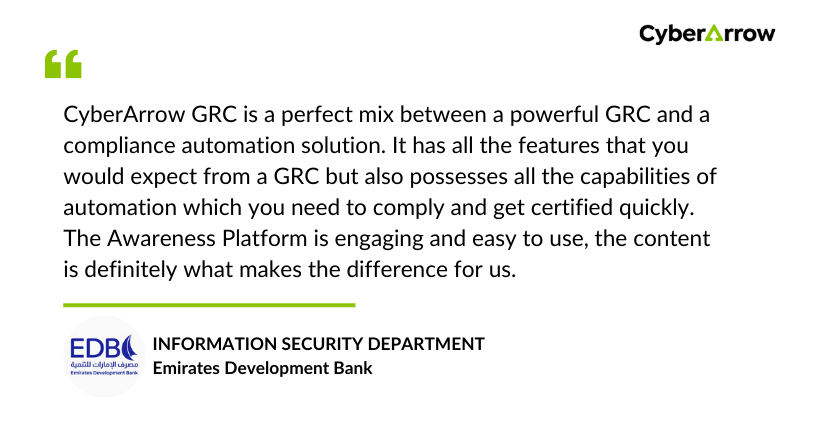
See what our clients have to say about CyberArrow GRC: