A complete guide to CCPA compliance requirements
The California Consumer Privacy Act (CCPA) is a crucial law designed to give California residents more control over their personal data. It sets clear requirements for businesses on how to collect, store, and share consumer information. For organizations operating in California or dealing with California residents’ data, understanding CCPA compliance requirements is critical to avoid hefty fines and protect customer trust.
This guide explains everything you need to know about CCPA compliance requirements and how to meet them effectively.
What is the CCPA?
The California Consumer Privacy Act, enacted in 2018, is one of the most comprehensive privacy laws in the United States. It applies to businesses that collect personal information from California residents and ensures they are transparent about how they handle data.
CCPA empowers individuals by granting them rights such as:
- Knowing what personal data is being collected.
- Requesting businesses to delete their personal information.
- Opting out of the sale of their data.
This law has paved the way for stricter privacy regulations nationwide, influencing businesses of all sizes.
Who needs to comply with CCPA?
CCPA compliance is not required for every business. It applies if a company meets at least one of these criteria:
- Has annual gross revenue of over $25 million.
- Buys, sells, or shares personal information of 50,000 or more California residents, households, or devices annually.
- Derives 50% or more of its annual revenue from selling personal information.
Additionally, businesses must comply if they are service providers or entities sharing branding with a parent company that falls under these criteria.
Key CCPA compliance requirements
To comply with the CCPA, businesses must follow these specific requirements:
1. Provide notice of data collection
- Businesses must inform consumers at or before the point of data collection about what personal information is being collected and why.
- This notice should include the categories of data collected and the purposes for which it will be used.
2. Offer consumers the right to know
- Consumers have the right to request access to the specific pieces of personal information a business collects about them.
- Businesses must also disclose the sources of the data, the purpose of collection, and any third parties with whom the data is shared.
3. Enable data deletion requests
- Consumers can request the deletion of their personal information. Businesses must comply unless the data is necessary for legal or operational purposes, such as completing a transaction or detecting fraud.
4. Allow consumers to opt out of data sales
- Businesses that sell personal information must provide a clear option for consumers to opt out.
- A “Do Not Sell My Personal Information” link must be visible on the company’s website homepage.
5. Maintain data security
- Businesses are responsible for implementing reasonable security measures to protect consumer data from unauthorized access or breaches.
- Failure to do so could result in legal action or penalties.
6. Update privacy policies
- Privacy policies must be updated annually to reflect current data collection and processing practices.
- The updated privacy policy should also detail consumers’ rights under the CCPA.
7. Respond to consumer requests promptly
- Businesses must respond to consumer requests (for data access, deletion, or opting out) within 45 days. This period can be extended by another 45 days if necessary, but consumers must be informed about the delay.
8. Train employees
- Employees handling consumer inquiries about privacy practices must be trained on how to comply with CCPA.
- This ensures that customer service and compliance teams understand the legal requirements.
Quick link: Your partner in North American GRC excellence
Exemptions under CCPA
While the CCPA is broad, there are some exemptions:
- Non-profit organizations: CCPA applies only to for-profit businesses.
- Data regulated by other laws: Information covered under laws like HIPAA or GLBA is exempt.
- Small businesses: Companies that don’t meet the revenue, data, or business model thresholds are excluded.
Quick link: CCPA vs GDPR
Penalties for non-compliance
Failing to comply with CCPA can result in serious penalties:
- Civil penalties: Up to $7,500 per intentional violation and $2,500 for unintentional violations.
- Private lawsuits: Consumers can sue businesses if their personal information is exposed to a data breach due to insufficient security measures.
In addition to fines, non-compliance can damage a company’s reputation and customer trust, making compliance essential.
How to achieve CCPA compliance
Following these steps can help businesses meet CCPA compliance requirements:
1. Conduct a data inventory: Identify what personal information you collect, how it is used, and where it is stored.
2. Implement a consumer request system: Set up systems to handle access, deletion, and opt-out requests efficiently.
3. Review vendor contracts: Ensure contracts with service providers include clauses for CCPA compliance.
4. Update your privacy policy: Include all the necessary information, such as consumer rights, data collection practices, and opt-out options.
5. Use technology solutions: Employ compliance tools to manage consumer data, respond to requests, and secure information effectively.
Automating CCPA compliance with CyberArrow GRC
Meeting CCPA compliance requirements is not just a legal necessity but also a way to build customer trust and protect your business. From providing data transparency to enabling consumer rights, the CCPA demands a proactive approach to data privacy.
CyberArrow GRC offers an all-in-one solution to automate and simplify your compliance journey, making it easier for businesses to navigate the complexities of the law.
CyberArrow GRC simplifies compliance by:
- Automating data inventory and mapping.
- Handling consumer requests for data access, deletion, and opt-outs.
- Monitoring data security to prevent breaches.
- Providing real-time compliance reports to ensure adherence to regulations.
By integrating CyberArrow GRC, businesses can reduce manual efforts, save time, and avoid penalties while focusing on their growth.
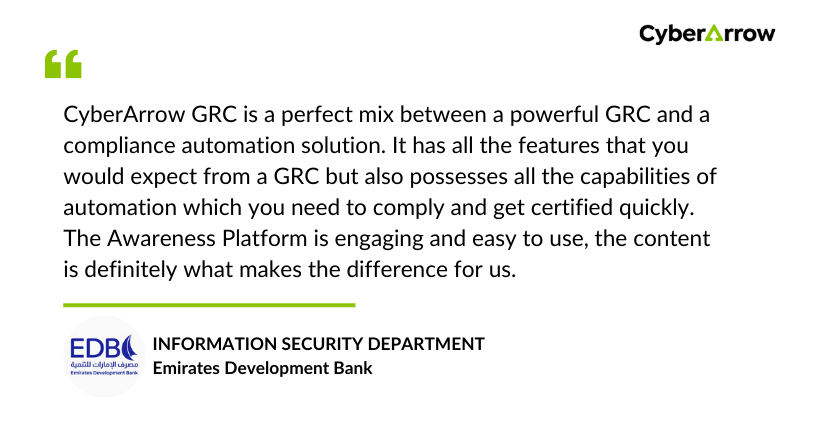
See what EDB has to say about CyberArrow GRC: