What is security management? Types & best practices
Security management is crucial for every organization in today’s digital landscape. With cyber threats increasing, businesses of all sizes must protect their sensitive data and assets to stay secure and resilient.
The challenge lies in effectively managing security risks, meeting compliance standards, and dealing with complex threats—all without sacrificing productivity. Many organizations struggle to balance security needs with their day-to-day operations.
In this guide, we’ll break down what security management is, explore its different types, and share best practices to enhance your organization’s defenses. Strengthening your security posture starts with the right knowledge and strategies.
What is security management?
Security management is the process of protecting an organization’s information, systems, and assets from security threats. It involves identifying risks, creating strategies to address them, and implementing controls to safeguard data and systems.
Security management is not just about technology. It includes policies, procedures, and employee training to reduce risks and ensure that everyone plays their part in keeping data secure. It is crucial for any business that handles sensitive data or depends on digital systems.
Types of security management
There are several key areas within security management that organizations need to focus on. Each area plays a role in building a comprehensive security strategy.
Here are the main types of security management:
1. Information security management (ISM)
- Purpose: To protect the confidentiality, integrity, and availability of data.
- Key activities: ISM involves risk assessments, implementing security controls, and ensuring compliance with standards like ISO/IEC 27001.
- Importance: It ensures that sensitive data is only accessible by authorized individuals and remains safe from breaches.
2. Network security management
- Purpose: To secure a company’s networks from unauthorized access, misuse, or attacks.
- Key activities: This includes configuring firewalls, using intrusion detection systems, and monitoring network traffic.
- Importance: A secure network ensures that cybercriminals cannot infiltrate systems, steal data, or disrupt operations.
3. Physical security management
- Purpose: To protect an organization’s physical assets, such as buildings, servers, and employees.
- Key activities: This involves implementing access controls, security cameras, and alarm systems.
- Importance: Physical security complements digital security and prevents unauthorized individuals from gaining physical access to sensitive areas.
4. Cyber security management
- Purpose: To protect digital systems and data from cyber threats.
- Key activities: This involves threat detection, incident response, and implementing security tools like antivirus software and encryption.
- Importance: Cyber security management is critical for defending against malware, ransomware, phishing, and other online threats.
5. Risk management
- Purpose: To identify and prioritize risks and create strategies to minimize them.
- Key activities: This involves identifying risks, assessing their impact, and deciding how to address them.
- Importance: Risk management ensures that organizations focus on the most critical risks and take action to reduce their potential impact.
6. Compliance management
- Purpose: To ensure that the organization meets all legal, regulatory, and contractual requirements.
- Key activities: This involves conducting audits, creating policies, and ensuring compliance with laws like GDPR or industry standards like PCI DSS.
- Importance: Compliance management protects organizations from legal penalties and builds customer trust.
Best practices for security management
To create a strong security management program, organizations should follow these best practices:
1. Conduct regular risk assessments
- Why: Threats change over time, and new risks can emerge. Regular assessments help organizations stay prepared.
- How: Identify potential risks, assess their likelihood and impact, and prioritize actions to mitigate them.
2. Develop security policies and procedures
- Why: Policies guide employee behavior and ensure consistent security practices.
- How: Create policies for password management, data handling, incident response, and more. Ensure employees are trained on these policies.
3. Implement security controls
- Why: Controls help prevent unauthorized access and reduce the risk of attacks.
- How: Use firewalls, intrusion detection systems, multi-factor authentication (MFA), and other security tools.
4. Train employees
- Why: Human error is one of the leading causes of security breaches.
- How: Provide regular training to employees on phishing attacks, password security, and other threats. Make security awareness a part of the company culture.
Quick link: What is hacktivism? How to stay safe online
5. Monitor and audit security systems
- Why: Continuous monitoring helps detect and respond to threats quickly.
- How: Use monitoring tools to track network activity, system logs, and user behavior. Regularly audit security systems to identify weaknesses.
6. Plan for incident response
- Why: Even the best defenses can fail. Having a response plan ensures the organization can recover quickly.
- How: Create an incident response plan that outlines roles, responsibilities, and steps to take during a security breach.
7. Ensure compliance with standards
- Why: Compliance protects organizations from legal penalties and builds customer trust.
- How: Identify relevant regulations and industry standards, such as ISO 27001, GDPR, or PCI DSS, and take steps to meet their requirements.
8. Use multi-layered security
- Why: Relying on a single defense is not enough to stop modern threats.
- How: Combine physical security, network security, cyber security, and employee training to create a multi-layered approach.
CyberArrow GRC for security management
Managing security across different areas can be complex and time-consuming. That’s where CyberArrow GRC (Governance, Risk, and Compliance) can make a big difference. It is designed to simplify security management and help organizations achieve compliance.
How CyberArrow GRC can help:
- Automate compliance processes: CyberArrow GRC makes compliance easy by automating tasks like audits, assessments, and documentation. Organizations can quickly meet standards like ISO/IEC 27001 and GDPR without manual work.
- Centralized risk management: The platform provides a centralized way to manage risks. Identify, prioritize, and mitigate risks all from one place, ensuring your security management program is effective.
- Real-time monitoring and alerts: CyberArrow GRC integrates with security tools to offer real-time monitoring. Receive instant alerts and take action before security incidents escalate.
- Improved collaboration: With CyberArrow, teams can collaborate on security initiatives, track tasks, and ensure everyone is on the same page. This helps maintain a strong security posture.
Conclusion
Security management is essential for protecting an organization’s assets, data, and reputation. By understanding the different types of security management and following best practices, businesses can reduce risks and strengthen their defenses.
Read how Emirates enhanced Information Security by automating ISO 27001 with CyberArrow.
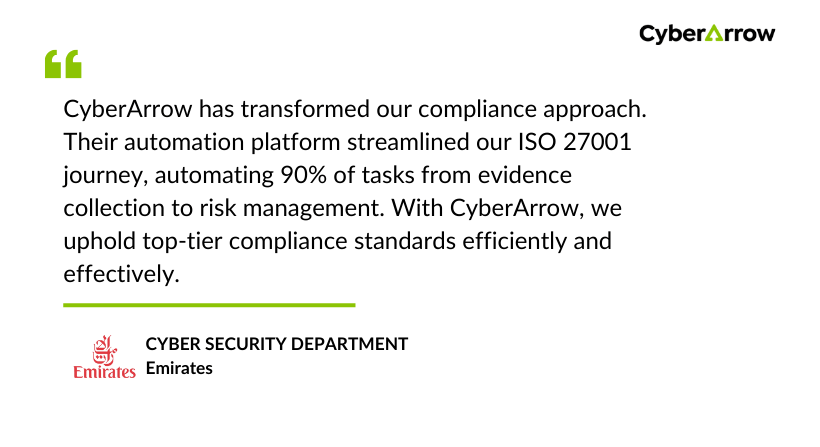
See what Emirates has to say about CyberArrow GRC: