What is a Business Impact Analysis (BIA)? How to conduct it?
When a company faces change, growth, or risks, understanding how those factors impact its business is crucial. A Business Impact Analysis (BIA) helps organizations predict how changes or disruptions can affect their operations, allowing them to prepare for challenges and maintain continuity.
Without a BIA, businesses may find themselves unprepared for the negative outcomes of unexpected events.
In this blog, we will break down what a Business Impact Analysis is, why it’s important, and how you can effectively conduct one.
What is a Business Impact Analysis?
A Business Impact Analysis (BIA) is a process that helps companies identify the potential effects of disruptions on their critical business operations. By understanding these effects, businesses can take proactive steps to minimize losses, both financially and operationally.
The key objectives of a BIA are:
- Identifying essential business functions
- Determining how disruptions affect these functions
- Establishing recovery timeframes and priorities
This analysis enables decision-makers to assess risks and make informed decisions that help the company stay resilient, even in challenging times.
Why is Business Impact Analysis important?
Conducting a BIA is not just an exercise; it is essential for any business aiming for long-term success. Here’s why it matters:
- Risk identification: It highlights vulnerabilities in business processes and identifies potential risks.
- Operational continuity: It ensures that critical operations can continue, or resume quickly, after a disruption.
- Informed decision-making: Provides data to help leadership make smarter decisions regarding resource allocation, risk mitigation, and recovery strategies.
- Regulatory compliance: Many industries require BIAs to meet regulatory and compliance standards.
Without a well-conducted BIA, a company could experience severe financial and operational damage during a crisis, potentially leading to long-term setbacks or even closure.
How to conduct a Business Impact Analysis
Conducting a BIA can seem daunting, but following these steps simplifies the process.
Here’s a step-by-step guide to conducting an effective business impact analysis:
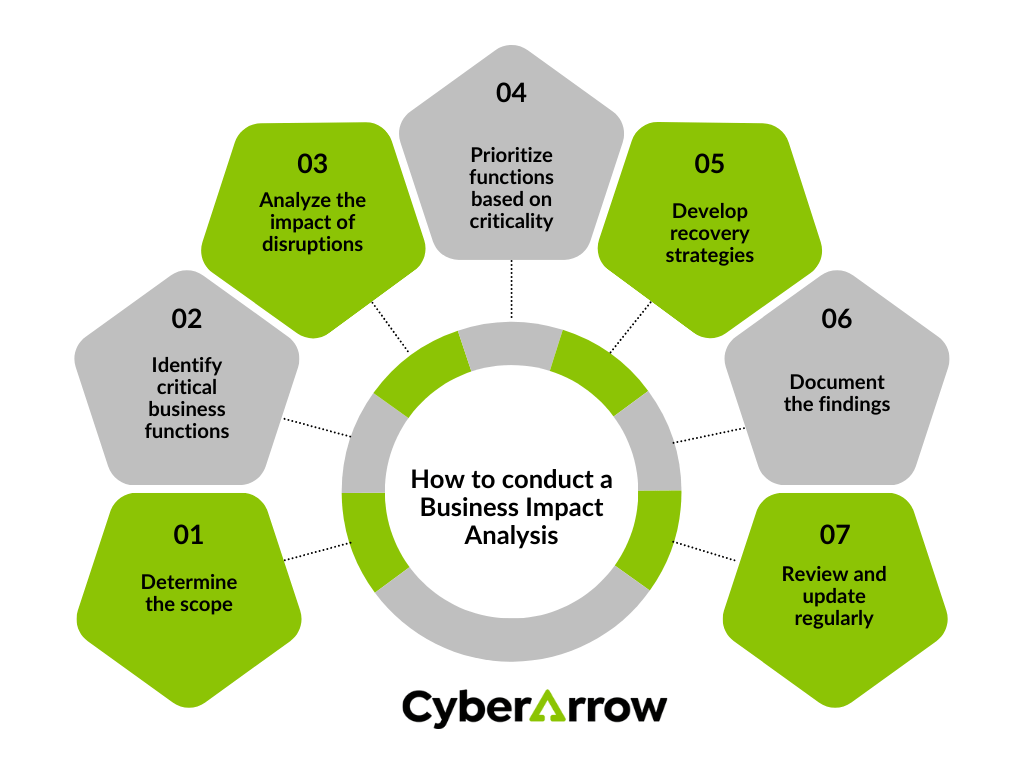
1. Determine the scope
The first step is to clearly define the scope of the BIA. This involves identifying:
- What business areas will be included? Focus on critical departments and processes that, if disrupted, would have a significant impact.
- What are the objectives? Set clear goals, such as understanding the financial and operational effects of a disruption.
Knowing the scope upfront ensures that your BIA stays focused and relevant.
2. Identify critical business functions
Next, identify the most important functions or processes within the organization. These are the functions that must continue or resume quickly during or after a disruption. For each critical function, ask:
- What does this function do for the company?
- What resources (people, technology, equipment) does it rely on?
- How would its disruption affect the company?
For example, a manufacturing company’s critical functions may include production lines and supply chain management, while a software company might prioritize IT infrastructure and customer support.
3. Analyze the impact of disruptions
Once critical functions are identified, assess the potential impact of disruptions. This analysis should consider:
- Financial impact: What are the monetary losses if a function is down for hours, days, or weeks?
- Operational impact: How will other business functions be affected?
- Reputation impact: How will customers, stakeholders, or regulators view the disruption?
You can use metrics like Maximum Tolerable Downtime (MTD) and Recovery Time Objective (RTO) to quantify these impacts.
4. Prioritize functions based on criticality
Not all functions are equally important. Some are more critical to the survival of the business.
In this step, prioritize functions based on:
- How critical are they to daily operations?
- What is the financial impact of their disruption?
- How quickly do they need to be restored?
Assigning priorities helps guide where to focus recovery efforts and resources when time is of the essence.
5. Develop recovery strategies
After determining which functions are most critical, it’s time to develop strategies for their recovery.
This involves:
- Backup plans for critical resources
- Alternative procedures
- Contingency plans
Ensure you have detailed action plans for restoring key operations, including employee roles, recovery timelines, and necessary resources.
6. Document the findings
Once you’ve gathered all the necessary information, it’s time to create a formal BIA report.
The report should include:
- An executive summary of the analysis
- Detailed findings for each critical function
- Recovery priorities and timeframes
- Recommended recovery strategies
Ensure that this report is accessible to stakeholders and is updated regularly to reflect changes in business operations or risk factors.
7. Review and update regularly
A BIA should not be a one-time event. Business environments evolve, and new risks can emerge, so it’s important to regularly review and update your BIA. Schedule reviews at least annually or whenever there are significant changes in business operations or external conditions.
How CyberArrow GRC can help conduct a Business Impact Analysis
A Business Impact Analysis (BIA) is essential for understanding the potential effects of disruptions on your business. It enables you to identify critical functions, assess the impact of disruptions, and develop strategies to maintain operational continuity. By following the steps outlined above, your organization can stay prepared for unexpected challenges.
However, conducting a BIA manually can be time-consuming and prone to human error. CyberArrow GRC offers a comprehensive solution to streamline the BIA process, particularly through its Risk Management Module.
Here’s how CyberArrow GRC can support your BIA efforts:
- Automated risk assessments: Automatically identify and assess potential risks associated with disruptions, making the BIA process faster and more efficient.
- Recovery strategy generation: Develop and document recovery strategies for critical business functions with ease.
- Compliance assurance: Ensure that your BIA aligns with industry regulations and compliance requirements.
- Real-time updates: Easily update your BIA as your business environment changes, keeping your data accurate and actionable.
Use case example:
Imagine your company is rolling out a new IT system. With CyberArrow’s Risk Management Module, you can:
- Automatically assess risks that the new system might introduce.
- Develop a clear recovery plan for critical business functions that may be affected.
- Ensure your company remains compliant with industry standards during the process.
See what DCD – Abu Dhabi has to say about CyberArrow GRC: