What are Living off the land (LOTL) attacks? How to prevent them?
In the world of cyber security, threats are evolving every day. One of the newer type of attack that has gained attention is called “Living off the land” (LOTL) attack. These attacks use legitimate software and tools already available on a system to carry out malicious activities. Unlike traditional cyber attacks that rely on outside malware or hacking tools, LOTL attacks blend in with normal processes, making them harder to detect.
This blog will explain what Living off the land attacks are, how they work, and how businesses can prevent them from happening.
What are Living off the land attacks?
Living off the land (LOTL) attacks use the tools and software that are already built into a system. Hackers take advantage of programs that are trusted by the operating system or the user, like PowerShell, Task Scheduler, or Windows Management Instrumentation (WMI). Since these tools are necessary for running normal tasks, security systems often overlook their misuse.
These attacks get their name from the fact that attackers use “native resources,” or tools that are already part of the “land,” instead of bringing in their own external malware. By hiding behind these trusted applications, they reduce the risk of being discovered.
How do Living off the land attacks work?
Living off the land attacks typically follow these steps:
Initial access: Hackers find a way to enter the system. This could be through phishing emails, weak passwords, or exploiting software vulnerabilities.
Abuse of legitimate tools: Once inside, instead of downloading malware that could raise red flags, they use built-in tools like PowerShell, cmd.exe, or even system scripts to carry out their attack. These tools are trusted by the operating system, which makes the attack more stealthy.
Elevation of privileges: In many cases, attackers try to gain higher-level access by exploiting the system’s permissions. This allows them to carry out more damaging tasks and move freely across the network.
Lateral movement: With elevated privileges, the attackers can move to other parts of the network. They continue to use legitimate tools, making it hard for traditional security systems to detect them.
Data theft or sabotage: Eventually, the hackers achieve their goal, whether it’s stealing sensitive data, planting ransomware, or sabotaging operations.
Since LOTL attacks rely on trusted tools, many antivirus programs, firewalls, and other traditional security solutions do not flag them. This makes them particularly dangerous and effective.
Examples of Living off the land attacks
To understand LOTL attacks better, here are a few examples of how these types of attacks have been carried out:
- PowerShell abuse: PowerShell is a powerful command-line tool used by administrators to manage systems. Attackers can write malicious scripts using PowerShell to gather data, disable security features, or move across a network—all while appearing as normal activity.
- Task scheduler: Windows Task Scheduler allows users to schedule tasks to run automatically at specific times. Hackers can use this tool to schedule malicious tasks that go unnoticed.
- WMI attacks: Windows Management Instrumentation (WMI) helps to manage data and devices on a network. Hackers can use WMI to execute malicious scripts or commands remotely.
Why are Living off the land attacks dangerous?
Living off the land attacks are particularly dangerous for several reasons:
- Stealthy: Since attackers use legitimate tools, their activities are harder to detect. Security teams often overlook these processes because they appear as normal system operations.
- No malware: Traditional security solutions like antivirus software often look for malware. However, LOTL attacks don’t rely on external malware, which makes them much harder to spot.
- Trust: The tools used in LOTL attacks are trusted by the operating system and security systems. This trust allows attackers to bypass many security checks.
- Quick spread: Once attackers gain access to the system, they can easily move laterally across the network using legitimate tools, infecting other machines and stealing sensitive data.
How to prevent Living off the land attacks
Preventing Living off the land attacks requires a proactive and layered security approach.
Here are some strategies businesses can implement to defend themselves:
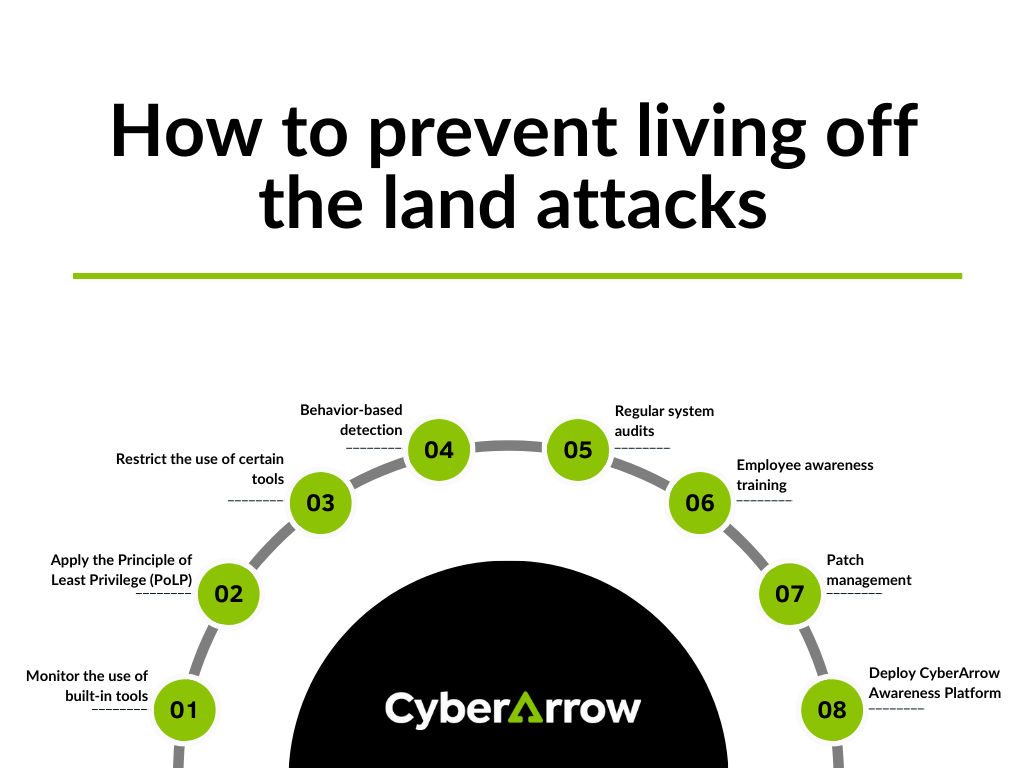
1. Monitor the use of built-in tools
Since LOTL attacks rely on legitimate tools like PowerShell or WMI, it’s crucial to monitor the usage of these tools. If they are being used in ways that don’t match normal behavior, security teams should be alerted. For example, if PowerShell is suddenly being used by an account that doesn’t normally use it, this could be a sign of an attack.
2. Apply the Principle of Least Privilege (PoLP)
Limit user access to only the tools and data they need to do their job. This reduces the likelihood of attackers gaining elevated privileges and moving freely across the system. Admin-level privileges should be granted only to trusted employees, and the system should regularly review these permissions.
3. Restrict the use of certain tools
If certain tools like PowerShell or Task Scheduler are not necessary for day-to-day operations, consider restricting their use. Implement policies that prevent non-administrators from running certain scripts or commands. This limits the attack surface for potential LOTL attacks.
4. Behavior-based detection
Rather than focusing only on signature-based detection, which looks for known threats, use behavior-based detection to identify unusual or suspicious activity. LOTL attacks often involve activities that don’t match normal user behavior, and spotting these anomalies can help identify an attack in progress.
5. Regular system audits
Conduct regular audits of your system’s logs and activities. This helps identify abnormal behavior that could be linked to a living off the land attack. By reviewing logs and system changes frequently, you can catch attacks early.
6. Employee awareness training
Phishing is a common method used to initiate LOTL attacks. Educate employees on how to recognize phishing emails and suspicious links. Implementing strong security training programs can reduce the risk of attackers gaining initial access.
7. Patch management
Keep your systems up to date with the latest security patches. Attackers often exploit vulnerabilities in outdated software. A strong patch management process can prevent many attacks before they start.
8. Deploy CyberArrow Awareness Platform
The CyberArrow Awareness Platform offers a powerful solution for managing security awareness and ensuring compliance. It automates security awareness programs for employees, helping them understand the risks and how to avoid common threats like phishing or suspicious tool use.
Protect your business with CyberArrow
Living off the land attacks are growing in popularity because they are hard to detect and incredibly effective. They exploit tools that are already trusted by the system, making traditional security solutions less effective. Businesses need to be aware of these risks and take proactive steps to prevent them.
One of the best ways to defend against LOTL attacks and other cyber security threats is through ongoing awareness and training. The CyberArrow Awareness Platform helps companies educate their employees about the latest threats and ensures that everyone in the organization knows how to prevent attacks. By automating your awareness and compliance programs, CyberArrow not only makes your company safer but also ensures that you meet industry regulations.
See what Silal has to say about CyberArrow: