Key changes in NIS2: What you need to know
The Network and Information Systems Directive (NIS) is a critical cyber security regulation that was first introduced in 2016. In response to the evolving cyber threat landscape, the European Union (EU) has introduced an updated version, NIS2. The new directive brings significant changes, aiming to further strengthen cyber security across member states. Understanding these key changes is crucial for organizations, particularly those that operate critical infrastructure, to ensure compliance and avoid penalties.
This blog will walk you through the major changes in NIS2, what they mean for your organization, and how to achieve compliance efficiently.
What is NIS2?
NIS2 is the updated version of the original NIS Directive, which was Europe’s first comprehensive cyber security legislation. The goal of NIS2 is to enhance cyber resilience across the EU by setting stricter security requirements for critical infrastructure and essential services. It addresses the shortcomings of the original directive and aims to create a more unified and robust approach to cyber security across the EU.
As of October 17, 2024, all EU member states must transpose NIS2 into national law, making it a legally binding directive for entities operating within those states.
Why is NIS2 important?
The original NIS Directive successfully improved cyber security awareness across Europe, but it faced challenges, especially with inconsistent adoption across member states. NIS2 addresses these issues by expanding its scope, increasing penalties for non-compliance, and implementing stricter cyber security requirements.
In today’s rapidly evolving threat landscape, cyberattacks are becoming more sophisticated. Ransomware, phishing, and AI-driven attacks are on the rise, and NIS2 seeks to ensure that essential sectors are well-equipped to defend against these threats. Compliance with NIS2 is not just a legal obligation; it’s also a vital step toward protecting sensitive data and ensuring the continuity of critical services.
Key changes in NIS2: What you need to know
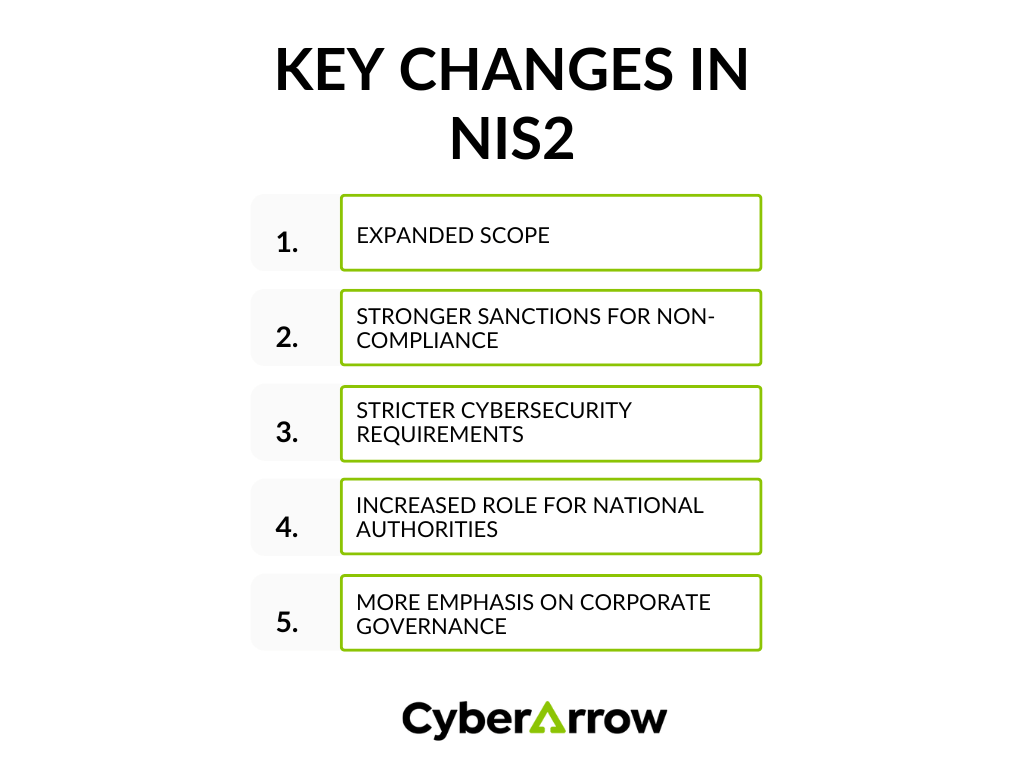
1. Expanded scope
One of the most significant changes in NIS2 is its expanded scope. The original directive primarily applied to “operators of essential services” (OES) and “digital service providers” (DSP). NIS2 broadens this scope by categorizing entities as either “essential” or “important,” regardless of whether they provide digital services.
- Essential entities: Organizations that provide critical services in sectors such as energy, healthcare, financial services, and digital infrastructure. These entities must meet stricter security requirements.
- Important entities: Medium-sized organizations in sectors such as postal services, food, and chemicals. While these organizations are not classified as critical, they are still subject to NIS2 due to their importance to the economy and society.
This broader classification means that more organizations will now be subject to NIS2’s requirements, increasing the number of sectors covered from 7 to 15.
2. Stronger sanctions for non-compliance
NIS2 introduces harsher penalties for organizations that fail to comply with its cyber security requirements. Non-compliance can lead to both financial and non-financial penalties, including:
- Administrative fines: Essential entities can face fines of up to €10 million or 2% of global turnover, whichever is higher. Important entities may face fines of up to €7 million or 1.4% of global turnover.
- Non-monetary penalties: These include compliance orders, security audits, and, in severe cases, a temporary ban on certain executives from holding management positions.
- Personal liability: NIS2 holds top management accountable, making them personally liable for cyber security incidents caused by gross negligence.
These stronger sanctions emphasize the importance of NIS2 compliance and encourage organizations to prioritize cyber security at every level.
3. Stricter cyber security requirements
Under NIS2, organizations must meet more stringent cyber security requirements, which are divided into several areas, including risk management, incident reporting, and business continuity.
a. Risk management
Organizations must adopt a proactive approach to managing cyber security risks. This includes implementing policies and procedures to mitigate risks, such as:
- Supply chain security: Ensuring that third-party suppliers and partners adhere to robust cyber security standards.
- Incident response plans: Establishing protocols for handling cyber security incidents and minimizing their impact.
- Data encryption and access controls: Strengthening access controls to protect sensitive data and ensure it remains secure.
b. Incident reporting
NIS2 mandates that organizations report cyber security incidents within a specific time frame:
- Initial notification: Within 24 hours of discovering a significant incident.
- Full report: Within 72 hours of the initial notification.
- Final report: A detailed report must be submitted within one month.
These reporting requirements ensure that national authorities are informed quickly, enabling a coordinated response to potential threats.
c. Business continuity and recovery
Organizations must have strategies in place to ensure business continuity in the event of a cyberattack. This includes implementing backup systems and recovery plans to minimize service disruption. The emphasis is on rapid recovery to maintain the stability of essential services.
4. Increased role for national authorities
NIS2 strengthens the role of national authorities by giving them more power to enforce compliance and oversee the cyber security efforts of organizations. Member states must establish competent authorities and Computer Security Incident Response Teams (CSIRTs) to monitor compliance, provide guidance, and coordinate responses to incidents.
National authorities also have the power to impose sanctions, conduct audits, and issue binding instructions to organizations that fail to comply with NIS2.
5. More emphasis on corporate governance
NIS2 places greater responsibility on management teams to oversee and ensure the implementation of cyber security measures. It emphasizes the importance of cyber security training for both management and staff to help them identify and mitigate potential threats.
Management bodies must also take ownership of their organization’s cyber security risk management strategy, ensuring that it is well-integrated into the overall business strategy.
How to achieve NIS2 compliance
Achieving NIS2 compliance can be a complex and resource-intensive process, particularly for larger organizations. However, it is essential to avoid significant financial penalties and safeguard your business from cyber threats.
Some steps you can take to achieve NIS2 compliance include:
- Conducting a thorough cyber security risk assessment to identify vulnerabilities.
- Implementing the necessary technical and organizational measures to mitigate risks.
- Establishing a robust incident response plan and ensuring your team is well-trained in its execution.
- Ensuring that your supply chain adheres to strong cyber security practices.
- Regularly updating your policies and procedures to remain compliant with evolving cyber security standards.
Automating NIS2 compliance with CyberArrow GRC
Navigating the complexities of NIS2 compliance can be challenging, but there is a solution that simplifies the process. CyberArrow GRC is a powerful governance, risk, and compliance (GRC) platform designed to help organizations automate their compliance with NIS2.
Why choose CyberArrow GRC?
- Streamlined compliance: CyberArrow GRC automates the process of managing and monitoring your compliance efforts, reducing the burden on your team.
- Real-time incident reporting: The platform helps you stay compliant with NIS2’s incident reporting requirements by providing real-time alerts and automated reporting tools.
- Risk management tools: CyberArrow GRC offers a range of tools to assess, manage, and mitigate cyber security risks, helping you meet NIS2’s strict risk management standards.
- Customizable workflows: Tailor workflows to your organization’s specific needs, ensuring that all critical cyber security measures are in place.
See what our clients have to say about CyberArrow GRC: