What is FISMA compliance? Key requirements and best practices
If your organization handles data for the federal government, you’ve probably heard of FISMA compliance. But what exactly is it, and why does it matter so much? The Federal Information Security Management Act (FISMA) isn’t just another bureaucratic checklist—it’s a critical law to protect sensitive government information from cyberattacks. Falling short on FISMA compliance could mean serious trouble, including hefty fines or losing federal contracts altogether.
Since cyber security threats constantly evolve, staying compliant with FISMA means much more than locking down data. It’s about showing you can keep that data safe, building trust with the government, and proving that your systems are as secure as needed.
So, what does it take to get FISMA compliance right?
Let’s break it down and explore everything you need to know to keep your organization on track.
What is FISMA compliance?
FISMA is a U.S. law enacted in 2002 to protect government information and systems from cyber threats. It sets the standards for how federal agencies—and those working with them—must secure their data. It covers everything from risk assessments to implementing security controls and continuous monitoring.
In 2014, FISMA got an update, modernizing its approach to cyber security through the Federal Information Security Modernization Act 2014, also known as FISMA Reform, which made some crucial changes.
These updates included:
- DHS was responsible for leading and enforcing information security policies for non-national security federal systems. This includes offering technical assistance and deploying cyber security technologies to those systems.
- Strengthened and clarified the OMB’s power to oversee and evaluate the security practices of federal agencies.
- Required the OMB to update or modify OMB Circular A-130 to remove inefficient reporting practices and streamline processes.
FISMA compliance levels
FISMA compliance has different levels of security categorization based on the impact that a potential loss of confidentiality, integrity, or availability could have on an organization. The categorization helps determine the appropriate security controls that need to be implemented.
Here are the three primary levels:
1. Low impact
The loss of confidentiality, integrity, or availability would have a limited adverse effect on organizational operations, assets, or individuals.
- Example: Publicly available or non-sensitive information, where a breach would result in minimal damage.
- Security controls: Basic security measures, including some standard operational controls, are typically sufficient.
2. Moderate impact
The loss would have a severe adverse effect on organizational operations, assets, or individuals.
- Example: Sensitive but unclassified information that, if compromised, could lead to significant operational disruptions or financial losses.
- Security controls: More stringent security measures are required, including additional technical controls and regular assessments.
3. High impact
The loss would have a severe or catastrophic effect on organizational operations, assets, or individuals.
- Example: Classified information or critical infrastructure data, where breaches could significantly harm national security or public safety.
- Security controls: The highest level of security controls is mandated, including extensive monitoring, continuous assessments, and robust incident response strategies.
What are FISMA compliance requirements?
FISMA compliance requires organizations to follow specific steps and processes to secure federal information systems.
Here are the core FISMA compliance requirements:
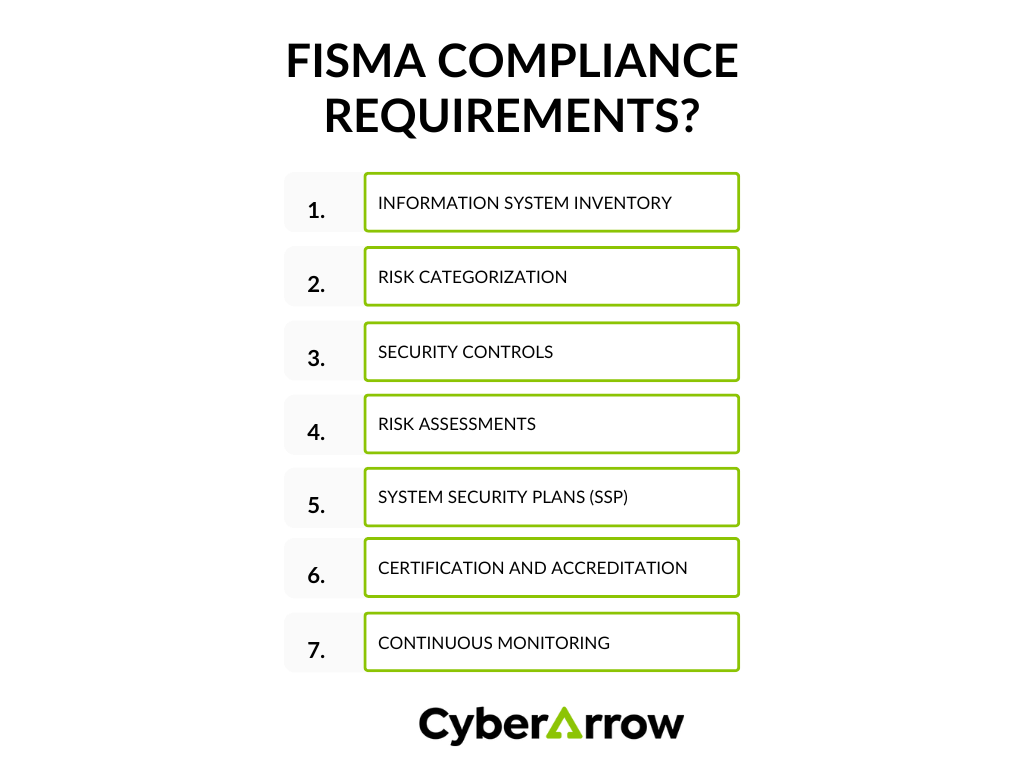
1. Information system inventory
Every organization must maintain a complete list of all the information systems it uses. This inventory helps track every system that holds or processes federal data, making it easier to secure them.
NIST SP 800-18, Revision 1, “Guide for Developing Security Plans for Federal Information Systems,” offers recommendations on categorizing information systems and defining their boundaries.
2. Risk categorization
Organizations must categorize their information systems based on the potential impact of a security breach. FISMA requires three categories: Low, moderate, or high impact, using FIPS 199 (Federal Information Processing Standards).
These categories help prioritize which systems need more security measures based on how damaging a breach would be to the organization or the federal government.
3. Security controls
The organization must apply appropriate security controls and security requirements defined in FIPS 200. These controls are specific safeguards designed to protect the system. NIST’s Special Publication 800-53 lists recommended security controls based on the system’s risk level. Security controls can include things like encryption, firewalls, and access controls.
4. Risk assessments
Organizations must regularly conduct risk assessments to identify potential threats and vulnerabilities within their systems. This involves evaluating the likelihood of a security breach and its possible consequences. The goal is to understand the most significant risks and ensure proper defenses are in place.
5. System security plans (SSP)
Every system must have a System Security Plan (SSP), a document outlining all the security controls and how the organization plans to manage risks. The SSP also provides a roadmap for improving system security over time and demonstrates how compliance with FISMA standards is maintained.
The SSP is a crucial component of the security certification and accreditation process. During this process, the SSP is reviewed and updated as needed. A certification agent then approves it. This approval confirms that the security controls outlined in the SSP align with the standards outlined in FIPS 199 and FIPS 200.
6. Certification and accreditation
Before any system can be used, it must undergo Certification and Accreditation (C&A). This is a formal approval process where the organization certifies that the security controls are in place and working effectively. Once certified, the system gets accredited, meaning it is authorized to operate under FISMA guidelines.
7. Continuous monitoring
After all the security measures are in place, organizations must monitor their systems closely and continuously. This means regularly checking for new vulnerabilities, updating security controls, and responding quickly to incidents or changes. Continuous monitoring ensures that security stays up-to-date and systems remain compliant over time.
Quick link: What is FedRAMP compliance?
How is FISMA connected with NIST?
FISMA and NIST (National Institute of Standards and Technology) are closely connected because NIST provides the guidelines and standards that help organizations achieve FISMA compliance.
Here’s how they’re related:
- FISMA sets the framework, but NIST creates the standards. FISMA requires federal agencies and contractors to implement specific security measures to protect government information systems. NIST develops technical guidelines, such as NIST Special Publication 800-53, which outlines the security controls federal agencies must follow to comply with FISMA.
- NIST provides detailed steps and procedures organizations must adopt to meet FISMA’s requirements. These standards cover everything from risk assessment to security controls and continuous monitoring, forming the foundation of FISMA compliance.
FISMA compliance best practices
Here are a few best practices to stay FISMA compliant:
- Classify information as it’s created: Classify information at the point of creation to prioritize security controls for most sensitive data first. By identifying and categorizing information based on its confidentiality, integrity, and availability needs, you can allocate resources more effectively to protect critical assets.
- Regularly update and patch systems: Keep software and systems up-to-date to maintain security. Establish a routine for applying patches and updates to software and hardware to protect against known vulnerabilities.
- Conduct regular security audits and assessments: Perform routine security audits and assessments to identify weaknesses in your security posture. These evaluations should include vulnerability assessments, penetration testing, and security control assessments to ensure that security measures are effective and compliant with FISMA standards.
- Conduct employee training: Human error is a leading cause of data breaches. Provide regular cyber security training and education for employees to reduce the chances of costly mistakes and enhance your overall organizational security.
- Maintain evidence of FISMA compliance: Thoroughly document compliance efforts. Record system inventories, risk categorization frameworks, security controls, and certification processes to demonstrate compliance during audits.
- Stay current with regulations: Regularly update knowledge of FISMA standards and new NIST guidelines. Staying informed about regulatory changes ensures security measures align with current requirements and address emerging threats.
How CyberArrow can help you with FISMA compliance?
FISMA compliance is more critical than ever for federal agencies and organizations that handle sensitive information. The evolving threat landscape demands a robust approach to information security that meets compliance requirements and strengthens the overall cyber security posture.
CyberArrow simplifies this journey by automating the compliance process. It allows organizations to efficiently manage their security controls, conduct risk assessments, and maintain continuous monitoring while reducing the administrative burden.
Here’s what CyberArrow offers:
- Automated compliance monitoring: CyberArrow automatically gathers evidence and supports 50+ integrations, making compliance easier.
- Continuous security KPI monitoring: Automated KPI assessments and reporting allow you to focus on what matters most.
- Streamlined risk management: Manage risk assessments with pre-mapped controls for 300+ risks and mitigations across FISMA and other standards.
Ready to streamline your FISMA compliance efforts? Explore how CyberArrow can transform your compliance strategy and enhance your information security management.
See what Emirates has to say about CyberArrow GRC: