Complete guide to GRC: Understanding governance, risk and compliance
Struggling to keep up with changing regulations and manage unexpected risks? Many organizations find themselves overwhelmed by governance, risk management, and compliance complexities. Fortunately, there’s a solution that can streamline these efforts and protect your business: Governance, Risk, and Compliance (GRC).
GRC offers a framework to integrate governance processes, risk management, and compliance measures. It empowers organizations to stay resilient and compliant while achieving their business goals.
Let’s discuss GRC and how GRC automation improves your GRC processes.
What is governance, risk, and compliance (GRC)?
Governance, risk, and compliance (GRC) is a framework for aligning an organization’s objectives, managing risks, and ensuring compliance with laws and regulations. It helps organizations reduce redundancies and improve resource allocation.
The three main components of GRC include:
- Governance: Governance refers to the rules, practices, and processes by which an organization is directed and controlled. It ensures business operations align with the company’s overall strategy and objectives while maintaining accountability and transparency.
- Risk management: It identifies, assesses, and prioritizes risks, followed by coordinated efforts to minimize, monitor, and control the probability or impact of adverse events. Organizations can use risk management to protect their systems from potential threats that could disrupt operations or harm their reputation.
- Compliance: Compliance is the process of complying with laws, regulations, standards, and internal policies relevant to the organization. It ensures the company operates within the legal framework and meets the requirements set by regulatory bodies and industry standards.
Benefits of the GRC framework
GRC offers a structured approach to achieve business objectives, manage business risks, and stay compliant with legal and ethical standards.
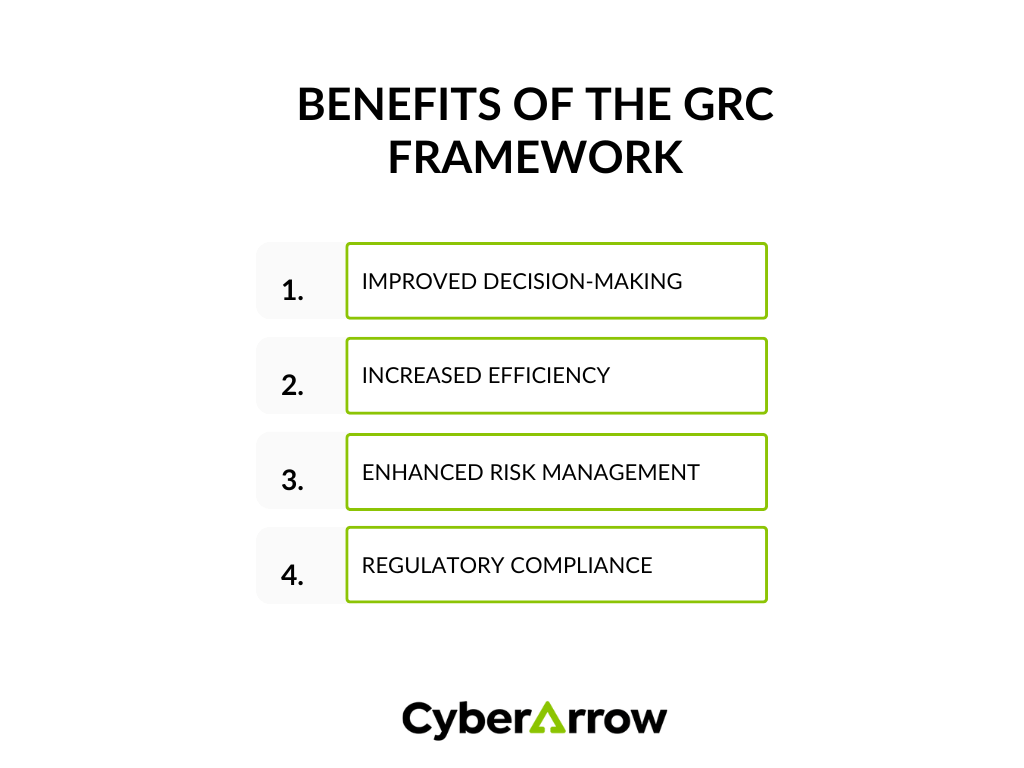
Having a GRC framework in place offers several benefits:
- Improved decision-making: A unified GRC strategy provides a comprehensive view of risks and regulatory requirements, enabling better-informed decisions.
- Increased efficiency: By integrating governance, risk, and compliance processes, organizations can streamline operations, reduce redundancies, and improve resource allocation.
- Enhanced risk management: It helps identify and address risks, reducing the likelihood of unexpected disruptions and mitigating potential impacts.
- Regulatory compliance: It ensures you stay up-to-date with laws and regulations to avoid legal penalties and protects the organization’s reputation.
How to Implement a GRC Framework
A GRC framework ensures effective governance, risk management, and compliance with relevant regulations. The following steps can help you integrate GRC practices into your existing operations and enhance overall performance and resilience.
1. Assess current state
- Conduct a thorough assessment of your current governance, risk, and compliance practices. Identify strengths, weaknesses, and gaps in existing processes.
- Document existing policies, procedures, and controls to establish a baseline for improvement.
- Engage key stakeholders to gain insights into current practices and gather feedback on areas needing improvement.
2. Set goals and objectives
- Establish clear, measurable goals for your GRC framework. These should align with your organization’s objectives and address identified gaps.
- Prioritize goals based on risk severity, regulatory requirements, and business impact.
- Create key performance indicators (KPIs) to monitor progress and measure the success of your GRC implementation.
3. Design the framework
- Develop a GRC framework that outlines roles, responsibilities, and workflows. Ensure it incorporates governance principles, risk management strategies, and compliance requirements.
- Create or update policies and procedures to reflect the new GRC framework. Ensure they are comprehensive, clear, and accessible to all relevant parties.
- Identify and implement appropriate tools and technology solutions, such as risk assessment tools, GRC software, and reporting systems, to support your GRC activities.
4. Integrate with existing processes
- Align the GRC framework with existing business processes to ensure integration. This includes incorporating GRC practices into daily operations, decision-making, and strategic planning.
- Conduct training sessions and awareness programs to educate employees about the new GRC framework and their roles within it. Ensure ongoing communication to reinforce the importance of GRC practices.
- Establish mechanisms for continuous monitoring and improvement of the GRC framework. Regularly review and update the framework to adapt to changing regulations, emerging risks, and organizational growth.
Why do you need GRC automation?
The complexities of governance, risk management, and compliance have increased. Manual processes often fail to manage these complexities efficiently, leading to increased risks and potential compliance failures. GRC automation can help overcome these challenges.
Here’s why you need GRC automation:
- Automated workflows: GRC automation replaces repetitive, manual tasks with automated workflows. This reduces the time and effort required to manage governance, risk, and compliance activities. Automation also minimizes human error and ensures greater accuracy in data handling and compliance reporting.
- Real-time monitoring and reporting: Automated systems continuously monitor risks, compliance status, and governance metrics, providing real-time insights and alerts. They can generate detailed, accurate reports to facilitate better decision-making and regulatory compliance.
- Enhanced risk management: Automation tools can identify potential risks early, allowing for implementing timely mitigation strategies. Advanced analytics and risk modeling capabilities provide deeper insights into risk patterns and trends.
- Regulatory compliance: Automated systems ensure compliance requirements are met by staying updated with the latest regulations and standards. Automation maintains comprehensive records and documentation, making preparing for and passing audits easier.
- Cost savings: By automating routine tasks, organizations can reallocate resources to more important initiatives and save compliance costs. Continuous compliance reduces the risk of regulatory fines and penalties and protects the organization’s financial health.
- Scalability: GRC automation solutions can easily scale with the organization as it grows. They ensure that governance, risk, and compliance processes remain effective regardless of the company’s size.
Why integrate CyberArrow to automate your GRC processes?
Businesses face several challenges, including inefficiency and complexity, when managing their GRC processes. CyberArrow offers a solution to simplify and enhance your GRC processes. Unlike traditional GRC systems, which can be time-consuming, CyberArrow makes your GRC efforts straightforward and efficient.
Why CyberArrow?
- Simplicity: CyberArrow GRC is built with simplicity and allows powerful features to be administered with minimal training.
- Save time & money: Understanding and managing GRC software can consume substantial time and resources. CyberArrow GRC minimizes these demands, reducing both the time and financial investment required for effective GRC management.
- Plug & play: The constantly changing landscape of local and international cybersecurity regulations can be overwhelming. CyberArrow GRC supports leading standards such as ISO 27001, UAE IA, NCA, and SAMA, making it easy to stay compliant.
- No manual work: Unlike many GRC programs that rely on manual documentation, CyberArrow GRC automates efforts based on your chosen regulations and standards. It eliminates the need for spreadsheets and manual updates.
Don’t Take Our Word for It
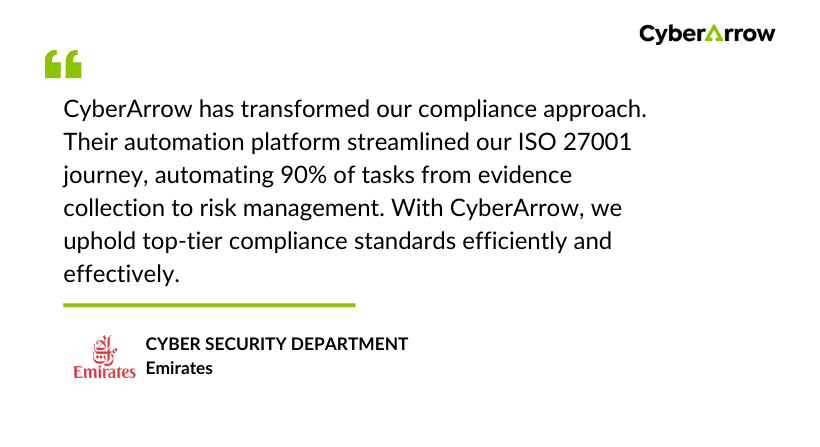
See what our users have to say about CyberArrow: