ISO 27001 for startups: Unlock more business globally
Startups are no longer confined to local markets. With the internet breaking down geographical barriers, startups have the potential to access global markets like never before. However, this expanded reach also increases cybersecurity risks, highlighting the need to comply with ISO 27001 for startups.
Establishing a startup is an ongoing educational journey, regardless of whether you are a budding entrepreneur or possess a track record of developing numerous enterprises. Each business presents its unique set of obstacles and trials, making the experience of securing funding, advancing product development, acquiring clients, and other facets of launching a company distinctive for every startup.
One particular area that exhibits notable disparities is the compliance requirements of startups. Various industries, such as technology or healthcare, entail specific regulations and standards. Your startup may necessitate documentation of compliance with multiple standards, with ISO 27001 becoming a requisite if your business involves secure data usage.
In this article, we will explore the importance of ISO 27001 for startups and how they can unlock business opportunities on a global scale.
Understanding ISO 27001
ISO 27001 is an international standard that provides a systematic approach to managing sensitive information, ensuring its confidentiality, integrity, and availability. It is not only about safeguarding data but also about establishing a culture of continuous improvement in information security. By adhering to ISO 27001 for startups, you can demonstrate your commitment to cybersecurity to clients, partners, and investors.
Learn: ISO 27001:2022 updates and what it means for your business?
Who needs to get ISO 27001 certified?
First and foremost, it’s essential to clarify that ISO 27001 certification is not obligatory. There won’t be any regulatory authority knocking on your company’s doors if you haven’t pursued it. However, security is increasingly regarded as a pivotal criterion in the contemporary business landscape, particularly when establishing partnerships with other service organizations.
With that in mind, it’s compulsory to get ISO 27001 certification under the following circumstances:
- Handling sensitive customer data: If your startup is involved in the collection, storage, processing, transmission, or access of sensitive customer data, ISO 27001 merits serious consideration as it fortifies your data security posture.
- Global business reach: If your startup primarily conducts business beyond the borders of North America, ISO 27001 can be highly relevant. This international standard aligns seamlessly with global business practices, enhancing your credibility on the international stage.
- International recognition: ISO 27001 certification offers your business an internationally recognized seal of approval. This recognition can substantially benefit your global presence and the trustworthiness of your operations.
Benefits of ISO 27001 for startups
ISO 27001 certification offers numerous benefits to startups, enhancing their cybersecurity posture and overall business operations.
Learn: Key benefits of automating ISO 27001 compliance
Let’s explore the benefits of ISO 27001 for startups.
1. Enhanced data security
ISO 27001 provides a structured framework for identifying, managing, and protecting sensitive data. This is crucial for startups dealing with customer data, financial information, or intellectual property. The standard’s risk assessment and mitigation processes help identify vulnerabilities and implement controls to reduce the risk of data breaches.
2. Global market access
ISO 27001 is internationally recognized. Having this certification can open doors to global markets and partnerships, as many clients and organizations worldwide prioritize working with certified partners. Also, ISO 27001 sets startups apart from competitors who may not have invested in robust information security management. It demonstrates a commitment to safeguarding client and partner data.
3. Compliance with regulations
ISO 27001 aligns with various data protection laws and industry-specific regulations (e.g., GDPR, HIPAA). Compliance with these regulations is often a prerequisite for startups operating in specific sectors or targeting certain markets.
4. Risk reduction
The standard encourages startups to adopt a proactive approach to risk management. By systematically assessing risks and implementing controls, startups can reduce the likelihood of costly security incidents. ISO 27001 emphasizes business continuity planning. This ensures that startups are prepared to handle disruptions, whether caused by cyberattacks, natural disasters, or other incidents.
5. Improved customer trust
ISO 27001 certification builds trust with clients, partners, and investors. It assures them that their sensitive information is handled securely, which is especially important for startups aiming to attract and retain clients. ISO 27001 requires transparency in information security processes. This transparency fosters trust by allowing stakeholders to understand how data is handled and protected.
6. Efficient operations
Implementing ISO 27001 often leads to streamlined and efficient processes. By defining roles and responsibilities and automating security tasks, startups can reduce operational friction.
Effective risk management can lead to cost savings. Preventing security incidents is typically more cost-effective than dealing with the aftermath of a breach.
7. Continuous improvement
ISO 27001 promotes a culture of continuous improvement in information security. This means that startups are continually assessing and enhancing their security measures to adapt to evolving threats. Startups with ISO 27001 certification are better equipped to adapt to changing security landscapes and emerging cyber threats.
FAQs
What is the ISO standard for startups?
ISO 27001 is the relevant ISO standard for startups. It’s an international standard for information security management systems, applicable to organizations of all sizes, including startups. ISO 27001 provides a framework for managing and protecting sensitive information effectively.
Is ISO 27001 certification for startups worth it?
Yes, ISO 27001 certification is often very much worth it for startups. It enhances data security, increases trust with clients and partners, aids in global market access, ensures compliance with regulations, and fosters a culture of continuous improvement in information security.
For which company is ISO 27001 useful?
ISO 27001 is useful for companies of various sizes and industries. It’s particularly valuable for businesses that handle sensitive data, operate globally, seek international recognition, and want to fortify their cybersecurity posture.
How CyberArrow helps implement ISO 27001 for startups?
While ISO 27001 offers numerous advantages, startups may face challenges in terms of cost, time, and resources required for implementation. It’s essential for startups to carefully weigh these factors against the potential benefits. Additionally, maintaining ISO 27001 compliance is an ongoing process that demands dedication and vigilance.
CyberArrow helps startups implement ISO 27001 by automating the time-consuming and manual compliance processes. It removes the need for labor-intensive tasks, such as manually collecting and analyzing security data. By automating compliance procedures, CyberArrow significantly reduces the chances of human errors that can lead to non-compliance.
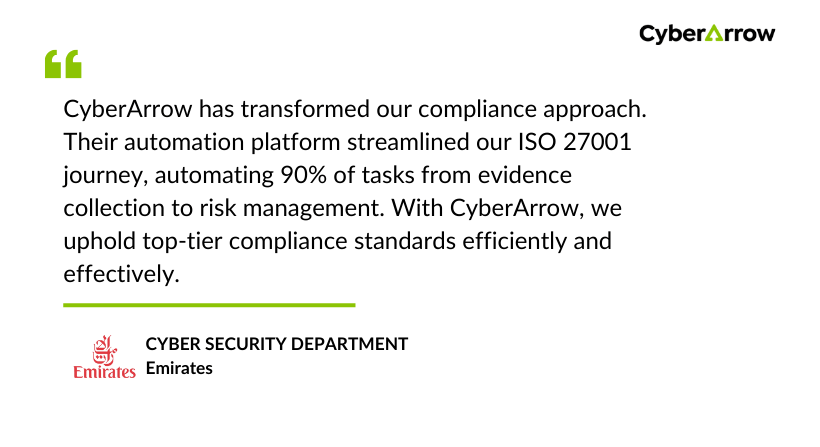
Read how Emirates enhanced Information Security by automating ISO 27001 with CyberArrow.
See what Emirates have to say about CyberArrow GRC: