Key benefits of automating ISO 27001 compliance
As data breaches and cyber threats have become the norm, organizations are under immense pressure to secure sensitive information. ISO 27001, a globally recognized information security standard, provides a framework for establishing, implementing, maintaining, and continually improving an information security management system (ISMS).
As the complexity of information security management grows, so does the need for automating ISO 27001 compliance. This approach streamlines ISO 27001 compliance and enhances security and operational excellence.
This article explores the key benefits of automating ISO 27001 compliance.
Understanding ISO 27001 Compliance
ISO 27001 compliance is a vital component of modern information security management. At its core, ISO 27001 is an internationally recognized standard that provides a comprehensive framework for establishing, implementing, maintaining, and continually improving an organization’s information security management system (ISMS).
The standard outlines a systematic approach to identifying, assessing, and managing information security risks, ensuring that sensitive data and valuable assets are safeguarded against a rapidly evolving landscape of cyber threats and vulnerabilities.
This compliance framework offers a structured methodology that empowers organizations to adapt to emerging security challenges while fostering a culture of ongoing improvement in their information security practices.
Importance of automating ISO 27001 compliance
Managing ISO 27001 compliance manually can be a daunting task for organizations. However, automation is a game changer — offering numerous benefits that elevate ISO 27001 compliance from a mere necessity to a strategic advantage.
Let’s explore the benefits of automating ISO 27001 compliance.
1. Enhanced accuracy and consistency
Automation eliminates the risk of human error that often accompanies manual compliance efforts. ISO 27001 compliance demands meticulous attention to detail, making any inconsistencies or mistakes potentially disastrous. Automated processes ensure that predefined rules and regulations are consistently followed, reducing the likelihood of errors that could lead to non-compliance.
2. Time and resource savings
Manually managing ISO 27001 compliance is a resource-intensive activity. It requires dedicated personnel to continuously monitor, assess, and update security measures. Automation significantly reduces the human effort required for these tasks, allowing staff to focus on more strategic initiatives. By streamlining routine processes, organizations can optimize resource allocation and improve overall operational efficiency.
3. Real-time monitoring and incident response
One of the most significant advantages of automation is the ability to monitor security measures in real-time. Automated tools like CyberArrow can continuously assess the ISMS, detect anomalies, and trigger immediate alerts when unauthorized activities occur. This proactive approach enables organizations to respond swiftly to potential threats, minimizing damage and reducing downtime.
4. Efficient documentation and reporting
ISO 27001 compliance mandates thorough documentation of security processes, controls, and incidents. Manual documentation can be time-consuming and prone to inconsistencies. Automated systems maintain accurate and up-to-date records, ensuring that documentation remains complete and easily accessible.
When audits or assessments are due, automated reporting capabilities simplify the process, providing auditors with the necessary evidence of compliance.
5. Scalability and consistency across multiple sites
Organizations with multiple locations or a global presence face the challenge of maintaining consistent compliance standards across all sites. Automating ISO 27001 compliance ensures that the same compliance procedures are applied uniformly across different locations, eliminating the need for duplicative efforts. This scalability helps maintain a high level of security and reduces the risk of oversight or deviation from established protocols.
6. Faster compliance audits
The prospect of compliance audits can be daunting, but automation eases the burden. Automated systems compile, organize, and present compliance-related data in a standardized format, simplifying the audit process. Auditors can access the necessary information quickly and efficiently, reducing the time and effort required for audits and assessments.
7. Reduced human error and insider threats
Human error remains a significant contributor to security breaches. By automating security processes, organizations can reduce the impact of human-driven vulnerabilities. Additionally, automated systems minimize the risk of insider threats by enforcing access controls, monitoring user activities, and detecting unusual behaviors promptly.
8. Continuous compliance improvement
ISO 27001 compliance is not a one-time endeavor; it requires continuous improvement. Automated systems support this iterative process by capturing data, analyzing trends, and suggesting areas for enhancement. These insights empower organizations to refine their security strategies and adapt to evolving threats effectively.
9. Adaptation to regulatory changes
The regulatory landscape for data protection and information security is ever-evolving. Compliance with new and updated regulations can be overwhelming, but automated tools can be updated to align with changing requirements. This adaptability ensures that organizations remain compliant with the latest standards without undergoing a complete overhaul of their processes.
10. Resource allocation for strategic initiatives
Manual compliance efforts can monopolize valuable resources that could be better utilized for strategic initiatives. Automation liberates organizations from the constant cycle of compliance management, allowing them to redirect human resources toward innovation, development, and growth.
FAQs
What is ISO 27001 compliance automation?
ISO 27001 compliance automation refers to using technology to streamline and simplify the process of adhering to ISO 27001 standards, from evidence collection to ongoing monitoring.
What are the benefits of automating ISO 27001 compliance?
Automating ISO 27001 compliance offers significant advantages. It streamlines processes, ensuring efficiency and reducing manual effort. Automation maintains accuracy, enforces consistent control adherence, and enhances real-time threat monitoring. Documentation becomes simpler, and audits are streamlined with organized records.
What is the role of CyberArrow in automating ISO 27001 compliance?
CyberArrow is a compliance automation platform designed to automate evidence collection, integrate security measures, and simplify ISO 27001 compliance.
Automate ISO 27001 compliance with CyberArrow GRC
Automating ISO 27001 compliance not only simplifies the certification process but also enhances your company’s overall security. CyberArrow GRC makes the journey to ISO 27001 certification faster and more efficient by reducing manual tasks and ensuring a smooth workflow.
Here’s why CyberArrow GRC is the ideal solution for automating ISO 27001 compliance:
- Automated evidence collection: Save time with automated evidence gathering for ISO 27001 controls.
- Cross-standard mapping: Easily manage multiple standards like ISO 27001 and GDPR with CyberArrow’s cross-mapping feature.
- Real-time monitoring: Keep track of compliance status and identify risks in real-time with advanced dashboards.
- Risk management: Automate risk assessments and mitigation efforts, reducing manual input.
- Seamless audit preparation: Invite external auditors to access the system, simplifying audit processes.
- Dedicated support: Work hand-in-hand with a dedicated team for personalized implementation guidance.
Must read: How Emirates enhanced Information Security by automating ISO 27001 with CyberArrow
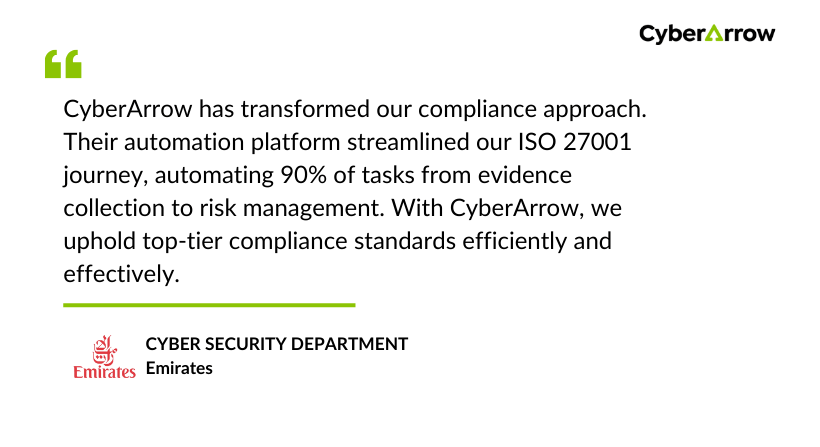
See what Emirates have to say about CyberArrow GRC: