ISO compliance Vs. other information security standards: A comparison
Understanding the difference between ISO compliance vs. other information security standards is crucial in today’s rapidly evolving digital landscape. Ensuring the security of sensitive information has become a top priority for organizations worldwide. As cyber threats grow in complexity and frequency, the need for robust information security practices has never been greater.
In this context, adherence to recognized information security standards is a crucial step towards safeguarding digital assets and maintaining the trust of clients and partners.
This article explores information security standards by comparing ISO compliance and information security standards.
By shedding light on their differences, strengths, and applicability, we hope to assist organizations in making informed decisions about their information security strategies.
Understanding ISO compliance
The International Organization for Standardization (ISO) stands as a beacon of standardization across various industries. Within the realm of information security, ISO 27001 shines as a widely recognized and respected framework.
ISO 27001 is an Information Security Management System (ISMS) standard that systematically manages sensitive information, encompassing risk assessment, implementation of controls, and continual improvement. Its global acceptance and applicability to organizations of all sizes have contributed to its reputation as a cornerstone of information security.
Other Prominent Information Security Standards
While ISO 27001 is prominent, it’s not the sole contender in information security standards. Other influential standards include the NIST Cybersecurity Framework, the CIS Controls, and the Payment Card Industry Data Security Standard (PCI DSS).
Each of these standards caters to specific aspects of information security, and their prevalence depends on industry requirements and regulatory frameworks.
Key differences: ISO compliance vs. Other information security standards
One of the key distinctions lies in the methodologies and structures of these standards. ISO’s approach is holistic, emphasizing risk management and adaptability. On the other hand, some standards, like the CIS Controls, offer a more prescriptive approach, detailing specific actions that organizations should undertake.
Let’s explore the key differences between ISO compliance and other information security standards:
- Scope variation: ISO compliance spans a wide array of industries and sectors thanks to its adaptable nature. However, there are instances where other standards are more appropriate due to specific industry mandates. For instance, the PCI DSS is critical for organizations dealing with payment card information, ensuring secure payment processing.
- Risk emphasis: ISO compliance places a pronounced emphasis on risk management, necessitating organizations to meticulously pinpoint and assess risks affecting their information security and then institute controls to counteract those risks. In contrast, some other standards could exhibit less explicit instructions concerning risk management protocols.
- Continual enhancement: ISO compliance necessitates organizations to consistently monitor and enhance their ISMS by conducting routine evaluations and assessments. In contrast, some other standards might place less importance on continuous improvement.
- Certification distinction: ISO compliance is characterized as a certifiable benchmark, allowing organizations to secure certification from an accredited third-party certification entity. Conversely, other standards may focus on providing recommendations or best practices without necessarily having a specific certification process in place.
- Flexibility: The design of ISO compliance underscores adaptability and versatility, catering to the individual requisites of disparate organizations, irrespective of their proportions, industries, or specific information security vulnerabilities. In contrast, other standards might demonstrate more stringent stipulations, which may not be universally apt.
- Compliance significance: Although ISO compliance doesn’t assume the status of a legal or regulatory compulsion, it equips organizations to manifest compliance with diverse information security regulations and legal frameworks. Alternatively, other standards could align closely with specific regulations or compliance prerequisites.
- Compliance cost and resource allocation: ISO compliance typically involves a comprehensive risk assessment and management system implementation. While this might require substantial upfront investment, it can yield significant long-term savings through reduced security incidents. Comparatively, other standards may require less initial investment due to their more focused scope.
- Global recognition and market perception: ISO’s global recognition carries weight in business partnerships and client relationships. Demonstrating ISO compliance can instill confidence in stakeholders. On the other hand, specific industry standards like PCI DSS can assure clients that their payment information is handled securely.
Selecting the right information security standard requires thoroughly evaluating an organization’s unique circumstances. Factors such as industry regulations, company size, risk tolerance, and existing security measures must all be considered. Whether choosing ISO compliance or another standard, the decision should align with your organization’s goals and resources.
FAQs
What is the difference between ISO and SOC compliance?
ISO compliance focuses on a broad range of international standards that cover various aspects of an organization’s operations, including information security. On the other hand, SOC (Service Organization Control) compliance specifically pertains to controls and practices in service organizations that handle sensitive data.
What is the difference between ISO 27001 and PCI DSS?
ISO 27001 is an information security standard that outlines a comprehensive framework for managing information security risks. PCI DSS (Payment Card Industry Data Security Standard) is specific to organizations that handle payment card data, providing guidelines to secure payment transactions and protect cardholder information.
What is the difference between NIST and ISO?
NIST (National Institute of Standards and Technology) provides the NIST Cybersecurity Framework, offering guidelines to manage and reduce cybersecurity risks. ISO 27001, from the International Organization for Standardization, is a broader standard focusing on information security management. NIST offers a framework, while ISO 27001 provides a structured approach for creating an Information Security Management System (ISMS).
Simplify compliance with information security standards with CyberArrow GRC
In the ever-evolving landscape of information security, achieving and maintaining compliance with standards can be challenging. However, the journey to safeguarding sensitive data and fortifying digital landscapes has been made remarkably simpler with GRC automation tools like CyberArrow.
CyberArrow GRC, a governance, risk and compliance automation tool, is a beacon of efficiency for organizations striving to adhere to information security standards. With its user-friendly interface and intuitive functionalities, CyberArrow takes the complexity out of the compliance equation.
By automating various compliance processes, such as risk assessment, control implementation, and continuous improvement tracking, CyberArrow empowers organizations to navigate the intricate landscape of standards with confidence.
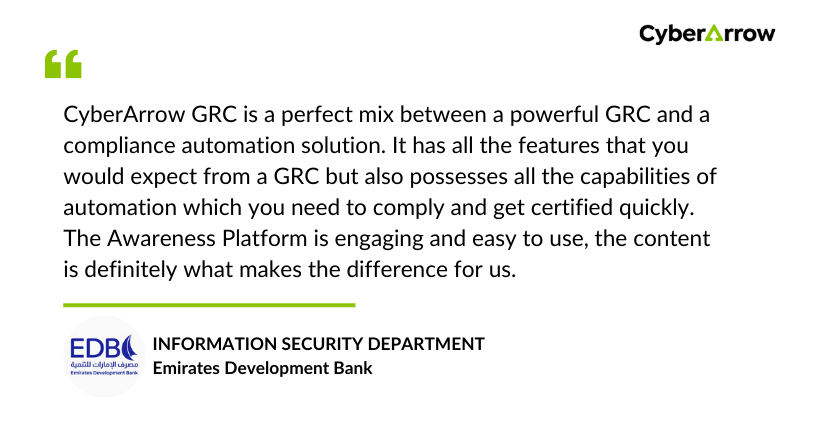
See what our clients have to say about CyberArrow GRC: