


PCI DSS requirements for storing credit card information
In today’s digital age, where credit card transactions have become the norm, ensuring cardholder data security is paramount. In a security breach at JD Sports in January 2023, hackers potentially accessed the personal and financial information of 10 million customers. With security breaches occurring more frequently than before, protecting cardholder information becomes more crucial. Organizations must adhere to PCI DSS requirements when storing credit card information to minimize the risk of data breaches and unauthorized use.
This article serves as a comprehensive guide to understanding the PCI DSS requirements for storing credit card data securely.
Understanding PCI DSS requirements for cardholder data storage
PCI DSS, developed by major credit card companies, aims to enhance the security of card transactions and protect sensitive cardholder information. It applies to any organization or business that stores, processes, or transmits cardholder data. To comply with PCI DSS, organizations must be aware of the data items authorized for storage and the security measures required.
Authorized cardholder data for storage
PCI DSS permits the storage of specific cardholder data, which includes the 16-digit Primary Account Number (PAN), cardholder’s name, expiration date, and service code. These data elements are crucial for transaction processing and subsequent verification. However, it’s important to note that EMV chip data is not considered cardholder data and cannot be stored after authorization.
Prohibited storage of sensitive authentication data (SAD)
Sensitive authentication data (SAD) is strictly prohibited from storage after authorization. SAD includes the full magnetic stripe data, CVV or comparable data, PIN, and PIN blocks. Storing such data significantly increases the risk of unauthorized access and potential fraud. Attackers often target SAD in card and card-not-present transactions, making its protection vital.
Encryption and rendering cardholder data unreadable
PCI DSS mandates that cardholder data be rendered unreadable using strong encryption techniques. Organizations must implement industry-standard encryption methods to safeguard this information. Accepted approaches include strong one-way hash functions, truncation, index tokens with securely stored pads, and the use of robust cryptography. Making the data unreadable, even if compromised, becomes useless to attackers.
Download your free PCI DSS checklist and assess your PCI DSS audit-readiness in minutes.
Download now
PCI DSS requirements for data retention and deletion
Organizations should retain cardholder data only for legitimate legal, regulatory, or business reasons. PCI DSS emphasizes the establishment of data retention and secure deletion policies. Deleting data after the minimum retention period is crucial unless there is a compelling reason to retain it. Moreover, if non-cardholder data is retained alongside card transactions, it must align with PCI DSS requirements.
Breakdown of PCI DSS requirements for storing credit card data
Requirement 3 of the PCI DSS compliance emphasizes protecting stored account data. Let’s look at the breakdown of PCI DSS requirement 3 related to storing cardholder data:
- PCI DSS requirement 3.1: Establish data retention policies and secure deletion procedures.
- PCI DSS Requirement 3.2: Prohibit storage of sensitive authentication data after authorization.
- PCI DSS requirement 3.3: Mask the 16-digit Primary Account Number (PAN) when displayed.
- PCI DSS requirement 3.4: Render PAN data is unreadable if storage is unavoidable.
- PCI DSS requirement 3.5: Protect encryption keys from disclosure and misuse.
- PCI DSS requirement 3.6: Document key management processes and procedures.
10 recommendations for storing credit card data
In addition to meeting the core PCI DSS requirements, organizations should implement the following best practices when storing credit card data:
- Never store sensitive authentication data.
- Make primary account numbers (card numbers) unreadable when stored.
- Retain cardholder data only when necessary, ensuring a legitimate purpose.
- Document and establish processes for storing and managing credit card transactions, including access controls and monitoring.
- Implement multi-factor authentication.
- Use strong and unique passwords.
- Regularly update and patch systems.
- Limit access to cardholder data on a need-to-know basis.
- Encrypt data transmissions.
- Regularly conduct security assessments and audits.
FAQs
What is cardholder data under PCI DSS requirements?
Cardholder data refers to any personally identifiable information (PII) that is linked to a payment card, such as a credit card or debit card. It includes the primary account number (PAN), cardholder name, expiration date, and service code. PCI DSS requirements mandate strict security measures for the protection of cardholder data.
Can you store CVV data?
According to PCI DSS requirements, storing the Card Verification Value (CVV) or Card Verification Code (CVC) is not allowed after authorization. Storing CVV data increases the risk of unauthorized access and potential fraud. Organizations should not retain CVV data once the transaction has been authorized.
Does PCI DSS apply to credit card holders?
PCI DSS (Payment Card Industry Data Security Standard) does not directly apply to credit card holders. It is a set of security standards and requirements imposed on organizations that handle, process, or store cardholder data. The purpose of PCI DSS is to ensure the protection of cardholder data and prevent data breaches. Credit card holders are, however, indirectly affected by PCI DSS as it aims to safeguard their sensitive information and maintain trust in the payment card industry.
Automating PCI DSS compliance with CyberArrow
Storing credit card information comes with strict PCI DSS requirements, designed to protect sensitive customer data and prevent security breaches. Meeting these requirements is critical for any business handling cardholder data, but the process can be complicated and time-consuming.
Instead of manually managing compliance, you can rely on CyberArrow GRC to simplify and automate the entire process.
Why choose CyberArrow GRC for PCI DSS compliance?
- Automated compliance: Ensure your business meets all PCI DSS requirements for storing credit card data without manual effort.
- Secure storage practices: Implement best-in-class encryption and tokenization to safeguard sensitive information.
- Real-time monitoring: Stay on top of compliance status with continuous tracking and alerts.
- Audit-ready documentation: Automatically generate and store the necessary documentation for PCI DSS audits, making the process stress-free.
A retail business utilized CyberArrow GRC to automate its PCI DSS compliance for securely storing credit card information. They reduced the time spent on manual compliance tasks by 80% and significantly improved their data security.
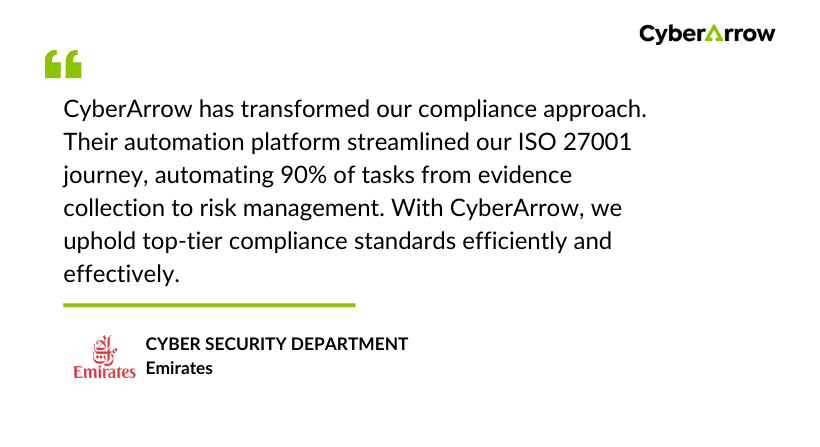
See what Emirates have to say about CyberArrow GRC:
Don’t let the complexities of PCI DSS compliance slow down your business.
