

Why does your business need CCM automation?
With businesses migrating their workloads to the cloud, several security concerns, including data loss, and accidental exposure of credentials, have become more critical than ever. Over the past few years, cyber threats have increased, thus making cloud security and cloud security compliance essential to ensure business continuity.
Several non-profit organizations, including the Cloud Security Alliance (CSA), have also created cybersecurity frameworks and controls to ensure secure cloud operations. One such framework is CSA Cloud Controls Matrix (CCM).
In this article, we will discuss the Cloud Controls Matrix, why it’s essential, and how automating CCM can benefit your business. But first, let’s talk about the Cloud Security Alliance (CSA).
What is the Cloud Security Alliance?
The Cloud Security Alliance (CSA) is one of the prominent organizations committed to providing awareness about best practices that help businesses secure their cloud environments. This organization provides enterprises with tools and guidance to improve their security and compliance posture by leveraging the controls and building stronger values on their systems.
CCM is composed of 198 controls structured in 17 domains that cover all the critical aspects of cloud computing. It provides businesses with systematic assessments for cloud implementation and guidance. This framework is aligned with the CSA Security Guidance for Cloud Computing.
What is CCM?
The Cloud Controls Matrix (CCM) is a set of cloud security controls and policies created by the CSA that helps organizations assess the risk related to cloud computing. CCM aids in developing security controls for enterprises working towards developing and using the cloud environment, enabling them to meet security and risk management goals.
How to use the CCM and CAIQ?
The CCM aligns well with the Consensus Assessments Initiative Questionnaire (CAIQ), a question set that helps enterprises discover specific topics they can discuss with potential cloud service providers.
Understand the following resources to use the CCM and CAIQ.
- Document controls
CCM provides one place to document controls for numerous industry-accepted security standards and regulations, including but not limited to; AICPA TSC, ISO 27001/27001, CIS, PCI DSS, NIST SP 800-53, etc. Integrating the CCM controls will also aid in fulfilling accompanying security standards and regulations.
- Assess cloud providers
CCM Version 4 now consists of the CAIQ in the same documents to provide enterprises with a set of yes or no questions that they can use to assess a cloud solution.
- Clarify the shared responsibility model
Cloud Control Matrix controls also define the attributes of shared responsibility between the cloud service providers (CSPs) and the customers (CSCs). Moreover, you can use it to define the business relevance of each control with the enterprise based on the work CSA does.
- Submit to the STAR registry
The STAR Registry stands for Security, Trust, Assurance, and Risk Registry, which CSPs can use to submit a self-assessment and ensure the delivery of security and data privacy across cloud technology.
Furthermore, CCM provides implementation and auditing guidelines, enabling enterprises to properly use the CCM and understand the CCM audit areas while providing them with the right set of tools.
Importance of CCM
The CSA Cloud Controls Matrix is essential for businesses and cloud providers alike since it provides security concepts that align with industry-accepted security standards and regulations. Moreover, it provides detailed guidance in numerous security domains, including application security, access management, mobile security, data center operations, etc.
Since cloud security is critical to ensure business operations, fulfilling CCM can benefit businesses in the following ways.
- Increased reliability and availability of resources
- Reduce ongoing operational and administrative expenses
- Centralized security and greater ease of scaling
- Enhanced DDoS protection
Importance of cloud security automation
Automating cloud security can benefit organizations in several ways, enabling them to secure their cloud environments and focus on other productive things, such as innovation and growth. Continuous automated security can protect your critical cloud assets and prevent threats from evolving. Some of the benefits of automated cloud security include the following.
- Continuous security operations
- Reduced manual errors
- Enhanced security compliance
- Minimized time and cost spent on security operations
- Advanced and robust security measures
- Rigorously discover and address security vulnerabilities.
Why does your business need Cloud Controls Matrix (CCM) automation?
With security remaining one of the top concerns about cloud computing and storage, CCM benefits businesses in several ways. However, manual controls and security processes can become tedious for enterprises and are more prone to human errors, increasing the time spent on security processes.
Your business needs CCM automation to break free from the monotonous manual tasks and monitoring of security processes to ensure their effectiveness. CCM automation will provide the following benefits to your business.
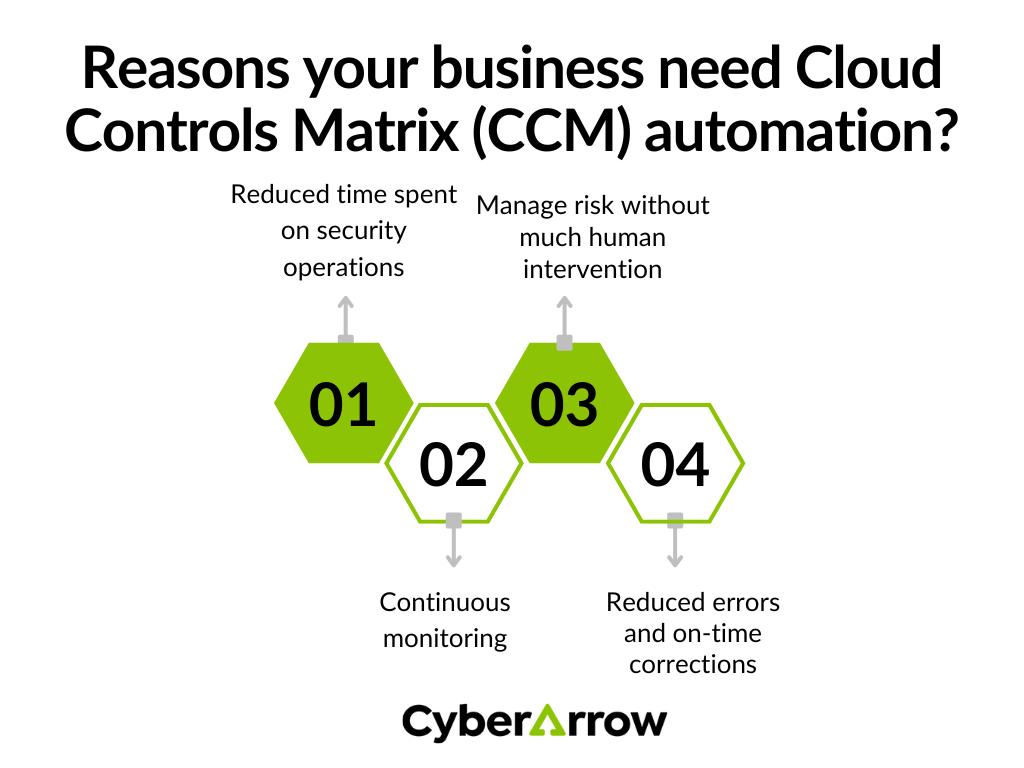
- Reduced time spent on security operations: Automated security operations and controls often run in the background without needing the support of IT professionals and manual controls, thus reducing the work time spent on security.
- Continuous monitoring: Automated security runs continuous checks against specific security threats, such as permission changes to files, user privilege, etc., and monitors processes and controls regularly to ensure ongoing operations.
- Evaluation: CCM automation also enables you to evaluate findings and manage risk without much human intervention.
- Reduced errors and on-time corrections: Manual processes can be daunting and are prone to human errors whereas automated processes reduce the chances of errors and automatically detect suspicious activity to help IT personnel take appropriate steps. Also, CCM automation enables IT professionals to do on-time corrections and patch vulnerabilities before they become a threat.
Automate CCM with CyberArrow!
By implementing CCM, you can enhance your cloud security, protect sensitive data, and ensure compliance with industry standards.
However, manually managing CCM can be a daunting and time-consuming task. That’s why CCM automation is so important. Automating CCM allows you to streamline your cloud security processes, reduce human error, and ensure continuous compliance.
This is where CyberArrow GRC comes in. CyberArrow GRC simplifies CCM automation, making it easier for your business to manage cloud security controls. With CyberArrow GRC, you can:
- Automate CCM implementation: Quickly and accurately implement the Cloud Controls Matrix without the need for manual input, saving time and reducing errors.
- Continuous monitoring: Automatically monitor your cloud security posture to ensure that all controls are up to date and compliant with the latest standards.
- Effortless reporting: Generate comprehensive reports to demonstrate your compliance with the Cloud Security Alliance’s guidelines and other regulations, simplifying audits and assessments.
See what HALA have to say about CyberArrow GRC:
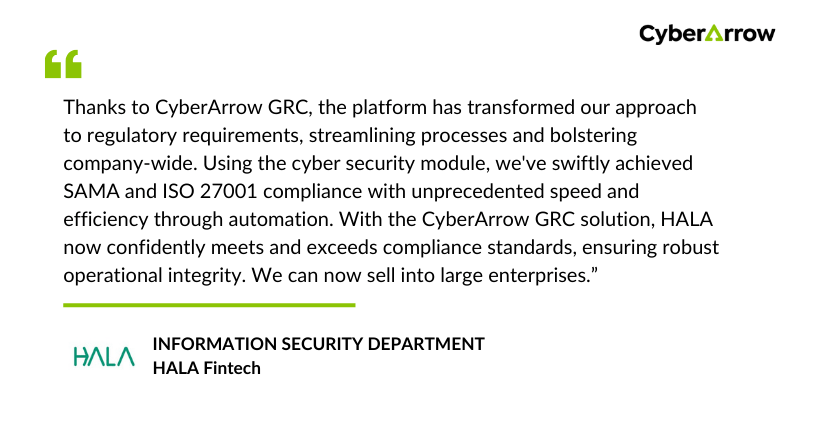
Read HALA’s success story with CyberArrow GRC.
By using CyberArrow GRC, you can automate CCM and strengthen your cloud security effortlessly. Let CyberArrow GRC handle the complexities of CCM so you can focus on growing your business with confidence.
