


What is Spanish National Security Framework (ENS), or Esquema Nacional de Seguridad?
Cyberattacks are getting smarter every day. That’s why countries around the world are creating strong rules to protect digital information. In Spain, one of the most important sets of rules is the Spanish National Security Framework (ENS), also called the Esquema Nacional de Seguridad.
If your business or public organization works with the Spanish government or handles citizen data, you must understand and follow the ENS. In this guide, we’ll explain what it is, why it matters, how it works, and how you can automate ENS compliance with CyberArrow GRC.
Let’s break it all down in simple terms.
- What is the Spanish National Security Framework (ENS)?
- Who must comply with ENS?
- Why ENS is important
- Main goals of ENS
- Core principles of ENS
- Security levels in ENS
- Key areas covered by ENS
- Documentation required for ENS
- Challenges of ENS compliance
- Automate ENS compliance with CyberArrow GRC
- Benefits of using CyberArrow GRC for ENS
- Final thoughts
What is the Spanish National Security Framework (ENS)?
The Spanish National Security Framework (ENS) is a legal framework set by the Spanish government. It explains how public organizations and some private ones must protect digital data and IT systems.
It was first created under Royal Decree 3/2010, and it was updated in Royal Decree 311/2022. These laws provide clear cyber security rules to make sure information stays safe, systems work well, and digital services remain reliable.
In short, ENS tells organizations how to be secure, what risks to avoid, and how to handle data safely.
Who must comply with ENS?
Not every business in Spain needs to follow ENS, but many do. The framework is mandatory for:
- Public Administration (local, regional, national).
- Suppliers and contractors working with the government.
- Private companies handling public sector data.
- Service providers offering cloud services to the government.
- Critical infrastructure and strategic operators.
If your company touches any part of a government project, system, or database, then ENS compliance is your responsibility.
Why ENS is important
Cyber security is not just a technical issue, it’s a matter of national interest. Here’s why ENS matters:
- Protects public services from cyberattacks.
- Keeps citizen data safe and private.
- Builds trust between citizens and digital government systems.
- Prepares for emergencies and security incidents.
- Helps meet EU-wide cyber security standards (like NIS2 and GDPR).
Without ENS, Spain’s public sector would be open to threats like hacking, ransomware, and service outages.
Main goals of ENS
The Spanish National Security Framework focuses on three big goals:
- Availability: Making sure systems are always up and running.
- Integrity: Making sure information isn’t changed or damaged.
- Confidentiality: Making sure only the right people can see the information.
Every rule, measure, and control in the ENS supports these goals.
Core principles of ENS
ENS is based on principles that help guide organizations to secure their systems:
- Security by design: Build security into systems from the beginning.
- Prevention, detection, and response: Don’t just wait for attacks to be ready.
- Continuous improvement: Always test and improve your security controls.
- Responsibility and accountability: Assign clear roles for security.
- Risk management: Identify and reduce risks to acceptable levels.
These principles make sure ENS isn’t just about following rules, it’s about creating a real culture of cyber security.
Security levels in ENS
ENS uses three levels of security:
- Basic
- Medium
- High
Your organization’s level depends on how important your systems and data are. For example:
- A city hall website may only need basic protection.
- A healthcare record system might need high security.
The higher the level, the stricter the security requirements.
Key areas covered by ENS
The ENS framework is very detailed. It includes many security measures (also called “controls”) in areas like:
Organizational measures
- Appointing a Chief Security Officer (CSO).
- Creating a Security Policy.
- Conducting regular risk analysis.
Operational measures
- Access control (who can enter the system).
- Backup and recovery plans.
- Incident response plans.
Technical measures
- Antivirus and firewalls.
- Network security.
- Data encryption.
Each organization must apply these controls according to its security level.
Quick link: What is SOX (Sarbanes-Oxley)?
Documentation required for ENS
Complying with ENS isn’t just about doing the right things—you also have to prove it with documentation. Some important documents include:
- Security Policy.
- Risk Analysis and Management Report.
- Security Measures Statement.
- Security Plan.
- Audit Reports.
These help track progress, show compliance, and prepare for official audits.
Challenges of ENS compliance
Many organizations struggle to keep up with ENS because:
- It’s complex and requires deep knowledge of security.
- There are lots of documents and reports to manage.
- Controls must be reviewed and updated regularly.
- It takes time and resources to stay compliant.
- Mistakes can lead to fines or reputational damage.
That’s why automating ENS compliance with a tool like CyberArrow GRC makes so much sense.
Automate ENS compliance with CyberArrow GRC
CyberArrow GRC is a powerful Governance, Risk, and Compliance (GRC) platform that helps you simplify, manage, and automate your ENS journey.
Here’s how CyberArrow GRC helps:
- Automated control mapping: Map your systems and processes to the required ENS controls fast and easily.
- Document management: Generate, organize, and store all your ENS documentation in one place.
- Risk assessments & gap analysis: Identify missing controls and measure how ready you are for an audit.
- Task scheduling & alerts: Set deadlines, assign tasks, and get reminders to stay on track.
- Audit-ready reporting: Create reports instantly that meet audit and government requirements.
- Role-based access & oversight: Assign roles, responsibilities, and track compliance progress across teams.
Benefits of using CyberArrow GRC for ENS
- Save time: No more manual tracking and report generation.
- Stay compliant: Follow ENS controls and keep everything updated in real-time.
- Be audit-ready: No stress during audits, your system will already have everything in place.
- Reduce risk: Catch vulnerabilities early and prevent costly data breaches.
- Boost reputation: Show clients and government partners that your organization takes cyber security seriously.
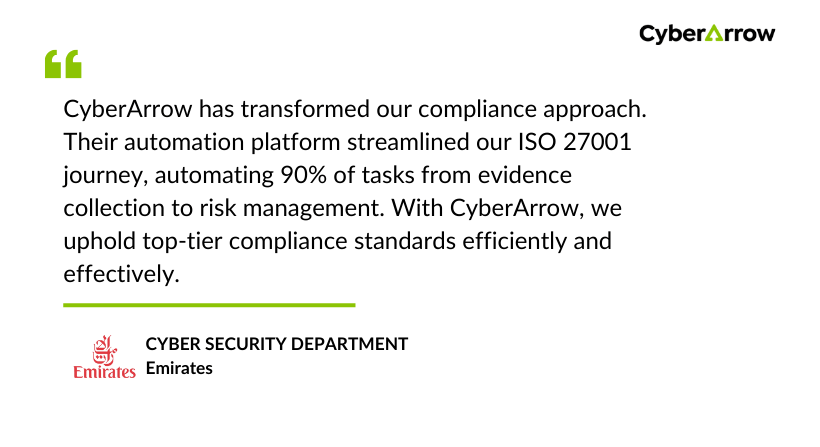
Read how Emirates enhanced information security by automating ISO 27001 with CyberArrow GRC.
See what Emirates has to say about CyberArrow GRC:
Final thoughts
The Spanish National Security Framework (ENS), or Esquema Nacional de Seguridad, is not optional; it’s mandatory for any organization working with the Spanish public sector.
It helps protect public services, secure citizen data, and build trust in digital systems. But staying compliant isn’t easy; it takes time, knowledge, and a lot of work.
That’s why organizations across Spain trust CyberArrow GRC to automate ENS compliance and stay ahead of threats. With its smart platform, your team can focus on running your business while CyberArrow takes care of your security framework.
