


What is NIST CSF compliance? How to achieve it?
Cyber security is no longer optional, every organization, regardless of size or industry, must protect its systems, data, and operations from cyber threats. However, ensuring strong cyber security practices can be challenging, especially when organizations lack a clear roadmap.
The NIST Cybersecurity Framework (NIST CSF) provides businesses with structured guidelines to identify, protect, detect, respond to, and recover from cyber threats. Organizations that follow these guidelines are considered NIST CSF compliant. While NIST CSF compliance is not legally required for all businesses, many industries adopt it voluntarily to strengthen their security posture and meet industry regulations.
This guide explores what NIST CSF compliance means, why it is important, and how businesses can achieve it. Additionally, we discuss how CyberArrow GRC can streamline the process through automation, making compliance more efficient and manageable.
What is NIST CSF compliance?
The National Institute of Standards and Technology Cybersecurity Framework (NIST CSF) is a set of voluntary guidelines designed to help organizations improve their cyber security risk management. It was originally developed in 2014 to enhance the security of critical infrastructure but has since been widely adopted by businesses in various industries.
Being NIST CSF compliant means that an organization has implemented the framework’s security controls to reduce cyber security risks, prevent data breaches, and respond effectively to security incidents.
Who needs to follow NIST CSF?
NIST CSF is applicable to organizations of all sizes, including:
- Government agencies
- Financial institutions
- Healthcare providers
- Technology companies
- Manufacturing firms
- Retail businesses handling customer data
Even though NIST CSF is not a legal requirement, many organizations adopt it to improve their cyber security strategies, meet regulatory expectations, and gain customer trust.
Core components of NIST CSF
The NIST Cybersecurity Framework is structured into three key components:
1. The core
The Core consists of five primary functions that organizations should follow to manage cyber security risks effectively:
- Identify – Understanding the organization’s cyber security risks, assets, and vulnerabilities.
- Protect – Implementing security measures to prevent cyber threats.
- Detect – Monitoring systems to identify potential security incidents.
- Respond – Taking appropriate actions when a cyber threat is detected.
- Recover – Restoring operations and minimizing damages after an attack.
Each of these functions includes several categories and subcategories that guide organizations in implementing effective security practices.
2. Implementation tiers
Tiers help organizations assess their cyber security maturity. The framework defines four levels:
- Tier 1: Partial – Cyber security is not a priority, and risk management is inconsistent.
- Tier 2: Risk informed – Some security measures exist, but they are not fully implemented.
- Tier 3: Repeatable – Cyber security processes are regularly applied and improved.
- Tier 4: Adaptive – The organization continuously improves its security strategies and adapts to emerging threats.
3. Profiles
A NIST CSF profile allows organizations to tailor the framework to their specific business needs, industry requirements, and risk tolerance.
Steps to achieve NIST CSF compliance
1. Conduct a risk assessment
Organizations must begin by evaluating their cyber security risks. This includes:
- Identifying critical IT assets, including hardware, software, and networks.
- Analyzing potential threats, such as ransomware, phishing, and insider attacks.
- Assessing the impact of security breaches on business operations.
2. Develop a cyber security strategy
Once risks are identified, businesses should establish a security strategy aligned with NIST CSF’s five core functions. This strategy should:
- Outline security policies and procedures.
- Define roles and responsibilities for cyber security teams.
- Ensure leadership support for security initiatives.
3. Implement security controls
Organizations must adopt specific security measures to mitigate risks. Key controls include:
- Access control – Restricting access to sensitive systems and data.
- Encryption – Protecting data from unauthorized access.
- Endpoint protection – Using antivirus and anti-malware tools.
- Network security – Implementing firewalls and intrusion detection systems.
- Incident response plan – Preparing procedures for handling security breaches.
4. Monitor and detect threats
Continuous monitoring is critical to identify cyber security threats in real time. Organizations should:
- Deploy security information and event management (SIEM) systems.
- Use intrusion detection and prevention systems.
- Conduct regular vulnerability assessments and penetration testing.
5. Train employees on cyber security best practices
Human error is a leading cause of security breaches. Regular training programs should:
- Educate employees on recognizing phishing attempts.
- Reinforce password management policies.
- Promote awareness of social engineering tactics.
6. Establish an incident response plan
Organizations must have a well-defined incident response plan to handle security breaches efficiently. This plan should include:
- Steps for containing and mitigating cyberattacks.
- Procedures for notifying stakeholders, including customers and regulatory bodies.
- A disaster recovery strategy to restore operations quickly.
7. Regularly review and improve cyber security measures
Achieving NIST CSF compliance is not a one-time process. Organizations must:
- Conduct regular security audits to identify gaps.
- Stay updated with emerging cyber security threats.
- Use automation tools to ensure compliance without manual errors.
Challenges in achieving NIST CSF compliance
Many organizations struggle with NIST CSF compliance due to:
- Complex security requirements that require continuous updates.
- Lack of in-house cyber security expertise to manage compliance.
- Time-consuming compliance tracking when using manual methods.
- Difficulty in mapping existing security controls to NIST CSF standards.
To overcome these challenges, organizations should leverage compliance automation tools that simplify the entire process.
Quick link: NIST incident response Life cycle
Automating NIST CSF compliance with CyberArrow GRC
Manually managing NIST CSF compliance can be overwhelming, especially for organizations with limited security resources. CyberArrow GRC simplifies compliance by automating key processes, reducing manual effort, and ensuring continuous monitoring.
How CyberArrow GRC helps with NIST CSF compliance
- Automated risk assessments: Quickly identify cyber security risks and compliance gaps.
- Pre-built compliance frameworks: Map existing security controls to NIST CSF standards effortlessly.
- Real-time security monitoring: Detect threats and vulnerabilities in real-time.
- Centralized compliance documentation: Store and manage policies, risk assessments, and audit reports in one place.
- Audit-ready compliance reports: Generate reports with a single click, ensuring readiness for internal and external audits.
Why choose CyberArrow GRC?
- Saves time and reduces manual errors in compliance tracking.
- Enhances cyber security posture by ensuring continuous monitoring.
- Supports multiple compliance frameworks beyond NIST CSF, including ISO 27001 and GDPR.
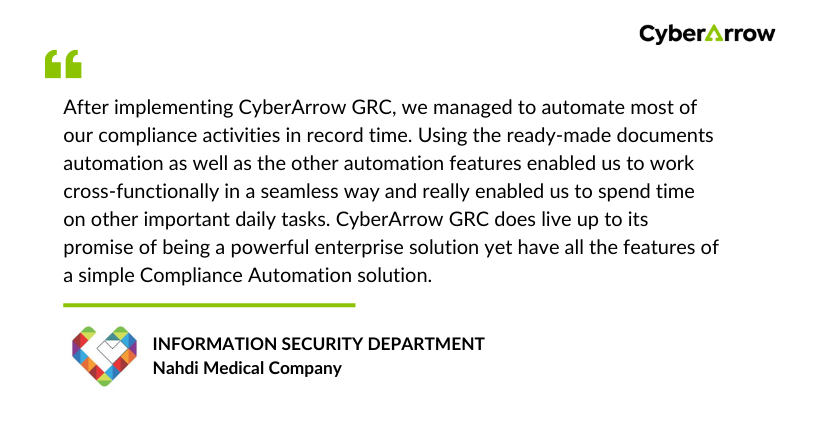
See what Nahdi has to say about CyberArrow GRC:
Conclusion
NIST CSF compliance is essential for businesses aiming to enhance their cyber security strategies and reduce risks. Following the framework’s guidelines enables organizations to identify vulnerabilities, protect sensitive data, and respond effectively to cyber threats.
However, managing compliance manually can be complex and resource-intensive. CyberArrow GRC provides an efficient solution by automating compliance tasks, streamlining risk assessments, and ensuring continuous monitoring.
For organizations looking to achieve NIST CSF compliance efficiently, CyberArrow GRC is the ideal solution.
