

What is ISO 20000 compliance? How to comply with it?
Managing IT services efficiently is critical for businesses today. Customers and stakeholders expect high-quality, reliable, and secure IT services. But how can organizations ensure they meet these expectations?
ISO 20000 compliance provides a solution. It is an internationally recognized standard for IT service management (ITSM). Organizations that comply with ISO 20000 follow best practices to improve IT service quality, reduce risks, and enhance customer satisfaction.
In this guide, you will learn what ISO 20000 compliance is, why it matters, requirements, and how CyberArrow GRC can automate the ISO 20000 certification process.
If you want to ensure efficient IT service management while reducing manual efforts, this guide is for you.
- What is ISO 20000 compliance?
- Why is ISO 20000 compliance important?
- ISO 20000 compliance requirements
- How to comply with ISO 20000: Step-by-step guide
- Step 1: Understand ISO 20000 requirements
- Step 2: Conduct a gap analysis
- Step 3: Develop a compliance plan
- Step 4: Implement a Service Management System (SMS)
- Step 5: Train employees and raise awareness
- Step 6: Monitor IT service performance
- Step 7: Conduct internal audits
- Step 8: Engage a certification body
- Step 9: Pass the certification audit
- Step 10: Maintain compliance with continuous improvement
- Common challenges in ISO 20000 compliance
- Automate ISO 20000 compliance with CyberArrow GRC
- Conclusion: Achieve ISO 20000 compliance with automation
What is ISO 20000 compliance?
ISO 20000 is an international standard for IT service management (ITSM), published by the International Organization for Standardization (ISO). It helps businesses establish an effective service management system (SMS) that meets global standards.
Key Objectives of ISO 20000 Compliance
- Ensuring IT services meet customer needs.
- Improving service reliability and efficiency.
- Reducing IT-related risks.
- Aligning IT service management with business goals.
- Supporting continuous service improvement.
Organizations that comply with ISO 20000 follow structured policies, processes, and controls to ensure high-quality IT service delivery.
Why is ISO 20000 compliance important?
ISO 20000 compliance is not just a certification, it’s a strategic advantage. It ensures that IT services are structured, secure, and continuously improving.
Benefits of ISO 20000 compliance
- Improves IT service quality: Ensures a structured approach to IT service delivery.
- Reduces downtime: Helps prevent service disruptions.
- Enhances customer trust: Shows commitment to reliable IT services.
- Ensures regulatory compliance: Aligns with industry IT service regulations.
- Boosts operational efficiency: Reduces waste and improves resource allocation.
- Strengthens risk management: Identifies and mitigates IT service risks.
Organizations that comply with ISO 20000 gain a competitive edge and improve their IT governance framework.
ISO 20000 compliance requirements
To comply with ISO 20000, organizations must establish a Service Management System (SMS) that meets the standard’s requirements.
Key ISO 20000 compliance areas
- Service Management System (SMS) implementation – Establish structured service management processes.
- Service delivery and performance management – Monitor and improve service delivery.
- Incident and problem management: Ensure quick resolution of IT issues.
- Change management: Manage changes to IT services effectively.
- Risk and compliance management: Identify and mitigate IT service risks.
- Service continuity and availability: Ensure IT services remain available.
- Performance measurement and continuous improvement: Track IT service quality and optimize processes.
Organizations must document policies, define responsibilities, and establish monitoring mechanisms to ensure compliance.
How to comply with ISO 20000: Step-by-step guide
Achieving ISO 20000 compliance requires a structured approach. Follow these steps to ensure compliance:
Step 1: Understand ISO 20000 requirements
Familiarize yourself with ISO 20000-1 to understand its IT service management principles and compliance expectations.
Step 2: Conduct a gap analysis
Evaluate your current IT service management (ITSM) processes to identify gaps between your practices and ISO 20000 requirements.
Step 3: Develop a compliance plan
Create a detailed roadmap to implement ISO 20000 controls, processes, and best practices.
Step 4: Implement a Service Management System (SMS)
- Define roles and responsibilities for IT service management.
- Establish policies and procedures for incident management, service continuity, and risk mitigation.
- Ensure alignment with ITIL best practices.
Step 5: Train employees and raise awareness
Educate your IT team about ISO 20000 best practices to ensure smooth implementation.
Step 6: Monitor IT service performance
- Track IT service availability, incident resolution, and service quality.
- Implement Key Performance Indicators (KPIs) to measure service efficiency.
Step 7: Conduct internal audits
Perform regular audits to assess compliance readiness and identify non-conformities.
Step 8: Engage a certification body
Hire an ISO 20000 certification body to conduct an independent external audit.
Step 9: Pass the certification audit
The certification body evaluates your SMS, policies, and controls. If everything meets ISO 20000 requirements, you receive ISO 20000 certification.
Step 10: Maintain compliance with continuous improvement
- Conduct regular IT service assessments.
- Implement corrective actions for service improvement.
- Stay updated with ISO 20000 changes and IT service advancements.
ISO 20000 compliance is an ongoing process, requiring continuous monitoring and optimization.
Quick link: What is ISO 27035 compliance?
Common challenges in ISO 20000 compliance
Organizations often face challenges when implementing ISO 20000 compliance, including:
- Manual compliance management: Keeping track of IT service records is time-consuming.
- Complex documentation: Managing service management policies and audit reports can be overwhelming.
- Lack of expertise: IT teams may struggle with ISO 20000 compliance requirements.
- Frequent audits: Preparing for audits without automation can lead to errors.
To simplify and accelerate ISO 20000 compliance, organizations need compliance automation solutions.
Automate ISO 20000 compliance with CyberArrow GRC
CyberArrow GRC is a powerful compliance automation platform that simplifies ISO 20000 compliance and reduces manual efforts.
How CyberArrow GRC helps with ISO 20000 compliance
- Automates up to 90% of compliance tasks: Reduces manual work.
- Provides pre-approved ISO 20000 document templates: Speeds up policy creation.
- Monitors IT service compliance in real-time: Detects non-conformities.
- Integrates with 80+ tools: Seamlessly connects with IT service management systems.
- Automates risk assessments: Identifies service risks and suggests solutions.
- Generates audit-ready reports: Simplifies ISO 20000 certification audits.
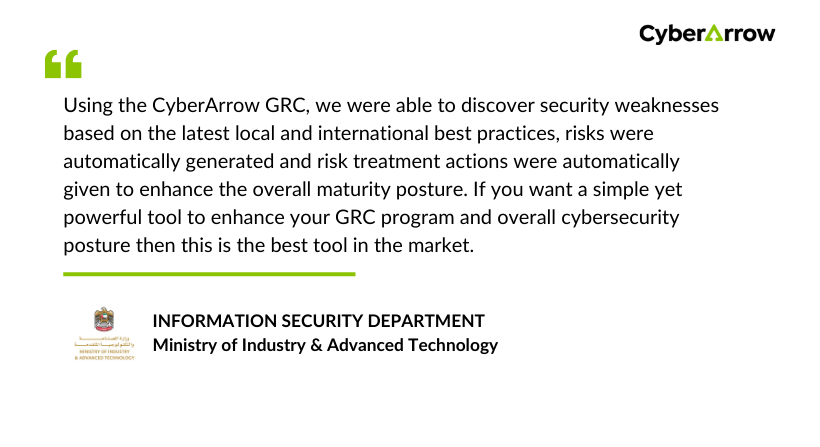
See what MOIAT has to say about CyberArrow GRC:
Conclusion: Achieve ISO 20000 compliance with automation
ISO 20000 compliance helps organizations enhance IT service quality, reduce risks, and improve customer trust. However, manual compliance processes can be time-consuming and error-prone.
With CyberArrow GRC, businesses can automate ISO 20000 compliance, streamline IT service management, and achieve certification faster. The platform simplifies compliance tracking, risk management, and audit preparation, ensuring a smooth ISO 20000 journey.
If your organization wants to achieve and maintain ISO 20000 compliance efficiently, CyberArrow GRC is the solution.
