


The dark web – What is it & why does it matter?
The internet is like a giant web of information, but not everything is easy to find. When we search on Google or use other search engines, we’re mostly seeing what’s called the “Regular Web.” But there’s another part of the internet called the dark web.
It’s different and hidden from regular search engines. Let’s explore what the dark web is, why it exists, and how it works.
What is the dark web?
The dark web is a section of the internet that isn’t visible through traditional search engines like Google. You can’t find dark web pages by just typing keywords into a search bar. Instead, you need special browsers, like the Tor browser, to access it.
Here’s why it’s called the dark web:
- Hidden and encrypted: The dark web uses encryption to keep information private and hidden. This means that the pages are not indexed or searchable by regular search engines.
- Special browsers needed: To browse the dark web, you need to use specific tools like the Tor browser. This browser helps you access hidden sites by masking your identity.
Why does the dark web exist?
The dark web isn’t all about illegal activities; it has some important uses too. Here’s why it exists:
- Privacy and anonymity: The dark web offers a way for people to surf the internet privately. This can be important for people who live in places where the internet is monitored or censored. It helps them communicate and access information without being tracked.
- Safe communication: For journalists and activists in oppressive regions, the dark web can provide a safe space to share information and expose issues without risking their safety.
Who created the dark web?
The dark web grew from a project called Tor, which stands for “The Onion Router.” This project was started by several people including David Goldschlag, Mike Reed, Paul Syverson, Roger Dingledine, and Nick Mathewson. They were researchers from the United States Naval Research Lab (NRL) and MIT. They created Tor to allow people to browse the internet privately and securely.
When Tor became available to the public in the 2000s, the dark web started to gain popularity. It provided a way to browse the internet without leaving a trace, which drew many users interested in anonymity.
What is the dark web used for?
The dark web has both positive and negative uses:
Legal uses: There are many legitimate reasons people use the dark web. It’s a place where you can:
- Find research information: Access academic and research material that might not be available elsewhere.
- Read rare books: Discover books and literature that are not easily found on the regular web
- Connect privately: Communicate in a private way, especially in places where the internet is controlled or censored.
Illegal uses: Unfortunately, the dark web is also known for illegal activities:
- Black markets: There are hidden marketplaces where people buy and sell illegal items like drugs, weapons, and stolen data.
- Hacking and fraud: Some parts of the dark web are used by hackers and fraudsters to exchange stolen information or plan attacks.
Dark web, deep web, and regular web: What’s the difference?
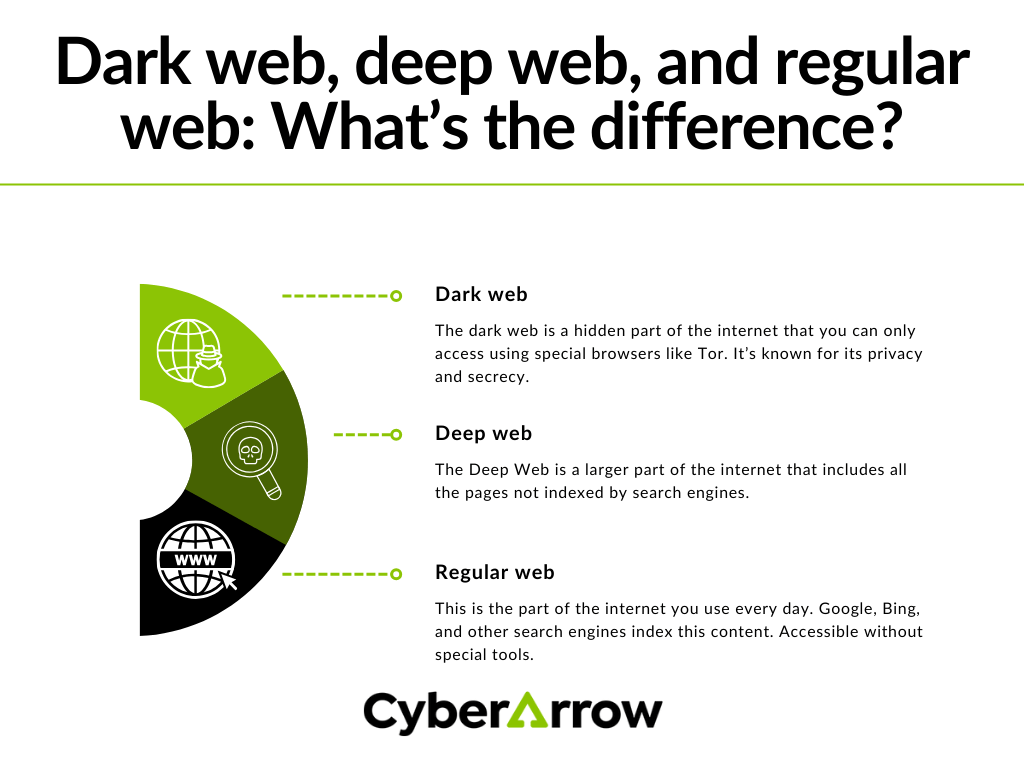
Dark web: The dark web is a hidden part of the internet that you can only access using special browsers like Tor. It’s known for its privacy and secrecy.
Deep web: The Deep Web is a larger part of the internet that includes all the pages not indexed by search engines. This includes things like:
- Private databases: Information in databases that requires a login to access.
- Subscription services: Sites that require payment or membership to view content.
- Personal accounts: Private email accounts and social media profiles.
The Deep Web is not the same as the dark web but includes it. Most of the Deep Web is perfectly legal and safe.
Regular web: This is the part of the internet you use every day. It includes:
- Search engines: Google, Bing, and other search engines index this content.
- Social media: Sites like Facebook, Twitter, and Instagram.
- News sites and blogs: Accessible without special tools.
Is it illegal to access the dark web?
Just visiting the dark web is not illegal. However, what you do there can be. Here’s what you need to keep in mind:
- Legal activities: Using the dark web for privacy and accessing information is not against the law. You can use it safely if you follow legal and ethical guidelines.
- Illegal activities: Engaging in illegal activities, like buying or selling illegal goods, is against the law and can get you into serious trouble.
Tips for safe browsing
If you choose to explore the dark web, here are some safety tips:
- Use special tools: Always use a special browser like Tor to access the dark web.
- Avoid downloading files: Be cautious and avoid downloading files from untrusted sources.
- Protect your privacy: Use VPNs and antivirus software to protect your personal information and keep your device safe.
- Be aware of scams: Watch out for scams and never share personal details or payment information on unregulated sites.
Conclusion
Understanding the dark web helps us see how the internet is not just one big open space. While it can be a valuable tool for privacy and safety, it also has parts that are risky and illegal. By knowing more about it, you can navigate the internet more wisely.
For organizations managing online risks and compliance, using tools like CyberArrow GRC can make a big difference. CyberArrow helps with:
- Automated policy management: Streamline and automate policy creation and updates.
- Risk assessments: Save time with automated risk assessments and reporting.
- Compliance tracking: Keep track of regulations and compliance effortlessly.
- Continuous monitoring: Integrate with your systems for ongoing security monitoring.
