


Strategies for effective Corporate risk management: A complete guide
In today’s fast-moving world, businesses face risks from all directions: cyber threats, legal changes, market shifts, natural disasters, and even internal mistakes. If you’re not ready, a single risk event can harm your company’s finances, reputation, or operations. That’s why having a strong corporate risk management strategy is so important.
This guide will help you understand what corporate risk management is, why it matters, and the top strategies your business can use to stay protected. We’ll also show how automation tools like CyberArrow GRC can make the process much easier and more effective.
What is corporate risk management?
Corporate risk management is the process businesses use to identify, assess, control, and monitor risks that could affect their goals. These risks can be internal or external, big or small, and can affect any part of the company.
The goal of risk management is not just to avoid bad things from happening. It’s also to make smart decisions, stay prepared, and continue growing even when things don’t go as planned.
Why corporate risk management is important
Without a proper risk management plan, your business could face:
- Unexpected losses from accidents, fraud, or cyberattacks.
- Regulatory penalties for non-compliance.
- Customer trust issues after data breaches or service failures.
- Interrupted operations due to disasters or system breakdowns.
- Reputation damage from negative media or public response.
On the other hand, good risk management helps your business:
- Make smarter decisions.
- Reduce costs by avoiding losses.
- Stay compliant with laws and industry rules.
- Build trust with customers, partners, and investors.
- Be more confident in handling uncertainty.
Types of risks in corporate environments
To manage risk well, you first need to know what types of risks your company faces. Common types include:
1. Operational risk
Problems in day-to-day processes, like system failures, human error, or supply chain delays.
2. Financial risk
Changes in market prices, interest rates, or customer payments that affect your bottom line.
3. Cyber security risk
Threats to your data and systems, like phishing, ransomware, or insider threats.
4. Regulatory and legal risk
Not following laws like GDPR, NIST, ISO, or regional standards like UAE PDPL or SDAIA PDPL.
5. Strategic risk
Risks from business decisions that don’t turn out as expected.
6. Reputational risk
Negative press, customer backlash, or poor service that hurts your brand.
Top strategies for effective corporate risk management
1. Start with a risk assessment
You can’t manage what you don’t understand. Begin by identifying all possible risks. Use internal reports, market analysis, employee feedback, and expert input. Then assess:
- Likelihood: How likely is it to happen?
- Impact: How serious would the damage be?
Create a risk matrix to rank and prioritize what needs attention first.
2. Create a risk register
Keep a central log of all known risks. Include:
- The risk description.
- Risk owner (who’s responsible).
- Likelihood and impact score.
- Mitigation plans.
- Status updates.
A clear risk register helps everyone stay informed and aligned.
3. Develop a risk response plan
For each top-priority risk, create a plan that outlines how to:
- Avoid the risk (eliminate the source).
- Reduce the risk (add controls or protections).
- Transfer the risk (insurance or third-party contracts).
- Accept the risk (if it’s low and manageable).
Make sure each plan has clear owners and timelines.
4. Involve the whole organization
Risk management shouldn’t be a one-person job. Build a culture where teams from IT, finance, HR, legal, and operations all take part. Everyone should know:
- What risks exist.
- What controls are in place.
- Who to contact when issues arise.
Regular training and communication are key.
5. Monitor and review regularly
Risks change over time. What was low-risk last year may be high-risk now. Review your risk register every quarter (or more often) and update your plans accordingly.
Use dashboards and reports to track:
- New or emerging risks.
- Progress on mitigation efforts.
- Incident response outcomes.
- Changes in regulatory obligations.
6. Automate your risk management program
Manual risk tracking, like spreadsheets and shared drives, is slow, error-prone, and hard to scale. That’s why many companies are moving to GRC (Governance, Risk, and Compliance) platforms to automate the process.
How automation improves corporate risk management
Using a platform like CyberArrow GRC can help your business manage risks more efficiently.
Here’s how:
Real-time visibility: Get instant updates on your risk status across departments and frameworks.
Centralized risk register: Log, update, and track all your risks from one place, accessible to all key stakeholders.
Automated risk assessments: CyberArrow uses built-in methodologies to calculate risk scores and recommend mitigation actions based on your business type and industry.
Alerts and notifications: Never miss a deadline or audit requirement again. Set automatic reminders for reviews, evidence collection, and mitigation follow-ups.
Policy and control mapping: Link risks to specific controls and policies. You can also map them across frameworks like ISO 27001, NIST CSF, SOC 2, and more without duplicating your work.
Compliance integration: As you manage risks, you’re also preparing for audits. CyberArrow GRC ties risk efforts directly to compliance standards, saving your team hours of manual effort.
Read how CyberArrow GRC improved risk assessment across departments for the DCD – Abu Dhabi.
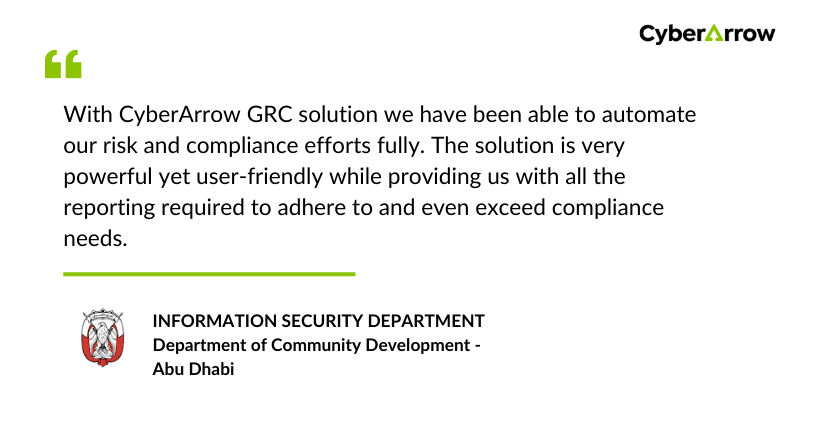
See what DCD – Abu Dhabi has to say about CyberArrow GRC:
Why choose CyberArrow GRC for corporate risk management?
CyberArrow GRC is a full-scale enterprise platform designed to help companies of all sizes:
- Automate their governance, risk, and compliance programs.
- Replace outdated spreadsheets with real-time dashboards.
- Align with multiple regulatory frameworks ISO, NIST, SOC 2, GDPR, UAE PDPL, and more.
- Perform enterprise-wide risk assessments with ease.
- Track internal control effectiveness and receive alerts for gaps.
- Stay ready for audits and inspections all year round.
You don’t need to be a risk expert to use CyberArrow. With built-in tools, templates, and expert guidance, your team can start seeing results in just a few weeks.
Final thoughts
Effective corporate risk management is more than a checkbox. It’s how modern companies protect their operations, reputation, and future growth.
By using the right strategies like risk assessments, organization-wide ownership, and automation, you can turn risk management from a burden into a competitive advantage.
And with tools like CyberArrow GRC, you don’t have to do it manually. You get the structure, visibility, and support your business needs to stay safe and compliant while focusing on what matters most: growing your company.
