A guide to NIST 800-53 control families
Cyber security is a major concern for organizations handling sensitive data. Cyber threats are increasing, and businesses must take strong measures to protect their systems. To help with this, the National Institute of Standards and Technology (NIST) created a framework called NIST 800-53.
NIST 800-53 provides security and privacy controls that organizations must follow to protect federal information systems. These controls are grouped into categories called control families. Each control family focuses on a different area of cyber security, such as access control, risk assessment, and incident response.
Understanding these control families is important for businesses that need to comply with NIST 800-53. However, managing and implementing these controls manually can be difficult. That is why automation is essential. In this article, we will explore NIST 800-53 control families, why they matter, and how businesses can automate compliance using CyberArrow GRC.
- What are NIST 800-53 control families?
- The 20 NIST 800-53 control families
- 1. Access control (AC)
- 2. Awareness and training (AT)
- 3. Audit and accountability (AU)
- 4. Assessment, authorization, and monitoring (CA)
- 5. Configuration management (CM)
- 6. Contingency planning (CP)
- 7. Identification and authentication (IA)
- 8. Incident response (IR)
- 9. Maintenance (MA)
- 10. Media protection (MP)
- 11. Physical and environmental protection (PE)
- 12. Planning (PL)
- 13. Personnel security (PS)
- 14. Risk assessment (RA)
- 15. System and services acquisition (SA)
- 16. System and communications protection (SC)
- 17. System and information integrity (SI)
- 18. Supply chain risk management (SR)
- 19. Program management (PM)
- 20. Privacy (PT)
- Challenges of managing NIST 800-53 compliance manually
- How to automate NIST 800-53 compliance with CyberArrow GRC?
- Why choose CyberArrow GRC?
What are NIST 800-53 control families?
NIST 800-53 contains a structured set of security and privacy controls designed to protect information systems. These controls are grouped into control families based on their purpose.
Each control family focuses on a different security function, such as protecting data, managing user access, or responding to cyber incidents. Together, these controls help organizations build a strong cyber security framework.
There are 20 control families in NIST 800-53 (Revision 5). These families cover a wide range of security topics, ensuring that organizations take a comprehensive approach to cyber security.
The 20 NIST 800-53 control families
1. Access control (AC)
This family focuses on who can access an organization’s systems and data. It includes rules for user authentication, role-based access, and preventing unauthorized access.
2. Awareness and training (AT)
Employees need to be aware of cyber security risks and best practices. This control family ensures that organizations provide regular training to staff.
3. Audit and accountability (AU)
Organizations must keep records of security events. This family includes controls for logging, monitoring, and reviewing security incidents.
4. Assessment, authorization, and monitoring (CA)
This family helps organizations assess security risks, authorize system access, and continuously monitor their cyber security status.
5. Configuration management (CM)
Security settings should be properly configured and updated. This family focuses on managing system configurations, patches, and software updates.
6. Contingency planning (CP)
Businesses need to be prepared for emergencies. This family includes controls for disaster recovery, backup plans, and incident response.
7. Identification and authentication (IA)
This family ensures that only authorized users can access systems. It includes multi-factor authentication and identity verification.
8. Incident response (IR)
Organizations must have a plan to detect, respond to, and recover from security incidents. This family focuses on incident reporting and response procedures.
9. Maintenance (MA)
Regular system maintenance is important for security. This family includes rules for system repairs, updates, and software patches.
10. Media protection (MP)
Organizations handle sensitive data on different types of media, such as USB drives, hard disks, and cloud storage. This family ensures that media is protected, encrypted, and properly disposed of.
11. Physical and environmental protection (PE)
Cyber security is not just about digital threats. This family includes controls to protect physical infrastructure, such as data centers, offices, and access points.
12. Planning (PL)
Organizations need a structured cyber security plan. This family ensures that companies develop security strategies, policies, and risk management plans.
13. Personnel security (PS)
Employees and contractors must be screened and monitored to reduce insider threats. This family includes background checks, security clearances, and employee termination procedures.
14. Risk assessment (RA)
This family focuses on identifying, analyzing, and managing cyber security risks. Organizations must perform regular risk assessments to identify vulnerabilities and threats.
15. System and services acquisition (SA)
When organizations purchase new IT systems, they must ensure that security is integrated from the start. This family includes vendor security assessments and supply chain risk management.
16. System and communications protection (SC)
This family covers the technical security controls needed to protect systems and data from cyber threats, such as firewalls, encryption, and network segmentation.
17. System and information integrity (SI)
Organizations need real-time threat detection and incident prevention. This family includes malware protection, intrusion detection, and system monitoring.
18. Supply chain risk management (SR)
Cyber threats can come from third-party vendors. This family focuses on managing risks in the supply chain and ensuring vendor security.
19. Program management (PM)
This family includes security planning, oversight, and governance at an organization-wide level.
20. Privacy (PT)
This family ensures that organizations protect personal data and comply with privacy laws and regulations.
Challenges of managing NIST 800-53 compliance manually
Managing NIST 800-53 control families manually can be difficult. Organizations face several challenges, such as:
- Complexity: There are hundreds of security controls to implement.
- Frequent updates: NIST regularly updates the framework, requiring businesses to adjust their security measures.
- Lack of visibility: Tracking compliance progress manually can lead to security gaps.
- Time-consuming audits: Preparing for compliance audits can take weeks without automation.
To solve these problems, businesses need compliance automation software that simplifies the process.
How to automate NIST 800-53 compliance with CyberArrow GRC?
CyberArrow GRC is a powerful compliance automation platform that helps organizations achieve and maintain NIST 800-53 compliance. Here’s how CyberArrow GRC makes compliance easier:
1. Automated compliance tracking
CyberArrow GRC provides real-time compliance monitoring, ensuring that businesses meet NIST 800-53 control requirements.
2. Pre-built compliance templates
The platform includes pre-configured security templates for NIST 800-53, making implementation faster and easier.
3. Risk assessments and security controls
CyberArrow GRC helps organizations identify security risks, implement controls, and track compliance progress.
4. Instant audit reports
Preparing for audits is easy with automated compliance reports, reducing manual work and saving time.
5. Integration with security tools
CyberArrow GRC works with existing security solutions, such as firewalls, SIEMs, and vulnerability scanners, for seamless compliance management.
Why choose CyberArrow GRC?
CyberArrow GRC is the best solution for businesses that need to comply with NIST 800-53. It offers:
- Full automation of compliance tasks
- Real-time compliance monitoring
- Pre-built templates for quick implementation
- Easy audit preparation with instant reports
- Seamless integration with security tools
With CyberArrow GRC, organizations can reduce compliance costs, save time, and strengthen cyber security.
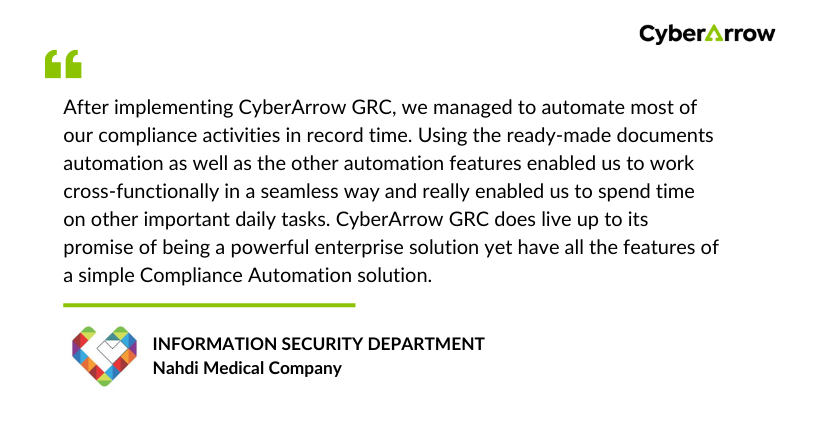
See what Nahdi has to say about CyberArrow GRC: