


NIST 800-171: A complete guide to NIST 800-171 compliance
NIST 800-171 is a cyber security framework designed to protect Controlled Unclassified Information (CUI) in non-federal systems. If your business works with the U.S. government, follows Department of Defense (DoD) contracts, or handles sensitive government data, then NIST 800-171 compliance is mandatory.
Failure to comply can lead to loss of government contracts, security risks, and legal penalties. However, meeting these compliance requirements can be complex and time-consuming. This guide will help you understand everything about NIST 800-171, including its importance, who needs to comply, key requirements, and how to achieve compliance.
By the end of this article, you will have a clear roadmap to meeting NIST 800-171 standards and protecting your business from compliance risks.
Understanding NIST 800-171 and its importance
NIST 800-171 is a cyber security standard developed by the National Institute of Standards and Technology (NIST). It provides security guidelines for organizations that store, process, or transmit Controlled Unclassified Information (CUI). This type of data is not classified but still requires protection to prevent unauthorized access and cyber threats.
The framework was introduced to strengthen data security for businesses that work with federal agencies, especially in industries like defense, research, and government contracting. It helps organizations improve security controls, prevent data breaches, and meet federal security requirements.
Failure to comply with NIST 800-171 can lead to severe consequences. Businesses that fail audits or violate security rules may lose government contracts, face penalties, or risk cyberattacks. By following the guidelines, companies can demonstrate strong cyber security practices and maintain trust with government agencies.
Who needs to comply with NIST 800-171?
NIST 800-171 compliance is required for any non-federal organization that handles Controlled Unclassified Information (CUI). This includes contractors, subcontractors, and third-party vendors that work with government agencies, the Department of Defense (DoD), NASA, and other federal institutions.
Businesses in industries such as aerospace, defense manufacturing, healthcare, and technology often deal with CUI and must ensure compliance. Even small businesses or subcontractors that store or process government data are subject to these regulations.
If your company is involved in federal contracts, you must implement NIST 800-171 security controls, pass security assessments, and maintain ongoing compliance to continue working with government clients.
Key requirements of NIST 800-171
To comply with NIST 800-171, organizations must follow 110 security requirements categorized into 14 key areas. These areas cover everything from access control to incident response.
Below are the most critical requirements:
1. Access control
Organizations must limit access to CUI data. Only authorized employees and systems should be able to view, modify, or share sensitive information. Multi-factor authentication (MFA) and role-based access controls help prevent unauthorized access.
2. Awareness and training
Employees must receive regular cyber security training to recognize security threats and follow best practices. This reduces the risk of human errors leading to security breaches.
3. Audit and accountability
Organizations must track and monitor who accesses CUI and what actions they take. Detailed logs and audit trails help detect suspicious activities and ensure accountability.
4. Configuration management
Systems must be properly configured and regularly updated to prevent security vulnerabilities. Outdated software or misconfigured settings can expose data to cyber threats.
5. Identification and authentication
Strong authentication methods, such as password policies, biometric verification, and security tokens, must be implemented to verify users before granting access to CUI.
6. Incident response
A formal incident response plan must be in place to detect, respond to, and recover from security incidents. Organizations must report breaches and take immediate action to contain threats.
7. Media protection
All digital and physical media storing CUI must be protected from unauthorized access. This includes hard drives, USBs, cloud storage, and printed documents.
8. Physical security
Organizations must secure their physical locations by controlling entry points, using surveillance systems, and restricting access to areas where CUI is stored.
9. Risk assessment
Regular risk assessments help organizations identify security vulnerabilities and potential threats. Businesses must evaluate risks and take preventive measures.
10. System and communications protection
Strong encryption methods must be used to protect data in transit and at rest. Secure communication channels prevent unauthorized interception of sensitive information.
Meeting these requirements can be challenging, but following a structured approach makes compliance easier.
Quick link: NIST 800-171 controls: Everything you need to know
How to achieve NIST 800-171 compliance
To meet NIST 800-171 requirements, organizations should follow these steps:
- Identify and classify CUI: Determine which data falls under NIST 800-171 and where it is stored.
- Conduct a security gap analysis: Compare current security controls with NIST 800-171 requirements to identify weaknesses.
- Develop a System Security Plan (SSP): This document outlines how your organization will implement security controls.
- Implement security controls: Apply the necessary security measures, such as encryption, access control, and monitoring tools.
- Monitor and update compliance efforts: Regularly assess security measures, train employees, and update policies to stay compliant.
Organizations that fail to meet compliance standards risk losing government contracts and exposing sensitive data to cyber threats. Automating compliance can streamline this process and reduce errors.
Quick link: What is NIST 800-53 compliance?
Simplify NIST 800-171 compliance with CyberArrow GRC
Achieving NIST 800-171 compliance manually can be time-consuming and complex. CyberArrow GRC simplifies this process by automating compliance management, risk assessments, and security controls.
With CyberArrow GRC, businesses can:
- Track compliance progress in real-time with an easy-to-use dashboard.
- Automate security assessments to identify and fix vulnerabilities quickly.
- Ensure continuous monitoring and reporting for audits and government requirements.
- Centralize compliance tasks to eliminate manual effort and reduce errors.
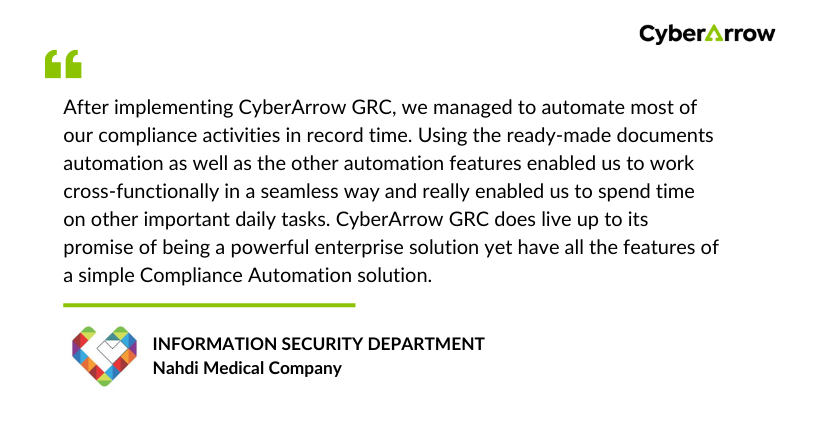
Read how CyberArrow GRC streamlined NIST compliance for Nahdi Medical Company.
See what Nahdi Medical Company has to say about CyberArrow GRC:
Final thoughts
NIST 800-171 is a critical cyber security standard for businesses working with the U.S. government. It protects Controlled Unclassified Information (CUI) and ensures that organizations follow strict security measures.
Non-compliance can lead to contract losses, security risks, and legal penalties. Implementing NIST 800-171 security controls is essential for business continuity and protecting sensitive data.
For businesses looking to simplify compliance and avoid manual work, CyberArrow GRC offers an automated solution. It streamlines security management, reduces risks, and ensures long-term compliance.
