ISO 22301 checklist : Implementation guide + free ISO 22301 checklist
Today, navigating disruptions has become essential for organizations of all sizes. Whether it’s a cyberattack, a natural disaster, or a global pandemic, businesses are constantly exposed to risks that threaten their operations. Without a robust strategy, recovery can be challenging or even impossible.
How prepared is your organization to continue operations during a crisis where disruptions are inevitable? How do you ensure business continuity?
A business continuity management system (BCMS) offers the framework to safeguard your business against unexpected disruptions. An effective BCMS ensures your business continues functioning during and after disruptions, and ISO 22301 is the international standard for business continuity. It helps organizations of any size prepare for, respond to, and recover from disruptions.
In this guide, we’ll walk you through the steps to implement ISO 22301 and provide a free ISO 22301 checklist to streamline your journey toward ISO 22301 certification.
What is ISO 22301?
ISO 22301 is the international standard for Business Continuity Management Systems (BCMS). It provides a comprehensive framework for organizations to manage disruptions and maintain essential operations during crises. It outlines best practices for identifying potential threats, assessing their impact, and implementing effective response strategies to ensure minimal downtime.
Key benefits of ISO 22301 compliance include the following:
- Operational resilience: Ensures that organizations can handle crises and continue operations without significant interruptions.
- Enhanced customer trust: Demonstrates a commitment to reliability and continuity, increasing trust from clients, partners, and stakeholders.
- Regulatory compliance: Helps organizations meet legal, regulatory, and contractual obligations related to business continuity.
- Risk mitigation: Reduces the impact of disruptive events by enabling proactive risk management and swift recovery.
- Competitive advantage: ISO 22301 certification can set an organization apart by showing its preparedness to handle unexpected challenges.
Why is ISO 22301 certification important?
Disruptions like pandemics, cyberattacks, and natural disasters are common today. These events can seriously impact a business without a plan, causing financial losses and damaging customer trust.
ISO 22301 certification helps organizations stay prepared by providing a clear framework for handling disruptions. It ensures businesses can continue essential operations during crises and recover quickly afterward. Regular testing and updates keep the organization ready for any challenge.
The certification also improves customer confidence, showing that a company is reliable even in tough situations. Additionally, it helps businesses meet regulatory requirements, ensuring they stay compliant while reducing risks.
Quick link: Your trusted partner for GRC automation in Asia-Pacific region
Step-by-step ISO 22301 implementation guide
Implementing ISO 22301 involves several key steps to ensure your Business Continuity Management System (BCMS) is effective and compliant. Here’s a straightforward guide to help you through the process:
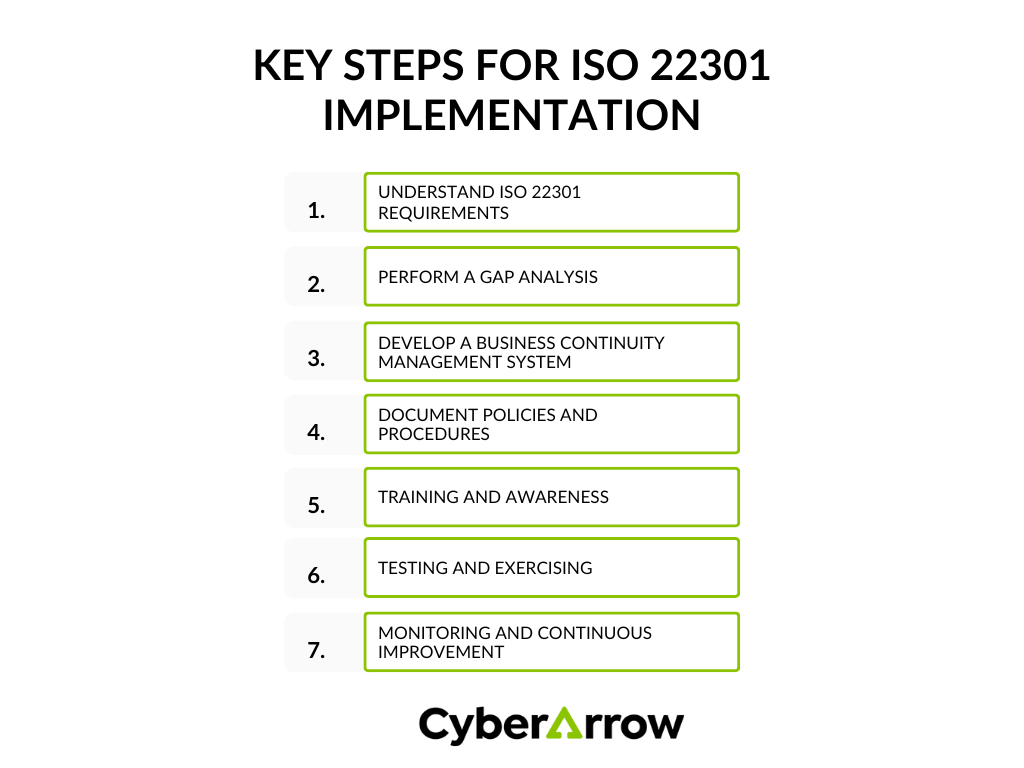
1. Understand ISO 22301 Requirements
Familiarize yourself with the ISO 22301 standard. Focus on the key clauses such as:
- Leadership: The role of top management in setting the direction and ensuring the BCMS is integrated into the organization’s processes.
- Planning: Requirements for identifying and assessing risks, setting objectives, and planning how to achieve them.
- Operation: Procedures for managing business continuity, including the implementation of strategies and response plans.
2. Perform a gap analysis
Conduct a detailed assessment of your current business continuity practices. Compare these with the ISO 22301 requirements to identify any gaps. This involves:
- Review existing policies: Evaluate your existing continuity plans and procedures.
- Assess capabilities: Determine if your current resources and processes meet the standard’s requirements.
3. Develop a business continuity management system (BCMS)
Based on the gap analysis, create or update your BCMS to address identified deficiencies. Key elements to focus on include:
- Risk assessments: Identify potential risks that could disrupt your operations and evaluate their impact.
- Business impact analysis (BIA): Determine which business functions are critical and the potential effects of disruptions.
- Business continuity strategies: Develop strategies to mitigate risks and ensure the continuation of critical functions.
4. Document policies and procedures
Develop comprehensive documentation that clearly outlines your BCMS policies and procedures. This should include:
- BCMS policy: A statement of the organization’s commitment to business continuity.
- Procedures: Detailed instructions on how to handle various types of disruptions, including emergency response and recovery plans.
- Roles and responsibilities: Define roles and responsibilities for key personnel involved in the BCMS.
5. Training and awareness
Implement training programs to ensure that employees understand the BCMS and their specific roles within it. This includes:
- Initial training: Educate staff on the BCMS policies, procedures, and their responsibilities.
- Ongoing training: Provide regular updates and refresher courses to inform everyone of any changes or improvements.
- Communication plans: Develop communication strategies to keep employees aware of the BCMS and any updates. This could include Regular updates through emails, meetings, or intranet and procedures for informing staff during a crisis.
6. Testing and exercising
Conduct regular tests and exercises to ensure the effectiveness of your BCMS. This involves:
- Tabletop exercises: Simulate scenarios to test response procedures and identify areas for improvement.
- Full-scale drills: Perform comprehensive drills that involve actual practice of emergency procedures.
- Review and analysis: Analyze the results of these tests to determine what worked well and what needs adjustment.
7. Monitoring and continuous improvement
Regularly monitor and review your BCMS to ensure it remains effective and up-to-date. Key activities include:
- Performance monitoring: Track the performance of your BCMS using key performance indicators (KPIs) and other metrics.
- Internal audits: Conduct regular internal audits to assess compliance with ISO 22301 and identify areas for improvement.
- Management reviews: Periodically review the BCMS with top management to evaluate its effectiveness and make necessary adjustments.
- Continuous improvement: Implement changes based on feedback, audit findings, and evolving risks to enhance the BCMS over time.
Quick link: Your trusted partner for GRC compliance in Latin America
Overcome ISO 22301 compliance challenges with CyberArrow
Maintaining ISO 22301 compliance can be daunting, especially when relying on manual processes. Organizations often face several challenges in managing compliance manually, including time-consuming manual processes.
Tracking progress and generating compliance reports can be cumbersome with manual processes. They often require manual data entry and consolidation from various sources, increasing the risk of inaccuracies and incomplete information.
CyberArrow offers a robust solution to these challenges, streamlining the compliance process and enhancing efficiency:
- Automated documentation and tracking: CyberArrow simplifies documentation by automating the creation and management of policies and procedures. This reduces the time and effort required to maintain compliance and ensures that all documents are consistently updated and accessible.
- Real-time monitoring and reporting: With CyberArrow, you can easily track your compliance status and generate detailed reports with just a few clicks. The platform provides real-time insights into your BCMS, helping you stay on top of any issues and ensure ongoing compliance.
To help you get started, CyberArrow offers a free ISO 22301 checklist. This checklist will guide you through the essential steps of implementing ISO 22301 and ensure you don’t miss any critical elements. Download your free ISO 22301 checklist here.
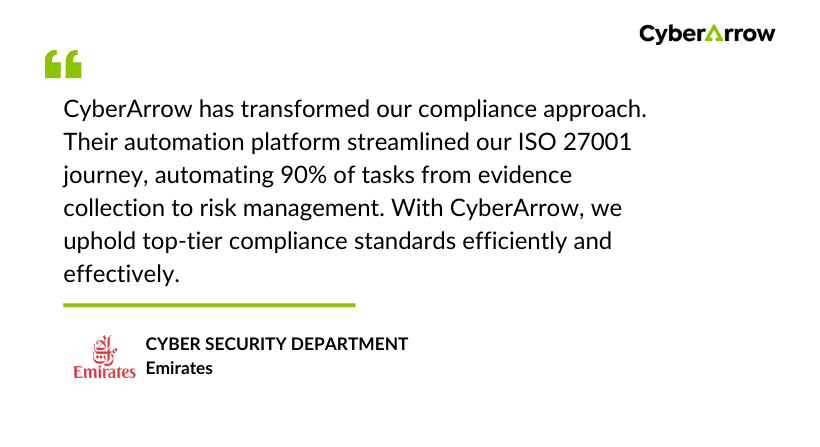
See what Emirates have to say about CyberArrow GRC: