


How to comply with Saudi Arabia’s Personal Data Protection Law (PDPL)?
The Personal Data Protection Law (PDPL) is a customer data protection law that seeks to protect the security and privacy of Saudi citizens’ personal and financial data. It is Saudi Arabia’s first data protection law passed by royal decree in September 2021, which came into effect on Sept 14, 2023.
The Saudi Data & Artificial Intelligence Authority (SDAIA) is the primary body chosen to implement and enforce PDPL, which will be enforced in Sept 2024. The National Data Management Office (NDMO) will operate as a supervisory body.

The implementing regulation given by SADIA for Saudi or UAE residents is an alarming indication that organizations should automate PDPL compliance.
This blog will walk you through who must comply with PDPL, what you need for PDPL compliance, and how to comply with PDPL step-by-step.
- Who Needs to Comply with Personal Data Protection Law in Saudi Arabia?
- How to Comply with Personal Data Protection Law?
- Key Requirements You Need to Know for Personal Data Protection Law
- 1. Understand the Personal Data Protection Regulation
- 2. Analyze the Impact of Current Data
- 3. Update the Data Security Policies and Processes
- 4. Implement a Data Protection Impact Assessment (DPIA)
- 5. Document Compliance Processes
- 6. Ensure Regular Monitoring & Continuous Improvement
- 7. Implement Cyber Security Technologies and Tools
- Automate PDPL Compliance with CyberArrow
- FAQs
Who needs to comply with Personal Data Protection Law in Saudi Arabia?
The Personal Data Protection Law (PDPL) applies to the following:
- Any entity processing the data of Saudi citizens must comply with the Personal Data Protection Law.
- It applies to both private and public organizations that come under the umbrella of Saudi citizen’s service providers.
- Any foreign organization that processes the personal data of Saudi nationals.
How to comply with Personal Data Protection Law?
Personal Data Protection Law compliance is a complex strategy to apply in an organization to secure customers’ sensitive data. However, you can prevent penalties with the correct understanding and automation of PDPL compliance.
But before we discuss the steps to comply with PDPL, let’s explore some key requirements for PDPL compliance.
Key requirements you need to know for Personal Data Protection Law
Preparation for Personal Data Protection Law is a necessary step for entities to perform before executing PDPL compliance. Following are some of the key requirements you need to know:
- Conduct a comprehensive audit of your organization’s collected data.
- Assess data processing operations held in the organization.
- Implement protection policies and procedures you need to take.
- Identify the data transfer outside the Kingdom.
- Appoint a Data Protection Officer to oversee the security of the organization.
- Train and raise awareness of PDPL among the employees within the organization.
For more information on getting prepared for PDPL compliance, visit our blog: Saudi Arabia PDPL compliance: How to get prepared.
Let’s dive in to explore measures to comply with Saudi Arabia’s PDPL.
1. Understand the Personal Data Protection Regulation
Understanding the law is crucial to ensure compliance. Personal Data Protection Law regulates the security and privacy of KSA’s customer data. It prevents the illegal and abusive use of customer data of Saudi registered organizations and international organizations that process data of Saudi citizens.
2. Analyze the impact of current data
First, collect and perform the audit to analyze any third-party involvement. Then, assist the data processing activities your organization carries out to collect the data of customers and the impact it has on the organization.
Analyze how the existing data impacts or supports the organization’s credibility and ensure that the data is sufficient for the effective production of goods and services for their customers. It will assist you in determining what type of data you require from your consumers under the regulations of PDPL compliance.
3. Update the data security policies and processes
Update your data security policies and processes following PDPL rules to avoid severe penalties or data breaches involving your consumers’ personal information. It will not only benefit you in the event of future data breaches but also increase the trust of potential consumers.
4. Implement a Data Protection Impact Assessment (DPIA)
Implement the Data Protection Impact Assessment (DPIA), which consists of documentation on the Privacy Impact Assessment, Questionnaire, and Vendor Assessment. The legal, compliance, IT, and privacy teams will be able to evaluate new technologies and partners in terms of the organization’s privacy duties and risks using these documents, which will also support third-party audits.
The core of the overall privacy policy will be these papers, which should be linked with other relevant rules and processes.
5. Document compliance processes
Document PDPL compliance processes, beginning with data auditing and progressing to data evaluation and staff training and ending with the appointment of a DPO.
Documentation also includes methods for obtaining consent, managing data subject rights, and reporting breaches to ensure compliance with PDPL rules. However, constant monitoring is required to safeguard your organization and customers against unpredictable cyber attacks.
6. Ensure regular monitoring & continuous improvement
Analyzing annual reports and fixing holes is a challenging effort. To avoid this, you should focus on regular monitoring, which functions as an alarm clock and alerts you about any odd activity. It will result in continuous improvement in the policies of an organization and reporting procedures to provide your consumers with a secure environment.
7. Implement cyber security technologies and tools
The adoption of manual compliance and GRC professionals is becoming obsolete as automation replaces human work with machine work. This ensures compliance in a short time while keeping you vigilant to cyber security threats. Leverage tools and technology to automate manual compliance processes and achieve regulatory compliance.
Automate PDPL (Personal Data Protection Law) compliance with CyberArrow
An organization that processes the data of Saudi citizens must adhere to PDPL compliance to retain the company’s integrity and reputation in the market. This also helps gain the trust of their customers so that they may believe in their data security.
Manual compliance is an old version. With businesses switching to automation for routine tasks, how could you rely on manual compliance processes for such a critical application? Automating your PDPL compliance is inexpensive, takes less time, and eliminates the need for professional assistance.
CyberArrow can help you improve your GRC journey by automating evidence monitoring and risk management. It is a solution that ensures your organization complies with all applicable legislation.
- You can receive quick alerts if you haven’t implemented or overlooked any compliance control.
- It allows for timely compliance automation following PDPL standards.
- You can also generate automated reports.
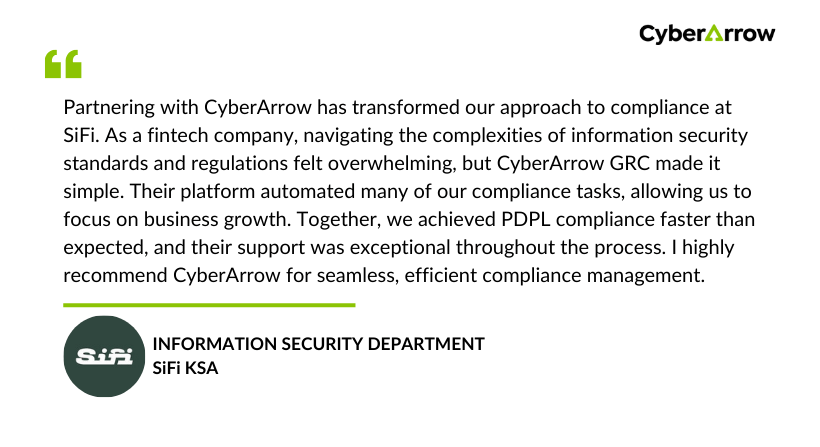
Read how SiFi automates PDPL compliance with CyberArrow GRC.
See what SiFi has to say about CyberArrow GRC:
FAQs
What is the personal data protection policy in Saudi Arabia?
PDPL Saudi Arabia came into being in 2021 and came into force in 2023 to protect the sensitive and personal data of Saudi citizens. The policy of Personal Data Protection Law in Saudi Arabia was:
- To address rising data privacy concerns
- To meet international data protection requirements.
What is the penalty for noncompliance with the Personal Data Protection Law in Saudi Arabia?
Publication of sensitive information can result in a two-year prison sentence or a fine of up to SAR three million, according to the Personal Data Protection Law (PDPL). A one-year prison sentence and a SAR one million fine are possible consequences for breaking data transmission rules.
The PDPL further mentions a warning letter and a fine of up to SAR 5,000,000 as additional penalties. Repeat offenders might be fined up to twice the maximum amount, although they would still be entitled to damages.
Is Saudi Arabia compliant with GDPR?
While Saudi Arabia is not GDPR compliant, it has developed a personal data protection law, which is the Kingdom’s first Data Protection Law. It aligns with international regulations, including the General Data Protection Regulation (GDPR).
