How to automate ISO 27001, SOC 2, PCI DSS certification?
Information security and compliance are critical concerns for businesses of all sizes. In this regard, ISO 27001, ISO 20000, SOC 2, and PCI DSS certifications have become necessary to secure data, each addressing specific facets of information security. ISO 27001 helps establish an Information Security Management System (ISMS), SOC 2 assesses service organizations’ controls, and PCI DSS aims to secure payment card data.
Achieving these certifications is proof of an organization’s commitment to robust cyber security and a prerequisite for engaging in secure business practices. However, the road to certification has complexities, from complex requirements to rigorous audits.
In this guide, we will explore the significance of ISO 27001, SOC 2, and PCI DSS certifications, shedding light on the challenges involved and providing insights into automating processes to streamline the certification process.
Understanding ISO 27001, SOC 2, and PCI DSS
ISO 27001, SOC 2, and PCI DSS are internationally recognized standards, each playing a crucial role in fortifying an organization’s information security posture.
ISO 27001
ISO 27001 sets the framework for establishing, implementing, maintaining, and continually improving an Information Security Management System (ISMS). This standard encompasses people, processes, and technology to ensure information confidentiality, integrity, and availability.
SOC 2
SOC 2, developed by the American Institute of CPAs (AICPA), focuses on service organizations and their systems. It evaluates the controls to secure sensitive data, emphasizing security, availability, processing integrity, confidentiality, and privacy.
PCI DSS
The Payment Card Industry Data Security Standard (PCI DSS) is tailored explicitly for entities that handle payment card information. PCI DSS outlines requirements to protect cardholder data, including encryption, access controls, and regular security assessments.
Importance of compliance
Compliance with these standards is not merely a checkbox exercise but a strategic business imperative. ISO 27001 ensures a systematic approach to managing sensitive information, fostering stakeholder trust.
SOC 2 certification assures clients of a service organization’s commitment to data security, promoting transparency and reliability. PCI DSS compliance is essential for any entity handling payment card information, reducing the risk of data breaches and safeguarding financial transactions.
Commonalities and differences
ISO 27001, SOC 2, and PCI DSS share a common focus on organizational and technical controls but exhibit variations in approach and scope.
- ISO 27001 emphasizes a risk-based approach, allowing organizations to tailor controls to their needs. It is a broad international information security management standard applicable to any organization.
- In contrast, SOC 2 concentrates on service provider’s security and privacy controls, evaluating their adherence to the five trust service categories. Its primary purpose is to assure users of a service provider’s controls.
- PCI DSS operates under a rule-based framework, specifying requirements for organizations handling credit and debit card data. Compliance with this standard is mandatory for organizations with varying obligations based on transaction volume.
Steps to automate ISO 27001, SOC 2, and PCI DSS

To automate the compliance process for ISO 27001, SOC 2, and PCI DSS, follow these steps:
1. Assessment and gap analysis
The journey to automate ISO 27001, SOC 2, and PCI DSS certifications begins with a thorough assessment and gap analysis. This involves identifying the current state of your organization’s information security practices, mapping existing processes to the stringent requirements of these certifications, and pinpointing gaps and areas for improvement. This crucial initial step lays the foundation for a targeted and efficient automation strategy.
2. Selection of automation tools
Choosing the right automation tools is necessary for a successful implementation. In this stage, diligent research is vital in identifying tools that align with the unique requirements of ISO 27001, SOC 2, and PCI DSS. Considerations include integration capabilities with existing systems, ease of use, and scalability.
One notable platform in this area is CyberArrow, offering a comprehensive suite of automation capabilities tailored to streamline the certification process.
3. Risk management automation
Risk management automation is necessary to mitigate risks proactively. CyberArrow stands out in its capability to automate risk management processes. Identifying and mitigating risks is an integral part of the certification journey. With CyberArrow, organizations can automate risk assessments, ensuring a proactive approach to cyber security.
This feature enhances the efficiency of risk management and contributes to the overall resilience of the information security framework.
4. Compliance monitoring and reporting
Maintaining ISO 27001, SOC 2, and PCI DSS certifications requires efficient compliance monitoring and reporting.
CyberArrow offers automated evidence monitoring and reporting, providing real-time insights into compliance status. Automated reporting saves time and resources and ensures accuracy and consistency in meeting the stringent reporting requirements of these certifications.
5. Employee training and awareness
An often overlooked but critical aspect of certification is the continuous training and awareness of employees. CyberArrow addresses this need with its cyber security awareness training modules.
Employee awareness training ensures that the workforce remains well-informed about the evolving threat scenery, reinforcing the human element as a strong line of defense.
By incorporating these steps, organizations can significantly streamline the certification process, enhance overall security posture, and navigate the complexities of ISO 27001, SOC 2, and PCI DSS efficiently and confidently.
Case study: Automating certification for ISO 27001, SOC 2, and PCI DSS
A leading technology firm sought to fortify its information security measures and obtain ISO 27001, SOC 2, and PCI DSS certifications. Strategically partnering with CyberArrow, the company aimed to leverage automation for a seamless and efficient certification process.
Automation implementation
Recognizing the complex demands of ISO 27001, SOC 2, and PCI DSS certifications, the technology firm embraced CyberArrow’s automation platform. This involved a comprehensive assessment, gap analysis, and the integration of the automation tool tailored to each certification’s unique requirements.
Challenges addressed
- Manual complexity: The firm faced challenges with manual compliance processes, leading to complexities and potential errors in meeting certification requirements.
- Diverse certification landscapes: Complying with standards such as ISO 27001, SOC 2, and PCI DSS presented distinct challenges.
- Resource efficiency: Manual compliance tasks were resource-intensive, diverting focus from strategic initiatives. Automation aimed to optimize resource utilization.
Outcomes
- Streamlined certification processes: The adoption of CyberArrow significantly streamlined the certification procedures for ISO 27001, SOC 2, and PCI DSS. Manual efforts were reduced, expediting the overall process.
- Precision in compliance: Automation ensured heightened accuracy in adhering to the intricate requirements of each certification. The platform’s capabilities aligned seamlessly with the diverse needs of ISO 27001, SOC 2, and PCI DSS.
- Strategic resource allocation: The technology firm liberated valuable human resources by automating compliance tasks. This allowed teams to concentrate on strategic initiatives, enhancing the overall resilience of the information security framework.
This case study highlights the transformative power of automation in achieving and maintaining ISO 27001, SOC 2, and PCI DSS certifications.
Want to get compliant? Learn how your organization can follow suit with CyberArrow – schedule a free demo today!
FAQs
How do you automate security compliance?
Automation of security compliance involves several key steps. First, conduct a thorough assessment and gap analysis of existing processes. Next, select suitable automation tools with integration capabilities. Tools like CyberArrow offer features for risk management automation, compliance monitoring, and reporting. Additionally, automate employee training and awareness to strengthen the human element in security.
Is SOC 2 equivalent to ISO 27001?
No, SOC 2 and ISO 27001 are distinct standards. SOC 2, developed by AICPA, focuses on controls related to service organizations and their systems. ISO 27001, on the other hand, establishes an Information Security Management System (ISMS) that is broader and applicable to any organization. While both address information security, they have different scopes and requirements.
Does ISO 27001 cover PCI DSS?
While ISO 27001 and PCI DSS share common goals in enhancing information security, they are not equivalent, and ISO 27001 does not explicitly cover PCI DSS. ISO 27001 focuses on establishing and maintaining an ISMS for overall information security, while PCI DSS is tailored explicitly for entities handling payment card information.
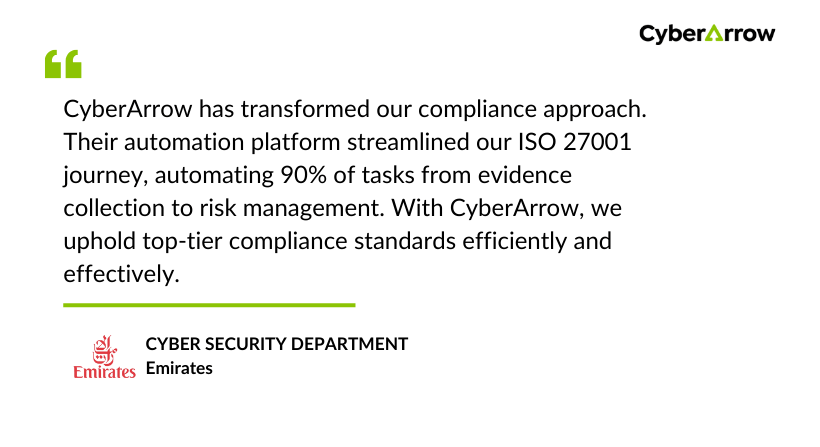
See what global brands like Emirates are saying about CyberArrow GRC: