


A complete guide to ISO 27019: Requirements & implementation for energy sector cyber security
Energy systems like power grids, wind farms, and oil pipelines rely heavily on technology. That makes them a big target for cyberattacks. To keep these systems secure, companies in the energy sector need a clear set of rules and best practices. That’s exactly what ISO 27019 provides.
This guide will help you understand what ISO 27019 is, why it matters, and how your organization can implement it easily. We’ll also show how CyberArrow GRC helps automate ISO 27019 compliance and connects it with other major frameworks like ISO 27001, NIST, and ISO 38500 using a cross-mapping feature that saves time and reduces confusion.
- What is ISO 27019?
- Why ISO 27019 is important
- Who should use ISO 27019?
- How ISO 27019 works
- Key requirements of ISO 27019
- Benefits of implementing ISO 27019
- ISO 27019 vs ISO 27001
- How to implement ISO 27019: Step-by-step
- How CyberArrow GRC makes ISO 27019 compliance easy
- Real-life use case: Power grid operator
- Final thoughts
What is ISO 27019?
ISO 27019 is an international standard that provides security guidelines for control systems in the energy sector. It builds on ISO 27001, which is the general standard for information security, but adds special rules for energy systems like:
- Power generation plants.
- Electricity grids.
- Oil and gas systems.
- Renewable energy sources.
- Smart meters and smart grids.
ISO 27019 helps protect these systems from cyber threats like hacking, malware, and system failure.
Why ISO 27019 is important
The energy sector runs on industrial control systems (ICS) and operational technology (OT). These are different from normal IT systems. They control machines, pipelines, switches, and more. If these systems fail or get attacked, the impact can be massive not just for one company, but for entire cities or countries.
ISO 27019 helps by:
- Reducing cyber risks.
- Improving resilience.
- Protecting people, equipment, and the environment.
- Ensuring reliable energy supply.
- Meeting government and regulatory demands.
With the rise of smart grids and IoT devices, energy companies need to be more careful than ever.
Who should use ISO 27019?
ISO 27019 is made for companies that work with energy control systems. This includes:
- Power generation companies.
- Energy distribution operators.
- Oil and gas refineries.
- Smart meter vendors.
- Renewable energy providers.
- Government energy departments.
- Third-party vendors handling energy data.
If your organization uses technology to control energy, this standard is for you.
How ISO 27019 works
ISO 27019 is based on ISO 27001, so if you’re already following that, you’re off to a good start. But ISO 27019 goes further. It gives sector-specific controls that match how energy systems work.
Core topics covered:
- Access control for control rooms and ICS.
- Monitoring and logging energy systems.
- Incident response for OT and SCADA networks.
- Secure communication between devices and systems.
- Physical security of critical energy equipment.
- System hardening for legacy devices.
ISO 27019 doesn’t replace ISO 27001 it extends it. Think of it as an extra layer made just for the energy sector.
Key requirements of ISO 27019
Here’s a simple breakdown of what organizations need to do:
1. Risk assessment
Identify risks that could affect your energy control systems and create a plan to reduce them.
2. Control system protection
Make sure ICS, SCADA, and other OT tools are protected from physical and digital threats.
3. Access controls
Limit who can enter control rooms, use SCADA systems, or access energy networks.
4. Monitoring and logging
Track and log everything that happens in your OT systems. This helps detect and investigate attacks quickly.
5. Incident response
Have a clear plan for what to do when something goes wrong. Who should act, and what steps should they take?
6. Maintenance and patching
Update your systems regularly, even if they’re old or not connected to the internet.
Quick link: A complete guide to ISO 38500
Benefits of implementing ISO 27019
Energy companies that follow ISO 27019 enjoy many advantages:
- Stronger protection against cyberattacks.
- Improved reliability of energy supply.
- Better compliance with national and global laws.
- Increased trust from partners and customers.
- A clear structure for managing cyber security.
ISO 27019 vs ISO 27001
Let’s compare them quickly:
| Feature | ISO 27001 | ISO 27019 |
| Focus area | General IT security | Energy sector control systems |
| Who uses it? | All industries | Energy, utilities, oil & gas |
| Covers OT/ICS? | No | Yes |
| Physical infrastructure | Light focus | Strong focus |
If you’re in the energy sector, ISO 27001 gives you the base, and ISO 27019 gives you the details.
How to implement ISO 27019: Step-by-step
Here’s a simple roadmap to get started:
Step 1: Understand the scope
List all your control systems, smart devices, and communication networks involved in energy generation or delivery.
Step 2: Perform a risk assessment
Identify threats, gaps, and weaknesses in your current system.
Step 3: Map controls
Match ISO 27019 controls to your operations. Use cross-mapping tools (like those in CyberArrow GRC) to connect ISO 27019 with ISO 27001 and NIST.
Step 4: Create policies and procedures
Write clear rules for access, monitoring, incident response, and system maintenance.
Step 5: Train employees
Make sure your staff understands how to follow security rules, especially those handling control systems.
Step 6: Monitor and improve
Use monitoring tools to track changes, check logs, and improve your system over time.
How CyberArrow GRC makes ISO 27019 compliance easy
Manual compliance takes time. There are tons of rules to follow, checklists to complete, and policies to update.
Here’s how CyberArrow GRC helps:
Automates ISO 27019 tasks: No more spreadsheets. CyberArrow automatically tracks tasks, reminders, and controls across all systems.
Smart cross-mapping: CyberArrow links ISO 27019 to ISO 27001, ISO 38500, and NIST helping you avoid duplication and saving time.
Real-time monitoring: Stay on top of compliance with dashboards, alerts, and built-in audit tracking.
Easy reporting: Generate reports for regulators, auditors, or your board with just a few clicks.
Built-in policy templates: Start fast with ready-made templates for the energy sector, then customize as needed.
Real-life use case: Power grid operator
A national power grid company used CyberArrow GRC to implement ISO 27019. Here’s what happened:
- They reduced compliance time by 40%.
- Linked ISO 27019 controls to existing ISO 27001 systems.
- Created policies for remote monitoring and physical access.
- Passed a government audit with zero findings.
CyberArrow gave them the tools to move fast and stay secure.
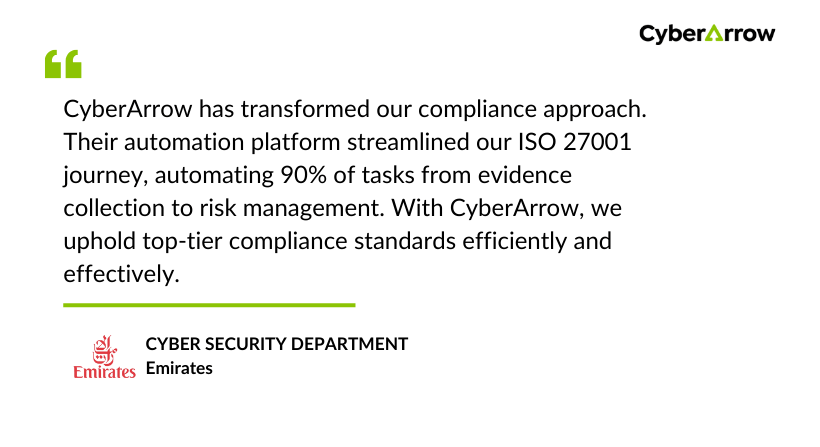
Read how Emirates enhanced Information Security by automating ISO 27001 with CyberArrow GRC.
See what Emirates has to say about CyberArrow GRC:
Final thoughts
If your business works in energy, electricity, oil, or gas, ISO 27019 is a must. It gives you the roadmap to secure your systems, protect your people, and stay compliant with global standards.
And with CyberArrow GRC, you don’t have to do it all manually. From automation to cross-mapping and monitoring, everything becomes easier, faster, and safer.
