


What is a business continuity management system (BCMS)?
In today’s world, businesses face unexpected disruptions such as cyberattacks, IT failures, supply chain disruptions, natural disasters, and pandemics. These incidents can lead to financial losses, reputational damage, and regulatory penalties if businesses are not prepared.
This is where a business continuity management system (BCMS) becomes essential. A BCMS is a structured framework that helps organizations prepare for, respond to, and recover from disruptions. It ensures that critical business functions continue to operate even during a crisis.
In this guide, we will explore what a BCMS is and why it is important, key components of an effective BCMS, International BCMS standards and frameworks such as ISO 22301, and how CyberArrow GRC automates BCMS compliance.
What is a business continuity management system (BCMS)?
A business continuity management system (BCMS) is a set of policies, procedures, and tools that ensure businesses can operate during and after disruptions. It focuses on risk management, emergency preparedness, and disaster recovery.
A BCMS is not just about responding to incidents, it involves identifying risks, planning recovery strategies, testing plans, and continuously improving resilience measures.
Why is BCMS important?
A strong BCMS helps organizations:
- Minimize operational downtime during crises.
- Protect revenue and avoid financial losses.
- Ensure regulatory compliance with industry standards.
- Reduce reputational damage from service disruptions.
- Increase customer trust and stakeholder confidence.
Without a BCMS, businesses struggle to recover quickly, leading to higher financial losses and legal consequences.
Key components of a business continuity management system (BCMS)
A BCMS framework consists of several critical elements that ensure organizations remain operational even during disruptions.
1. Risk assessment and business impact analysis (BIA)
Organizations must first identify potential threats and analyze their impact on critical business functions. A business impact analysis (BIA) helps:
- Determine the financial and operational impact of disruptions.
- Prioritize mission-critical processes.
- Identify dependencies on third-party vendors, IT systems, and key employees.
2. Business continuity strategy development
Once risks are identified, organizations must create strategies to continue operations. This includes:
- Establishing alternative work locations.
- Setting up backup IT infrastructure.
- Creating contingency plans for suppliers.
3. Business continuity plan (BCP) implementation
A business continuity plan (BCP) outlines step-by-step procedures to follow during a crisis. It includes:
- Emergency response actions to protect employees.
- Communication protocols to inform stakeholders.
- Backup and data recovery strategies.
4. Regular testing and training
A BCMS must be tested regularly to ensure it is effective and up to date. This involves:
- Simulated crisis drills.
- Tabletop exercises for key employees.
- Evaluating plan effectiveness and making necessary improvements.
5. Continuous monitoring and improvement
A BCMS should not remain static. Businesses must:
- Regularly update business continuity plans based on new threats.
- Monitor compliance with regulatory standards.
- Refine recovery strategies based on past incidents.
Business continuity standards and frameworks
To implement an effective BCMS, organizations should follow recognized international standards that provide guidelines for business continuity.
1. ISO 22301: The global standard for BCMS
ISO 22301 is the leading international standard for business continuity management. It provides a structured framework for risk management, business continuity planning, and disaster recovery.
Companies that achieve ISO 22301 certification demonstrate operational resilience and compliance with global best practices.
2. NIST SP 800-34: IT contingency planning
Developed by the National Institute of Standards and Technology (NIST), this standard focuses on business continuity for IT systems. It helps organizations develop:
- IT disaster recovery plans.
- Incident response strategies.
- Cyber resilience measures.
3. FFIEC business continuity guidelines
The Federal Financial Institutions Examination Council (FFIEC) provides BCMS guidelines for financial institutions. These ensure banks and financial firms can continue critical operations even during disruptions.
4. ITIL (Information Technology Infrastructure Library)
ITIL focuses on business continuity in IT service management. It helps businesses align IT continuity planning with business strategies.
Challenges in business continuity management
Implementing and maintaining a BCMS comes with several challenges, including:
- Complexity in managing multiple regulatory requirements.
- Difficulty in keeping BCMS updated with evolving threats.
- Lack of automation in risk assessment and compliance tracking.
- High cost of manual business continuity planning.
How CyberArrow GRC automates BCMS compliance
Managing BCMS compliance manually can be time-consuming, costly, and prone to errors. CyberArrow GRC provides an automated solution to simplify business continuity planning, risk assessments, and compliance management.
1. Cross-standard compliance mapping
CyberArrow GRC helps organizations comply with multiple BCMS standards at once. It maps ISO 22301, NIST, FFIEC, and other frameworks, allowing businesses to reduce redundant compliance efforts.
2. Automated risk management
CyberArrow’s Enterprise Risk Management (ERM) module identifies, assesses, and mitigates risks automatically. This ensures businesses stay ahead of potential threats.
3. Continuous compliance monitoring
CyberArrow GRC provides real-time monitoring of BCMS compliance. Businesses receive alerts on compliance gaps, ensuring they remain audit-ready.
4. Pre-approved templates for business continuity planning
CyberArrow GRC includes pre-approved templates for BCMS documentation, making it easier to develop:
- Business continuity plans.
- Risk assessment reports.
- Incident response procedures.
5. Centralized reporting for audits
CyberArrow GRC simplifies regulatory audits by generating compliance reports automatically. Businesses can track their BCMS compliance status in real-time.
Conclusion
A business continuity management system (BCMS) is crucial for ensuring that organizations can respond to, recover from, and continue operations during disruptions. Frameworks like ISO 22301, NIST SP 800-34, and FFIEC guidelines help businesses establish resilient continuity plans.
However, manual BCMS compliance is complex and time-consuming. CyberArrow GRC simplifies BCMS compliance by providing:
- Automated risk management.
- Cross-standard compliance mapping.
- Real-time compliance monitoring.
- Pre-approved business continuity templates.
- Centralized reporting for audits.
Read how Areeba automates ISO 27001 and ISO 22301 with CyberArrow GRC.
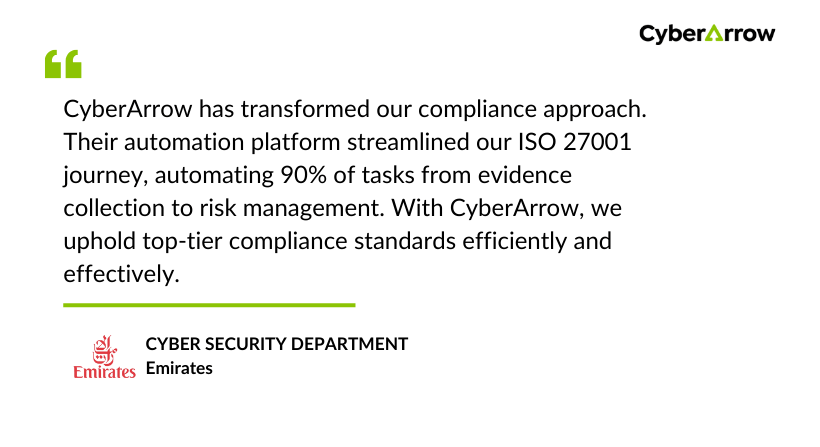
See what global brands like Emirates has to say about CyberArrow GRC:
FAQs
What is the purpose of a business continuity management system (BCMS)?
A business continuity management system (BCMS) helps organizations prepare for, respond to, and recover from unexpected disruptions such as cyberattacks, natural disasters, or IT failures. It ensures that critical business functions continue operating, minimizing financial losses and maintaining compliance with regulatory standards.
What are the key standards for business continuity management?
Some of the most recognized BCMS standards include ISO 22301, which is the global standard for business continuity management, NIST SP 800-34, which provides IT contingency planning guidelines for federal agencies, FFIEC Guidelines, which focus on business continuity for financial institutions, and the ITIL Framework, which outlines best practices for IT service continuity management.
How does CyberArrow GRC help with BCMS compliance?
CyberArrow GRC automates BCMS compliance by providing cross-standard compliance mapping for frameworks like ISO 22301 and NIST. It offers automated risk assessments to identify potential disruptions, real-time compliance monitoring to track regulatory adherence, and pre-approved templates for business continuity planning and audits. This simplifies compliance management and reduces the manual effort required for maintaining a robust BCMS.
