


Top ISO 27001 risks for cloud systems and how to treat them
Cloud systems are now a core part of modern business. Organizations use cloud platforms to store data, run applications, and support daily operations. While cloud services offer flexibility and scale, they also introduce new security risks.
ISO 27001 requires organizations to identify, assess, and treat risks related to information security. For cloud environments, this process is especially important because data, systems, and access are often shared across many services and users.
This guide explains the most common ISO 27001 risks for cloud systems, why they matter, and how organizations can treat them in a practical and structured way.
- Why cloud risks matter under ISO 27001
- Understanding ISO 27001 risk treatment for cloud systems
- Top ISO 27001 risks for cloud systems
- Risk 1: Cloud misconfiguration
- Risk 2: Weak identity and access management
- Risk 3: Lack of visibility and logging
- Risk 4: Data breach or data leakage
- Risk 5: Insecure APIs and integrations
- Risk 6: Shared responsibility confusion
- Risk 7: Third-party and vendor risk
- Risk 8: Data residency and legal risks
- Risk 9: Weak backup and recovery
- Risk 10: Lack of cloud security skills
- How to prioritize ISO 27001 risks in cloud environments
- Common audit findings related to cloud risks
- How CyberArrow GRC helps manage ISO 27001 cloud risks
- Conclusion
- FAQs
Why cloud risks matter under ISO 27001
ISO 27001 focuses on protecting the confidentiality, integrity, and availability of information. Cloud environments directly impact all three areas.
Cloud risks matter because:
- Data is stored outside traditional networks.
- Access is often remote.
- Shared responsibility models can cause confusion.
- Misconfigurations are common.
- Third-party dependencies increase.
ISO 27001 requires organizations to understand these risks and apply appropriate controls.
Understanding ISO 27001 risk treatment for cloud systems
ISO 27001 does not tell organizations to avoid the cloud. Instead, it requires a risk based approach.
Organizations must:
- Identify cloud-related risks.
- Assess likelihood and impact.
- Select risk treatment options.
- Implement appropriate controls.
- Monitor effectiveness.
Cloud risks must be treated like any other information security risk.
Top ISO 27001 risks for cloud systems
Below are the most common cloud risks seen during ISO 27001 audits.
Risk 1: Cloud misconfiguration
Why does this risk exist?
Cloud platforms offer many configuration options. A small mistake can expose systems or data.
Common examples include:
- Public storage buckets.
- Open network ports.
- Weak firewall rules.
- Disabled logging.
Misconfigurations are one of the leading causes of cloud breaches.
How to treat this risk?
Organizations can treat this risk by:
- Defining secure configuration standards.
- Using access control policies.
- Reviewing cloud settings regularly.
- Enabling monitoring and alerts.
- Training teams on cloud security basics.
ISO 27001 Annex A controls related to operations security and access control support this treatment.
Risk 2: Weak identity and access management
Why does this risk exist?
Cloud systems rely heavily on identity and access controls. Poor access management increases the risk of unauthorized access.
Common issues include:
- Shared accounts.
- Excessive permissions.
- Lack of access reviews.
- Missing multi-factor authentication.
How to treat this risk?
Risk treatment actions include:
- Applying least privilege access.
- Using role-based permissions.
- Enabling multi-factor authentication.
- Performing regular access reviews.
- Removing access when roles change.
These controls support ISO 27001 access control requirements.
Risk 3: Lack of visibility and logging
Why does this risk exist?
Without proper logging, organizations cannot detect or investigate security incidents.
Cloud risks increase when:
- Logs are not enabled.
- Logs are not reviewed.
- Log retention is too short.
How to treat this risk?
Organizations should:
- Enable logging across cloud services.
- Centralize log storage.
- Define log review procedures.
- Set retention periods based on risk.
- Monitor alerts regularly.
Logging supports incident management and monitoring controls under ISO 27001.
Risk 4: Data breach or data leakage
Why does this risk exist?
Cloud systems often store sensitive data such as customer records, financial data, or intellectual property.
Risks increase due to:
- Poor access controls.
- Insecure data sharing.
- Weak encryption.
- Human error.
How to treat this risk?
Effective treatment includes:
- Encrypting data at rest.
- Encrypting data in transit.
- Classifying data properly.
- Restricting data access.
- Monitoring data usage.
ISO 27001 cryptography and data protection controls support this risk.
Risk 5: Insecure APIs and integrations
Why does this risk exist?
Cloud systems rely on APIs to connect services. Insecure APIs can be abused by attackers.
Common problems include:
- Missing authentication.
- Weak authorization checks.
- Lack of monitoring.
How to treat this risk?
Organizations can reduce this risk by:
- Securing API authentication.
- Limiting API access.
- Monitoring API usage.
- Testing APIs regularly.
Secure development and operations controls help address this risk.
Risk 6: Shared responsibility confusion
Why does this risk exist?
Cloud providers and customers share security responsibilities. Misunderstanding this model leads to gaps.
Organizations may assume:
- The provider handles all security.
- Controls are automatic.
- Compliance is guaranteed.
This is rarely true.
How to treat this risk?
Treatment actions include:
- Understanding provider responsibilities.
- Documenting customer responsibilities.
- Defining cloud security roles.
- Mapping controls clearly.
Clear documentation supports ISO 27001 governance requirements.
Risk 7: Third-party and vendor risk
Why does this risk exist?
Cloud services depend on multiple third parties.
Risks include:
- Vendor outages.
- Security weaknesses.
- Limited visibility into vendor controls.
How to treat this risk?
Organizations should:
- Perform vendor risk assessments.
- Review cloud provider certifications.
- Define security requirements in contracts.
- Monitor vendor performance.
ISO 27001 supplier relationship controls support this.
Risk 8: Data residency and legal risks
Why does this risk exist?
Cloud data may be stored in different regions. This can create legal and compliance risks.
Issues include:
- Data stored outside approved regions.
- Conflict with local regulations.
- Lack of data location visibility.
How to treat this risk?
Risk treatment includes:
- Selecting approved data regions.
- Documenting data locations.
- Reviewing legal requirements.
- Monitoring changes in storage locations.
Compliance controls help manage this risk.
Risk 9: Weak backup and recovery
Why does this risk exist?
Cloud systems can fail due to outages, attacks, or mistakes.
Risks increase when:
- Backups are not tested.
- Backup scope is incomplete.
- Recovery plans are unclear.
How to treat this risk?
Organizations should:
- Define backup policies.
- Test recovery regularly.
- Monitor backup success.
- Protect backup data.
Business continuity controls under ISO 27001 address this risk.
Risk 10: Lack of cloud security skills
Why does this risk exist?
Cloud security requires specific knowledge. Skills gaps increase risk.
Common issues include:
- Poor configuration decisions.
- Missed security alerts.
- Slow incident response.
How to treat this risk?
Treatment options include:
- Training technical teams.
- Defining clear procedures.
- Using automation where possible.
- Seeking expert guidance.
Competence and awareness controls support this treatment.
How to prioritize ISO 27001 risks in cloud environments
Not all risks have the same impact. Organizations should:
- Rank risks by likelihood and impact.
- Focus on high-risk areas first.
- Review risks regularly.
- Update treatment plans.
Risk prioritization ensures efficient use of resources.
Common audit findings related to cloud risks
Auditors often identify:
- Missing access reviews.
- Weak logging practices.
- Unclear shared responsibility.
- Incomplete risk assessments.
- Poor evidence management.
Addressing these early issues improves audit outcomes.
Why manual risk management is not enough
Manual cloud risk management leads to:
- Outdated risk registers.
- Missed control gaps.
- Poor visibility.
- Audit stress.
Cloud environments change too fast for spreadsheets.
How CyberArrow GRC helps manage ISO 27001 cloud risks
CyberArrow GRC helps organizations manage ISO 27001 risks for cloud systems in a structured and automated way.
CyberArrow GRC supports:
- Centralized cloud risk registers.
- Risk assessment workflows.
- Control mapping to ISO 27001.
- Evidence tracking.
- Policy management.
- Real-time risk visibility.
Automation helps teams keep up with cloud changes.
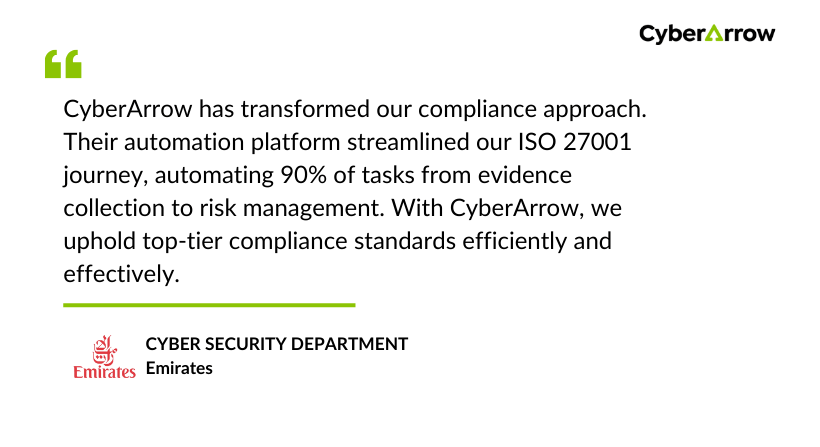
Read how Emirates enhanced Information Security by automating ISO 27001 with CyberArrow.
See what Emirates has to say about CyberArrow GRC:
Conclusion
Cloud systems bring many benefits, but they also introduce serious information security risks. ISO 27001 requires organizations to identify these risks and treat them properly.
By understanding common cloud risks and applying practical controls, organizations can protect data, reduce incidents, and pass ISO 27001 audits with confidence.
Managing cloud risks manually is difficult and error-prone. CyberArrow GRC provides a centralized platform to manage ISO 27001 risks, controls, and evidence efficiently.
For organizations running cloud systems, CyberArrow GRC is the right solution to strengthen security and maintain ISO 27001 compliance over time.
FAQs
What are the ISO 27001 risks in cloud environments?
ISO 27001 risks in cloud environments are security threats that can affect data confidentiality, integrity, or availability. These include misconfigurations, weak access controls, data leakage, and third-party risks.
Does ISO 27001 allow organizations to use cloud services?
Yes. ISO 27001 allows the use of cloud services. Organizations must identify cloud-related risks and apply appropriate controls to manage those risks effectively.
Who is responsible for security in cloud environments under ISO 27001?
Security responsibility is shared between the cloud service provider and the organization. Providers secure the infrastructure, while organizations are responsible for configuring services, managing access, and protecting their data.
How often should cloud risks be reviewed for ISO 27001?
Cloud risks should be reviewed regularly and whenever there are major changes to systems, services, or business processes. Regular reviews help keep risk assessments accurate and effective.
How can organizations manage cloud risks more efficiently for ISO 27001?
Organizations can manage cloud risks more efficiently by using a centralized GRC platform. CyberArrow GRC helps track cloud risks, map controls, manage evidence, and maintain audit readiness.
