

ISO 27001 stage 2 audit checklist: A detailed guide
ISO 27001 certification is a major achievement for any organization. It proves that information security is not only documented but also working in practice. The final and most important step in this journey is the ISO 27001 stage 2 audit.
Many organizations pass stage 1 but struggle during stage 2 because they are not prepared for real-world testing. Stage 2 focuses on evidence, implementation, and effectiveness. Auditors want proof that controls are active, risks are managed, and security processes are followed daily.
This guide explains what the ISO 27001 stage 2 audit is, what auditors check, and provides a detailed checklist to help organizations prepare properly.
- What is the ISO 27001 stage 2 audit
- Why the stage 2 audit is critical
- What auditors focus on in stage 2
- ISO 27001 stage 2 audit checklist
- ISMS scope and context checklist
- Leadership and governance checklist
- Risk assessment and risk treatment checklist
- Statement of applicability checklist
- Information security policies and procedures checklist
- Access control implementation checklist
- Asset management checklist
- Cryptography and data protection checklist
- Operations security checklist
- Incident management checklist
- Business continuity and disaster recovery checklist
- Supplier and third-party security checklist
- Security awareness and training checklist
- Internal audit checklist
- Management review checklist
- Corrective actions and improvement checklist
- Common ISO 27001 stage 2 audit findings
- How to prepare for the stage 2 audit
- Why manual preparation fails
- How CyberArrow GRC helps with ISO 27001 stage 2 audits
- Conclusion
- FAQs
What is the ISO 27001 stage 2 audit
The ISO 27001 stage 2 audit is the final certification audit. It verifies that the Information Security Management System is fully implemented and operating as designed.
During stage 2, auditors:
- Test implemented controls.
- Review real evidence.
- Interview employees.
- Verify risk treatment actions.
- Confirm continuous improvement.
Unlike stage 1, this audit goes deep into operations.
Why the stage 2 audit is critical
The stage 2 audit determines whether certification is granted.
It is critical because:
- Controls are tested in real scenarios.
- Gaps result in non-conformities.
- Certification depends on audit results.
- Evidence must be complete and current.
Good preparation reduces audit findings and delays.
What auditors focus on in stage 2
Auditors focus on three main areas:
- Implementation of ISO 27001 clauses.
- Effectiveness of Annex A controls.
- Evidence of ongoing operation.
Auditors expect consistency between documentation and practice.
ISO 27001 stage 2 audit checklist
The checklist below covers key audit areas and explains what auditors expect to see.
ISMS scope and context checklist
Auditors will confirm that the ISMS scope matches reality.
They will check:
- Scope matches actual systems and locations.
- No undocumented exclusions.
- Business context remains valid.
- Interested parties identified.
Any mismatch can raise concerns.
Leadership and governance checklist
Leadership involvement must be visible.
Auditors will check:
- Approved information security policy.
- Leadership awareness of ISMS.
- Defined roles and responsibilities.
- Evidence of leadership support.
Security must be supported from the top.
Risk assessment and risk treatment checklist
Risk management is central to ISO 27001.
Auditors will check:
- Completed risk assessments.
- Risks aligned with scope.
- Risk ratings applied consistently.
- Risk owners assigned.
- Risk treatment actions completed.
Risk assessments must be recent and relevant.
Statement of applicability checklist
The Statement of Applicability is closely reviewed.
Auditors will check:
- All Annex A controls listed.
- Applicability clearly marked.
- Justifications for exclusions.
- Controls implemented as stated.
Inconsistencies are common audit findings.
Information security policies and procedures checklist
Policies must be active, not just written.
Auditors will check:
- Policies approved and current.
- Policies communicated to staff.
- Procedures followed in practice.
- Document control in place.
Outdated policies raise red flags.
Access control implementation checklist
Access control is often tested in detail.
Auditors will check:
- User access lists.
- Role-based permissions.
- Access approval records.
- Access review evidence.
- Joiner and leaver processes.
Unauthorized access is a serious issue.
Asset management checklist
Organizations must manage information assets.
Auditors will check:
- Asset inventory.
- Asset owners assigned.
- Data classification applied.
- Protection measures in place.
Missing assets indicate weak control.
Cryptography and data protection checklist
Data protection must be enforced.
Auditors will check:
- Encryption for data at rest.
- Encryption for data in transit.
- Key management practices.
- Backup encryption.
These controls protect sensitive data.
Operations security checklist
Operations security shows daily discipline.
Auditors will check:
- Logging and monitoring records.
- Patch management evidence.
- Malware protection reports.
- Vulnerability management actions.
Logs must show regular review.
Incident management checklist
Incident response must be operational.
Auditors will check:
- Incident response plan.
- Incident records.
- Response timelines.
- Lessons learned documentation.
Even minor incidents must be recorded.
Business continuity and disaster recovery checklist
Availability is part of security.
Auditors will check:
- Business continuity plans.
- Backup records.
- Recovery testing evidence.
- Defined recovery objectives.
Plans must be tested, not theoretical.
Supplier and third-party security checklist
Third-party risks are closely reviewed.
Auditors will check:
- Supplier risk assessments.
- Security requirements in contracts.
- Monitoring of suppliers.
- Evidence of reviews.
Unmanaged suppliers create risk.
Security awareness and training checklist
Employees play a key role.
Auditors will check:
- Training plans.
- Training attendance records.
- Awareness activities.
- Role-specific training.
Staff interviews often confirm this.
Internal audit checklist
Internal audits must be completed.
Auditors will check:
- Internal audit reports.
- Identified non-conformities.
- Corrective actions.
- Follow-up records.
Internal audits prove self-assessment.
Management review checklist
Management review must be real and effective.
Auditors will check:
- Management review minutes.
- Inputs and outputs.
- Decisions made.
- Actions tracked.
Reviews must include security performance.
Corrective actions and improvement checklist
Improvement is mandatory.
Auditors will check:
- Non-conformity records.
- Root cause analysis.
- Corrective actions taken.
- Evidence of improvement.
Repeated issues weaken confidence.
Common ISO 27001 stage 2 audit findings
Organizations often fail due to:
- Incomplete risk treatment.
- Weak access reviews.
- Missing evidence.
- Controls not followed in practice.
- Poor internal audits.
Preparation prevents these issues.
How to prepare for the stage 2 audit
Organizations should:
- Review all controls in scope.
- Update risk assessments.
- Collect current evidence.
- Train employees.
- Perform internal audits.
- Fix gaps before audit.
Preparation should start months before the audit.
Why manual preparation fails
Manual preparation often leads to:
- Missing documents.
- Outdated evidence.
- Poor visibility.
- Stress during audits.
Spreadsheets do not scale.
How CyberArrow GRC helps with ISO 27001 stage 2 audits
CyberArrow GRC helps organizations prepare for the stage 2 audit by centralizing and automating ISO 27001 compliance.
CyberArrow GRC supports:
- Control tracking.
- Risk assessments and treatment.
- Policy management.
- Evidence collection.
- Audit-ready documentation.
- Real-time compliance dashboards.
This reduces manual effort and audit risk.
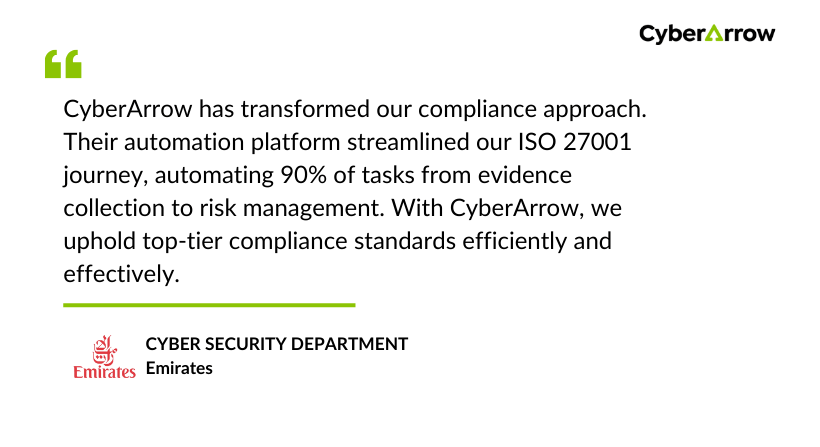
Read how Emirates enhanced Information Security by automating ISO 27001 with CyberArrow.
See what Emirates has to say about CyberArrow GRC:
Conclusion
The ISO 27001 stage 2 audit is the most critical step in achieving certification. It tests whether information security controls work in practice and whether the organization manages security consistently.
Using a detailed checklist helps teams understand what auditors expect and prepare evidence properly. Without structure and automation, organizations risk delays, findings, and added cost.
CyberArrow GRC provides a centralized platform to manage ISO 27001 controls, risks, and evidence. It helps organizations stay audit-ready, reduce manual work, and approach the stage 2 audit with confidence.
For organizations preparing for ISO 27001 certification, CyberArrow GRC is the right solution to support a successful stage 2 audit journey.
FAQs
What is the main goal of the ISO 27001 stage 2 audit?
The main goal of the stage 2 audit is to confirm that the Information Security Management System is fully implemented and working in practice. Auditors check real evidence, interview staff, and verify that security controls are effective.
How is the stage 2 audit different from the stage 1 audit?
Stage 1 focuses on readiness and documentation. Stage 2 focuses on implementation and evidence. In stage 2, auditors test controls, review records, and confirm that processes are followed daily.
What type of evidence is required for the stage 2 audit?
Evidence includes access reviews, risk assessments, incident records, logs, training records, internal audit reports, management review minutes, and proof that controls are operating as defined.
How long does the ISO 27001 stage 2 audit usually take?
The duration depends on the size and complexity of the organization. Most stage 2 audits take several days and involve interviews, system reviews, and evidence checks across teams.
How can organizations reduce the risk of findings during the stage 2 audit?
Organizations can reduce risk by keeping evidence up to date, performing internal audits, fixing gaps early, training staff, and using a centralized GRC platform like CyberArrow GRC to manage controls and documentation.
