

What is NCA NCNICC – 1:2025? Requirements and implementation guide
Cyber security expectations in Saudi Arabia continue to evolve. The National Cybersecurity Authority has introduced a new standard called NCNICC – 1:2025, designed to strengthen cyber security practices across the private sector. Many organizations are now asking what NCNICC – 1:2025 is, who it applies to, and how to implement it correctly.
This guide explains NCNICC – 1:2025 in simple terms. It covers the purpose of the standard, its requirements, who must comply, and how organizations can implement NCNICC – 1:2025 controls in a practical and structured way.
What is NCNICC – 1:2025
NCNICC stands for Non-Critical National Infrastructure Private Sector Entities Cybersecurity Controls. It is a national cyber security control framework issued by the National Cybersecurity Authority of Saudi Arabia.
NCNICC – 1:2025 applies to private sector organizations that are not classified as Critical National Infrastructure. It establishes a baseline set of cyber security controls that these organizations are expected to follow to reduce cyber risks and improve security maturity.
NCNICC – 1:2025 is designed to ensure that all private sector entities maintain an acceptable level of cyber security, even if they do not fall under stricter sector specific regulations.
Why NCNICC – 1:2025 was introduced
Before NCNICC – 1:2025, cyber security regulations in Saudi Arabia focused mainly on:
- Critical National Infrastructure.
- Financial institutions.
- Government entities.
This left many private sector organizations without a clear regulatory cyber security framework. NCNICC – 1:2025 fills this gap by defining clear expectations for non-CNI entities.
NCNICC – 1:2025 was introduced to:
- Improve national cyber security resilience.
- Reduce cyber risks across private businesses.
- Protect digital services and information assets.
- Support Saudi Arabia digital transformation goals.
- Create consistent cyber security practices.
Who must comply with NCNICC – 1:2025
NCNICC – 1:2025 applies to private sector entities operating in Saudi Arabia that are not classified as CNI.
This includes:
- Technology companies.
- SaaS providers.
- E commerce platforms.
- Manufacturing companies.
- Retail businesses.
- Logistics and supply chain organizations.
- Service providers.
- Startups and scale ups.
If an organization operates digital systems, handles data, or provides online services, NCNICC – 1:2025 is likely applicable.
Is NCNICC – 1:2025 mandatory
NCNICC – 1:2025 is issued by the National Cybersecurity Authority. Organizations are expected to assess applicability and implement relevant controls.
While NCNICC – 1:2025 may not always be enforced through public certification, it can be:
- Requested during regulatory reviews.
- Required by customers or partners.
- Included in vendor security assessments.
- Used in audits or investigations.
Organizations that ignore NCNICC – 1:2025 may face increased regulatory and business risk.
Structure of the NCNICC – 1:2025 framework
NCNICC – 1:2025 is organized into cyber security control domains. Each domain focuses on a key area of cyber security governance and operations.
The framework follows a structure similar to global standards, making it easier to integrate into existing security programs.
Key NCNICC – 1:2025 control domains
Cyber security governance
This domain focuses on leadership, roles, and accountability.
Organizations must:
- Assign cyber security roles and responsibilities.
- Establish cyber security policies.
- Ensure leadership oversight.
- Align cyber security with business objectives.
Governance ensures that cyber security is managed at the organizational level.
Risk management
Risk management is a core requirement of NCNICC – 1:2025.
Organizations must:
- Identify cyber security risks.
- Assess likelihood and impact.
- Define risk treatment actions.
- Review risks regularly.
Risk management helps organizations prioritize controls based on real threats.
Asset management
Organizations must know what they are protecting.
Requirements include:
- Identifying information assets.
- Classifying data based on sensitivity.
- Assigning asset owners.
- Protecting assets throughout their lifecycle.
Asset management supports better control and monitoring.
Identity and access control
Access control protects systems and data from unauthorized use.
Organizations must:
- Limit access based on job roles.
- Review user access regularly.
- Use strong authentication methods.
- Remove access when no longer needed.
Weak access control is a common cause of security incidents.
Cyber security operations
This domain focuses on daily security activities.
Organizations must:
- Monitor systems and networks.
- Manage vulnerabilities and patches.
- Protect against malware.
- Log and review security events.
Operational controls reduce exposure to attacks.
Incident management
Organizations must be ready to respond to incidents.
Requirements include:
- Incident response procedures.
- Defined response roles.
- Incident reporting and tracking.
- Lessons learned after incidents.
Effective incident management limits damage and downtime.
Third party and supplier security
Suppliers can introduce risk.
Organizations must:
- Assess supplier cyber security risks.
- Define security requirements in contracts.
- Monitor third party compliance.
Third party risk management is critical for modern supply chains.
Business continuity and resilience
Availability is part of cyber security.
Organizations must:
- Plan for disruptions.
- Maintain backups.
- Test recovery processes.
- Protect critical services.
Business continuity ensures operations can continue during incidents.
Compliance and monitoring
Organizations must monitor and improve security.
Requirements include:
- Compliance tracking.
- Internal reviews.
- Continuous improvement.
- Reporting to leadership.
Monitoring ensures long term effectiveness.
How NCNICC – 1:2025 compares to other frameworks
NCNICC – 1:2025 shares similarities with global standards such as:
However, NCNICC – 1:2025 is tailored specifically for Saudi Arabia and focuses on non-CNI private sector entities.
Organizations already following ISO 27001 or NIST may find it easier to align with NCNICC – 1:2025 through control mapping.
Steps to implement NCNICC – 1:2025
Step 1: Assess applicability
Organizations should first confirm whether NCNICC – 1:2025 applies based on:
- Business activities.
- Data handled.
- Digital services provided.
Step 2: Define scope
Define:
- Systems in scope.
- Locations.
- Data types.
- Third parties.
Clear scope prevents confusion during implementation.
Step 3: Perform risk assessment
Identify risks related to:
- Systems.
- Data.
- Users.
- Suppliers.
Document risk ratings and treatment plans.
Step 4: Implement controls
Implement required controls across:
- Governance.
- Technical security.
- Operations.
- Supplier management.
Controls should align with identified risks.
Step 5: Document policies and procedures
Documentation is critical.
Maintain:
- Policies.
- Procedures.
- Guidelines.
- Records.
Documents should reflect actual practices.
Step 6: Train employees
Security awareness is essential.
Train employees on:
- Cyber security responsibilities.
- Incident reporting.
- Safe behavior.
Human error remains a major risk.
Step 7: Monitor and improve
NCNICC – 1:2025 requires continuous effort.
Monitor:
- Control effectiveness.
- Security incidents.
- Compliance gaps.
Improve controls based on findings.
Common challenges with NCNICC – 1:2025 implementation
Organizations often face:
- Manual compliance tracking.
- Scattered documentation.
- Limited visibility into control status.
- Difficulty mapping controls.
- Audit preparation stress.
These challenges increase as organizations grow.
How CyberArrow GRC supports NCNICC – 1:2025 compliance
CyberArrow GRC supports:
- Centralized NCNICC – 1:2025 control management.
- Risk assessments and treatment workflows.
- Policy management and approvals.
- Evidence collection and tracking.
- Control mapping to ISO 27001 and other standards.
- Real time compliance dashboards.
- Audit readiness.
CyberArrow GRC reduces manual work and helps teams maintain consistent compliance.
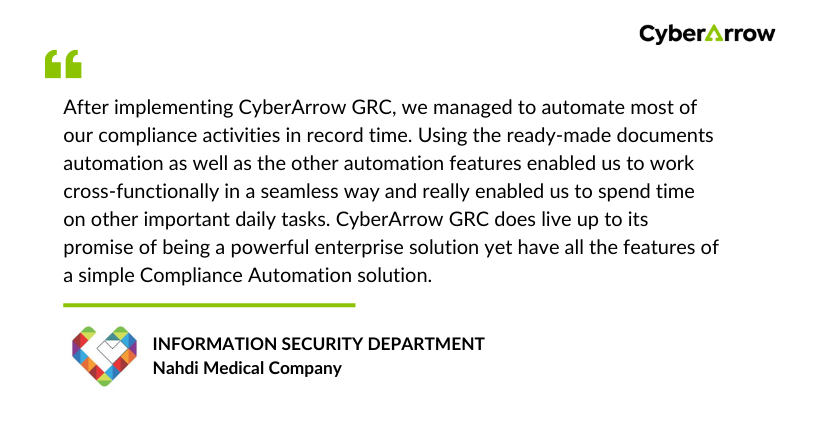
See what Nahdi Medical Company has to say about CyberArrow GRC:
Conclusion
NCNICC – 1:2025 is a significant step in strengthening cyber security across the Saudi private sector. It establishes clear expectations for non-CNI organizations and helps reduce national cyber risk.
Implementing NCNICC – 1:2025 requires structure, planning, and ongoing effort. Manual methods make this difficult and increase the risk of gaps.
CyberArrow GRC provides organizations with the tools needed to implement NCNICC – 1:2025 efficiently, manage controls effectively, and stay compliant over time. For organizations looking to build a strong and scalable cyber security program, CyberArrow GRC is the right platform to support NCNICC – 1:2025 compliance with confidence.
FAQs
What is NCNICC – 1:2025 and who issued it?
NCNICC – 1:2025 is a cyber security control framework issued by the National Cybersecurity Authority of Saudi Arabia. It is designed to establish baseline cyber security requirements for private sector entities that are not classified as Critical National Infrastructure.
Which organizations are in scope of NCNICC – 1:2025?
NCNICC – 1:2025 applies to private sector organizations operating in Saudi Arabia that are not classified as CNI. This includes companies that operate digital systems, provide online services, or handle information assets, based on applicability assessment.
Is NCNICC – 1:2025 a replacement for ISO 27001 or other frameworks?
No. NCNICC – 1:2025 does not replace international standards like ISO 27001. It is a Saudi national framework that defines minimum cyber security controls. Organizations may align NCNICC – 1:2025 with other frameworks as part of their overall security program.
Does NCNICC – 1:2025 require formal certification?
NCNICC – 1:2025 is not a certification standard. Organizations are expected to assess applicability, implement relevant controls, and maintain evidence of compliance. Compliance may be reviewed by regulators, customers, or partners when required.
What is the first step to implementing NCNICC – 1:2025?
The first step is to review the NCNICC – 1:2025 framework, assess applicability to the organization, define the scope of systems and data, and identify gaps between current cyber security practices and the required controls.
