

ISO 27001 requirements for companies in USA: Local laws, risks, and audit notes
Companies in the United States operate in one of the most regulated and high risk digital environments in the world. They manage large volumes of personal data, financial records, health information, and business critical systems. Cyber attacks, data breaches, and regulatory scrutiny continue to rise across industries.
ISO 27001 is a global standard that helps US companies build a strong information security program. It provides a structured way to protect data, manage risks, and demonstrate security maturity to customers, regulators, and partners.
This guide explains the ISO 27001 requirements for companies in the USA, how they align with local laws, common risks faced by US organizations, and key audit notes to prepare for certification.
- Why ISO 27001 matters for companies in the USA
- How ISO 27001 fits into the US regulatory landscape
- Key US laws related to ISO 27001
- ISO 27001 requirements overview
- ISO 27001 clauses explained for US companies
- ISO 27001 Annex A controls for US companies
- Common risks for US companies under ISO 27001
- Audit notes for ISO 27001 in the USA
- Typical audit evidence requested
- How US companies can prepare for ISO 27001 audits
- Common challenges for US companies
- How CyberArrow GRC helps US companies meet ISO 27001 requirements
- Conclusion
- FAQs
Why ISO 27001 matters for companies in the USA
US companies face growing pressure from regulators, customers, and business partners to prove that data is protected properly. While ISO 27001 is not a US law, it is widely accepted as proof of strong security governance.
ISO 27001 is important for US companies because it:
- Supports compliance with US data protection laws.
- Reduces cyber and operational risks.
- Improves trust with customers and partners.
- Helps pass security assessments and audits.
- Strengthens incident response and resilience.
- Supports business growth and global operations.
Many US companies also use ISO 27001 to support contracts with international customers.
How ISO 27001 fits into the US regulatory landscape
The United States does not have a single national data protection law. Instead, companies must follow a mix of federal, state, and industry specific regulations.
ISO 27001 helps companies create a consistent security framework that supports these laws.
Key US laws related to ISO 27001
Federal laws
US companies may be subject to federal regulations such as:
- HIPAA for healthcare data.
- GLBA for financial institutions.
- FISMA for federal agencies and contractors.
- SOX for financial reporting controls.
ISO 27001 supports many of the security and risk management expectations in these laws.
State data protection laws
Many states have their own data protection rules.
Examples include:
- California Consumer Privacy Act.
- New York SHIELD Act.
- Virginia Consumer Data Protection Act.
- Colorado Privacy Act.
ISO 27001 helps companies build controls that protect personal data and support these laws.
Industry standards and contracts
US companies often must meet:
ISO 27001 provides a strong foundation for these requirements.
ISO 27001 requirements overview
ISO 27001 requirements fall into two main areas:
- Clauses 4 to 10, which define the Information Security Management System.
- Annex A controls, which define specific security practices.
Both are required for certification.
ISO 27001 clauses explained for US companies
Clause 4: Context of the organization
US companies must understand internal and external factors that affect security.
This includes:
- Regulatory obligations.
- Industry risks.
- Customer expectations.
- Business operations.
- Data types handled.
The ISMS scope must clearly describe which systems, locations, and processes are included.
Clause 5: Leadership
Leadership commitment is critical.
US auditors expect:
- Approved information security policies.
- Clear roles and responsibilities.
- Evidence of leadership involvement.
- Support for security objectives.
Security must be treated as a business priority, not only an IT task.
Clause 6: Planning
Planning focuses on risk management.
US companies must:
- Identify security risks.
- Assess likelihood and impact.
- Define risk treatment actions.
- Set measurable security objectives.
Common US risks include ransomware, insider threats, and third party breaches.
Clause 7: Support
Support includes people, training, and documentation.
US organizations must:
- Train employees on security practices.
- Maintain updated policies and procedures.
- Control access to sensitive documents.
- Ensure clear internal communication.
Security awareness is especially important due to phishing and social engineering risks.
Clause 8: Operation
This clause covers daily security operations.
Requirements include:
- Running risk assessments regularly.
- Managing incidents.
- Applying security controls consistently.
- Keeping records of actions taken.
Operational discipline is critical during audits.
Clause 9: Performance evaluation
US companies must measure ISMS effectiveness.
This includes:
- Internal audits.
- Management reviews.
- Performance metrics.
Auditors look for evidence that security is monitored and reviewed.
Clause 10: Improvement
Organizations must improve security over time.
This includes:
- Tracking non conformities.
- Applying corrective actions.
- Updating controls and policies.
Continuous improvement is a key audit focus.
ISO 27001 Annex A controls for US companies
Annex A includes technical and organizational controls. Many are especially important in the US threat landscape.
Access control
Access control protects sensitive data.
Key practices include:
- Least privilege access.
- Multi factor authentication.
- Role based permissions.
- Regular access reviews.
Unauthorized access is a common cause of US data breaches.
Asset management
US companies must track:
- IT systems.
- Cloud services.
- Data assets.
- End user devices.
Assets should be classified based on sensitivity and regulatory impact.
Cryptography and data protection
Encryption is critical for protecting regulated data.
Controls include:
- Encrypting data at rest.
- Encrypting data in transit.
- Secure key management.
Encryption supports compliance with many US laws.
Operations security
Operations security keeps systems stable and secure.
Key controls include:
- Logging and monitoring.
- Patch management.
- Malware protection.
- Backup and recovery.
Auditors often request evidence of operational controls.
Incident management
US companies must respond quickly to incidents.
Controls include:
- Incident response plans.
- Breach notification procedures.
- Incident tracking records.
Timely response reduces legal and financial impact.
Supplier and third party security
Third party risk is a major issue in the US.
Controls include:
- Vendor risk assessments.
- Security requirements in contracts.
- Ongoing vendor monitoring.
Many US breaches originate from vendors.
Business continuity management
Availability is part of security.
US companies must:
- Maintain disaster recovery plans.
- Test backups.
- Define recovery objectives.
Business continuity supports operational resilience.
Compliance controls
Organizations must monitor compliance with:
- Federal laws.
- State laws.
- Industry standards.
- Contractual obligations.
ISO 27001 supports structured compliance tracking.
Common risks for US companies under ISO 27001
US organizations face several common risks:
- Ransomware attacks.
- Phishing and social engineering.
- Cloud misconfigurations.
- Insider threats.
- Vendor breaches.
- Regulatory penalties.
- Data leakage.
ISO 27001 helps identify and manage these risks in a structured way.
Audit notes for ISO 27001 in the USA
Auditors in the US focus on evidence and consistency.
Common audit observations include:
- Missing risk assessments.
- Outdated policies.
- Weak access reviews.
- Incomplete incident records.
- Poor vendor documentation.
- Scattered audit evidence.
Preparing evidence throughout the year reduces audit stress.
Typical audit evidence requested
Auditors often ask for:
- ISMS scope document.
- Risk register.
- Risk treatment plan.
- Policies and procedures.
- Access review records.
- Incident response records.
- Training records.
- Internal audit reports.
- Management review minutes.
All evidence should be current and easy to access.
How US companies can prepare for ISO 27001 audits
Step 1: Define clear scope
Document systems, locations, and data in scope.
Step 2: Perform risk assessments
Focus on US specific threats and regulations.
Step 3: Implement Annex A controls
Map controls to identified risks.
Step 4: Train employees
Security awareness is critical.
Step 5: Maintain evidence
Keep documentation updated all year.
Common challenges for US companies
US companies often struggle with:
- Manual compliance tracking.
- Multiple overlapping regulations.
- Evidence spread across systems.
- Limited compliance visibility.
- Audit preparation pressure.
Automation helps solve these challenges.
How CyberArrow GRC helps US companies meet ISO 27001 requirements
CyberArrow GRC supports US companies by providing a centralized and automated compliance platform.
Key benefits include:
- ISO 27001 control library.
- Automated evidence collection.
- Risk assessment workflows.
- Policy management and approvals.
- Vendor risk management.
- Audit-ready documentation.
- Real time dashboards.
- Cross framework mapping for US regulations.
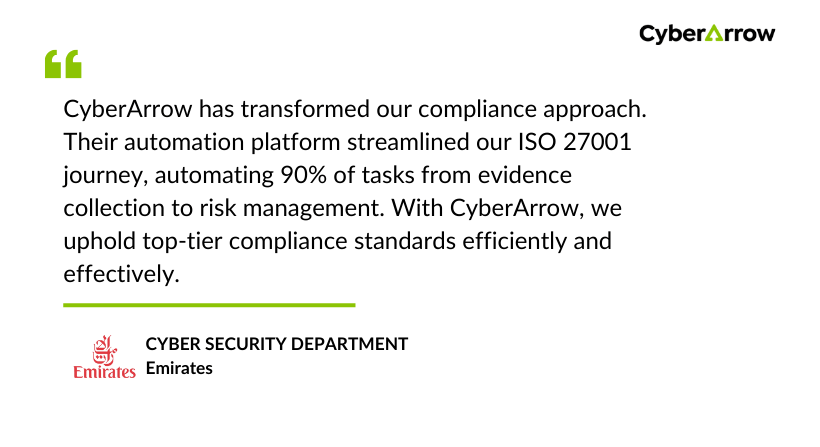
Read how Emirates enhanced Information Security by automating ISO 27001 with CyberArrow.
See what Emirates has to say about CyberArrow GRC:
Conclusion
ISO 27001 is a powerful framework for companies in the USA that want to strengthen security, manage risk, and meet regulatory expectations. It supports a wide range of US laws and industry requirements while providing a globally recognized security standard.
However, managing ISO 27001 manually is difficult, especially in a complex regulatory environment. CyberArrow GRC provides the automation, visibility, and structure needed to manage ISO 27001 requirements efficiently.
For US companies looking to build a mature and scalable security program, CyberArrow GRC is the right platform to support long term compliance and trust.
FAQs
Is ISO 27001 required by law in the United States?
No. ISO 27001 is not required by law in the United States. However, many US companies adopt it to meet customer expectations, support regulatory compliance, and prove that they manage information security in a structured way.
How does ISO 27001 help US companies meet local data protection laws?
ISO 27001 provides controls for access management, risk assessments, incident response, and data protection. These controls support many US laws such as HIPAA, GLBA, and state privacy laws by strengthening security governance.
Which industries in the USA benefit most from ISO 27001?
Industries such as healthcare, finance, SaaS, technology, government contractors, and e-commerce benefit the most. These industries handle sensitive data and face high regulatory and cyber risk.
What are common ISO 27001 audit findings for US companies?
Common findings include outdated risk assessments, weak access reviews, missing vendor documentation, incomplete incident records, and poor evidence organization. Keeping documentation updated throughout the year helps reduce these issues.
How can US companies manage ISO 27001 compliance more efficiently?
US companies can manage ISO 27001 compliance more efficiently by using a centralized GRC platform. Tools like CyberArrow GRC automate evidence collection, track risks, manage policies, and provide real time visibility into compliance status.
