


ISO 27001 compliance for AWS: Controls, logging, and evidence guide
Many organizations run their systems on Amazon Web Services. AWS offers flexibility, scale, and strong security features. But using AWS alone does not mean an organization is compliant with ISO 27001. Companies must still design controls, manage risks, collect evidence, and prove that security is managed correctly.
ISO 27001 compliance for AWS requires a clear understanding of shared responsibility, proper configuration of cloud services, and strong governance. This guide explains how ISO 27001 applies to AWS, which controls matter most, how logging should be handled, and what evidence auditors expect to see.
- What ISO 27001 compliance means in an AWS environment
- AWS shared responsibility model and ISO 27001
- ISO 27001 clauses applied to AWS
- Key ISO 27001 Annex A controls for AWS
- Logging and Monitoring in AWS
- Audit evidence for ISO 27001 compliance on AWS
- Common challenges with ISO 27001 compliance for AWS
- How CyberArrow GRC helps with ISO 27001 compliance for AWS
- Conclusion
- FAQs
What ISO 27001 compliance means in an AWS environment
ISO 27001 is a standard for managing information security. It requires organizations to build an Information Security Management System that covers people, processes, and technology.
When using AWS, ISO 27001 compliance means:
- Understanding which security controls AWS provides.
- Implementing customer-owned controls correctly.
- Managing risks related to cloud services.
- Monitoring and logging security activity.
- Keeping evidence for audits.
AWS is secure by design, but compliance depends on how services are configured and governed.
AWS shared responsibility model and ISO 27001
AWS follows a shared responsibility model.
AWS is responsible for:
- Physical security of data centers.
- Underlying infrastructure.
- Hardware and networking.
Customers are responsible for:
- Data protection.
- Identity and access management.
- Network configuration.
- Operating system security.
- Application security.
- Logging and monitoring.
ISO 27001 compliance for AWS focuses mainly on customer responsibilities.
ISO 27001 clauses applied to AWS
ISO 27001 Clauses 4 to 10 apply to AWS environments the same way they apply to on premise systems.
Clause 4: Context of the organization
Organizations must define the scope of the ISMS.
For AWS, this includes:
- AWS accounts in scope.
- Regions used.
- Services in use.
- Data types stored in AWS.
- Regulatory requirements.
The scope must clearly mention AWS services.
Clause 5: Leadership
Leadership must support cloud security.
This includes:
- Approving cloud security policies.
- Assigning AWS security roles.
- Supporting cloud risk management.
Cloud security should be a leadership priority.
Clause 6: Planning
Planning focuses on risk management.
For AWS, risks may include:
- Misconfigured storage.
- Overly broad permissions.
- Insecure APIs.
- Lack of logging.
- Third-party integrations.
Organizations must assess these risks and define treatment plans.
Clause 7: Support
Support includes training, tools, and documentation.
AWS-specific support includes:
- Cloud security training.
- Secure configuration guides.
- Documented AWS architecture.
- Access to security documentation.
Staff must understand how to use AWS securely.
Clause 8: Operation
Operation focuses on daily security tasks.
This includes:
- Managing AWS access.
- Monitoring logs.
- Responding to incidents.
- Applying security updates.
Operational controls must be consistent and repeatable.
Clause 9: Performance evaluation
Organizations must measure security performance.
For AWS, this includes:
- Reviewing security metrics.
- Monitoring alerts.
- Running internal audits.
- Reviewing cloud security posture.
Clause 10: Improvement
Security must improve over time.
This includes:
- Fixing audit findings.
- Improving AWS configurations.
- Updating policies and controls.
Key ISO 27001 Annex A controls for AWS
Annex A includes technical and operational controls. Below are the most important ones for AWS environments.
Access control in AWS
Access control is critical for cloud security.
Key AWS practices include:
- Using AWS IAM roles instead of long-term credentials.
- Enforcing least privilege permissions.
- Enabling multi-factor authentication.
- Reviewing IAM permissions regularly.
- Separating production and non-production access.
Auditors expect to see clear IAM policies and access reviews.
Asset management for AWS resources
Organizations must know what they run in AWS.
Assets include:
- EC2 instances.
- S3 buckets.
- RDS databases.
- Lambda functions.
- IAM roles.
- VPCs.
Assets should be inventoried and classified based on data sensitivity.
Data protection and cryptography
Encryption is essential for ISO 27001 compliance for AWS.
Key practices include:
- Encrypting data at rest using AWS KMS.
- Encrypting data in transit using TLS.
- Managing encryption keys securely.
- Limiting access to keys.
Auditors often review encryption settings closely.
Network security controls
Network controls protect cloud resources.
Key AWS controls include:
- VPC segmentation.
- Security groups with least access.
- Network access control lists.
- Private subnets for sensitive systems.
Network diagrams are often requested as audit evidence.
Logging and Monitoring in AWS
Logging is one of the most important ISO 27001 requirements.
Core AWS logging services
Organizations should enable and monitor:
- AWS CloudTrail for API activity.
- CloudWatch logs for system events.
- VPC Flow Logs for network traffic.
- S3 access logs for storage access.
- GuardDuty for threat detection.
Logs must be retained according to policy.
Log management best practices
To meet ISO 27001 requirements:
- Enable logging across all AWS accounts.
- Centralize logs in a secure account.
- Protect logs from deletion.
- Monitor alerts and anomalies.
- Document log retention rules.
Auditors will ask how logs are protected and reviewed.
Incident management in AWS
Organizations must be able to detect and respond to incidents.
AWS-related incident response includes:
- Detecting suspicious API calls.
- Responding to unauthorized access.
- Isolating compromised resources.
- Preserving evidence.
Incident response plans must include AWS scenarios.
Backup and business continuity
Availability is part of information security.
Key AWS practices include:
- Automated backups for databases.
- Cross-region replication.
- Disaster recovery testing.
- Documented recovery objectives.
Evidence of backup testing is often requested during audits.
Change management in AWS
Changes can introduce risk.
Organizations must:
- Document infrastructure changes.
- Use infrastructure as code where possible.
- Review changes before deployment.
- Track approvals.
Changing records helps demonstrate control.
Third-party and supplier security
AWS itself is a supplier.
Organizations should:
- Review AWS compliance reports.
- Understand AWS certifications.
- Document shared responsibility.
- Assess third-party integrations.
Vendor management applies even in cloud environments.
Audit evidence for ISO 27001 compliance on AWS
Auditors do not only review configurations. They review evidence.
Common evidence includes:
- IAM access reviews.
- CloudTrail logs.
- Encryption screenshots.
- Network diagrams.
- Backup reports.
- Incident response records.
- Risk assessments.
- Policies and procedures.
Evidence must be current and easy to access.
Common challenges with ISO 27001 compliance for AWS
Organizations often struggle with:
- Manual evidence collection.
- Logs spread across accounts.
- Unclear ownership of controls.
- Too many AWS services.
- Limited visibility into compliance status.
These challenges grow as environments scale.
How CyberArrow GRC helps with ISO 27001 compliance for AWS
CyberArrow GRC helps organizations manage ISO 27001 compliance for AWS in a structured and automated way.
Key benefits include:
- Central ISO 27001 control library.
- Mapping AWS controls to ISO 27001 requirements.
- Automated evidence collection workflows.
- Central storage for audit evidence.
- Risk assessment and treatment tracking.
- Policy management and approvals.
- Vendor and cloud risk management.
- Real-time dashboards for compliance status.
CyberArrow GRC helps teams reduce manual work, improve visibility, and stay audit-ready across AWS environments.
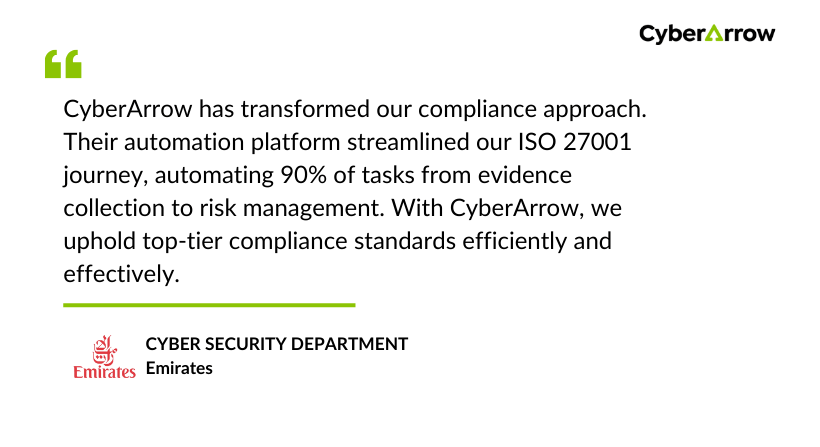
Read how Emirates enhanced Information Security by automating ISO 27001 with CyberArrow.
See what Emirates has to say about CyberArrow GRC:
Conclusion
ISO 27001 compliance for AWS requires more than using secure cloud services. Organizations must design controls, manage risks, monitor activity, and maintain clear audit evidence. AWS provides strong tools, but compliance depends on how they are configured and governed.
ISO 27001 helps organizations build trust, reduce cloud risks, and meet regulatory expectations. However, managing cloud compliance manually becomes complex and time-consuming as environments grow.
CyberArrow GRC provides the structure, automation, and visibility needed to manage ISO 27001 compliance for AWS effectively. It helps teams connect cloud security controls with governance, risk, and compliance requirements.
For organizations running on AWS and aiming for ISO 27001, CyberArrow GRC is the right platform to support secure and scalable compliance.
FAQs
What does ISO 27001 compliance for AWS mean?
ISO 27001 compliance for AWS means using AWS services in a way that meets information security management requirements. It includes managing access, protecting data, monitoring activity, and keeping audit evidence for cloud systems.
Is AWS already ISO 27001 compliant?
AWS infrastructure is ISO 27001 certified, but this does not make customer workloads compliant. Customers are responsible for configuring security controls, managing access, monitoring logs, and protecting data in their own AWS environments.
Which AWS services are most important for ISO 27001 compliance?
Key AWS services include IAM for access control, CloudTrail for activity logging, CloudWatch for monitoring, KMS for encryption, S3 for storage security, and GuardDuty for threat detection.
What evidence do auditors ask for in AWS ISO 27001 audits?
Auditors often ask for IAM access reviews, CloudTrail logs, encryption settings, network diagrams, backup reports, incident response records, and documented risk assessments linked to AWS services.
How can organizations simplify ISO 27001 compliance for AWS?
Organizations can simplify compliance by centralizing controls, automating evidence collection, and tracking risks in one system. Platforms like CyberArrow GRC help teams manage cloud compliance efficiently and stay audit-ready all year.
