

SaaS security tools: How to choose the right solution for your organization
As organizations adopt more SaaS applications, security teams face a familiar problem: limited visibility, inconsistent controls, and growing audit pressure. Tracking SaaS risks manually does not scale, and relying on ad-hoc reviews leaves gaps that often surface during manual audits or incidents.
SaaS security tools help organizations regain control by providing visibility, monitoring, and structure across their SaaS environments. The challenge is not whether to use these tools, but how to choose the right mix that supports both security operations and compliance requirements.
So let’s break it down in this article below.
- What organizations expect from SaaS security tools today
- Core categories of SaaS security tools
- How to evaluate SaaS security tools for your organization
- Common gaps organizations face when choosing SaaS security tools
- Choosing the right mix of SaaS security tools
- Strengthen your SaaS security and compliance environment with CyberArrow GRC
- FAQs
What organizations expect from SaaS security tools today
Modern SaaS environments change constantly. Business teams introduce new applications, access levels evolve, and configurations drift over time. As a result, SaaS security tools are expected to do more than flag isolated issues.
Organizations typically expect these tools to provide:
- Ongoing visibility into SaaS usage and ownership.
- Clear control over user access and permissions.
- Continuous monitoring instead of one-time checks.
- Evidence that can be reused for audits and customer reviews.
Tools that cannot meet these expectations often create more manual work rather than reduce it.
Core categories of SaaS security tools
SaaS security is not addressed by a single tool. Most organizations rely on multiple categories of tools that work together to reduce risk and maintain oversight.
1. SaaS discovery and visibility tools
These tools help identify which SaaS applications are being used across the organization, including unsanctioned or low-visibility tools. They provide insight into usage patterns, data exposure, and ownership, which is often the first step toward improving control.
2. Access and identity security tools
Access security tools focus on who has access to which SaaS applications and at what level. They support role management, privileged access reviews, and joiner-mover-leaver processes, helping reduce risks caused by excessive or outdated permissions.
3. Configuration and posture management tools
These tools monitor SaaS application settings and configurations over time. They help detect insecure defaults, misconfigurations, and drift that can increase exposure if left unchecked.
4. Third-party and vendor risk tools
Vendor risk tools support the evaluation of SaaS providers themselves. They help track security posture, assess risk, and document due diligence, which is especially important for compliance and procurement reviews.
5. Compliance and risk management platforms
These platforms bring structure to SaaS security implementation by centralizing risks, controls, ownership, and evidence. Instead of managing SaaS security in spreadsheets, organizations can track issues, reviews, and remediation in a consistent and auditable way.
How to evaluate SaaS security tools for your organization
Choosing SaaS security tools should be driven by how your organization operates, not by feature lists alone. A tool that works well in isolation may still fail if it does not integrate with your broader security and compliance processes.
When evaluating tools, consider:
- Coverage across the SaaS applications you actually use.
- Ability to map controls to frameworks such as ISO 27001 or SOC 2.
- Support for continuous monitoring rather than point-in-time assessments.
- Quality of reporting and evidence generation.
- Ease of use for security, compliance, and audit teams.
- Scalability as the number of SaaS applications grows.
Tools that support both security teams and compliance workflows deliver more long-term value.
Common gaps organizations face when choosing SaaS security tools
Many SaaS security initiatives struggle not because of missing tools, but because of poor selection and implementation decisions.
Common gaps include:
- Purchasing isolated tools that do not integrate with each other.
- Focusing only on technical security while ignoring audit and compliance needs.
- Underestimating the effort required to collect and maintain evidence.
- Choosing tools that rely heavily on manual input and periodic reviews.
Addressing these gaps early helps prevent tool sprawl and reduces operational overhead.
Choosing the right mix of SaaS security tools
Choosing SaaS security tools is not about picking a single product and calling the job done. Most organizations need a combination of tools that address different risk areas as their SaaS environment grows.
A practical, scalable approach usually includes:
- Start with SaaS visibility and discovery: Identify which SaaS applications are in use, who owns them, and what data they handle. Without this baseline, it is difficult to apply consistent security or accountability.
- Add access and identity-focused controls: Focus on managing user permissions, privileged access, and offboarding processes. Reducing excessive access is often the fastest way to lower SaaS risk.
- Introduce configuration and monitoring capabilities: Monitor security settings, login behavior, and configuration drift across critical SaaS tools to catch issues early rather than during an audit or incident.
- Include vendor and third-party risk coverage: Use structured assessments and ongoing reviews to understand how SaaS vendors handle data protection, availability, and incident response.
- Centralize oversight through a risk and compliance platform: Bring evidence, ownership, reviews, and control tracking into one place to support audits, customer assurance, and ongoing governance.
This layered model allows organizations to improve SaaS security over time without slowing down the business. Each tool plays a specific role, and together they create a manageable, audit-ready SaaS security program.
Strengthen your SaaS security and compliance environment with CyberArrow GRC
Managing SaaS security tools becomes much easier when security, risk, and compliance work together instead of in silos. CyberArrow helps organizations bring structure, visibility, and accountability to their SaaS security efforts without adding manual work.
With CyberArrow, teams can:
- Track risks, controls, and ownership in one place instead of scattered spreadsheets and screenshots.
- Align security practices with standards such as ISO 22301, GDPR, and other regulatory frameworks without duplicating effort.
- Gather and maintain audit-ready evidence from integrated tools and documented processes, reducing last-minute audit stress.
- Keep risk assessments, reviews, and remediation activities up to date as SaaS environments evolve.
- Give security, compliance, and business owners a shared view of SaaS risks and responsibilities.
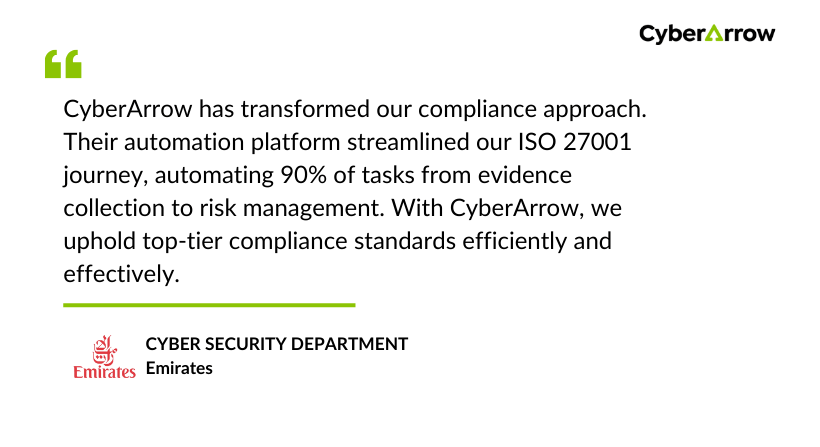
See what our clients have to say about CyberArrow GRC:
FAQs
What are SaaS security tools?
SaaS security tools help organizations manage risks associated with cloud-based applications. They focus on areas such as access control, configuration management, vendor risk, monitoring, and audit readiness.
Do organizations need multiple SaaS security tools?
In most cases, yes. SaaS environments involve different risk areas, and a layered set of tools provides better coverage than relying on a single solution.
How do SaaS security tools support compliance audits?
They help demonstrate visibility into applications, controlled access, regular reviews, and documented processes. This makes it easier to provide evidence during audits and customer assessments.
How often should SaaS security tools be reviewed or updated?
SaaS security tooling should be reviewed regularly, especially when new applications are added, business processes change, or compliance requirements evolve.
