


Stop manual third-party security vetting: How CyberArrow automates your GRC program
Every company works with vendors, suppliers, SaaS products, and external partners. As the business grows, the number of third parties grows with it. Each new tool, app, or service introduces new risks that must be checked and monitored. This is where third-party security vetting becomes essential. But doing all this work manually creates stress, delays, and confusion across the organization.
A strong GRC program cannot depend on manual tracking, long spreadsheets, endless emails, and random folders. Third-party security must be clear, organized, and repeatable. Modern companies use automation to simplify the vetting process, improve accuracy, and reduce time spent on manual reviews.
CyberArrow GRC is designed for companies that want to stop manual third-party security vetting and build a stronger, automated GRC program. This blog explains why manual vendor vetting creates problems, how automation improves the process, and why CyberArrow GRC gives companies a cleaner and more reliable way to manage third-party security.
- Why manual third-party security vetting creates problems
- Why automation is important for a modern GRC program
- How manual work slows down the GRC program
- How CyberArrow GRC automates third-party security vetting
- How automated third-party security improves the entire GRC program
- Why CyberArrow GRC is the best solution for automated third-party security
- Conclusion
- FAQs
Why manual third-party security vetting creates problems
Manual vetting becomes complicated very fast. Even a small company can work with dozens of tools and vendors. Large companies often work with hundreds. Manual methods break at this scale.
Here are the biggest problems companies face with manual third-party security vetting:
- Manual vetting takes long hours because teams must check each vendor manually. They must review documents, send emails, collect questionnaires, and compare everything inside spreadsheets. This slows down business operations and holds back teams that need tools to work.
- Spreadsheets become difficult to manage because they contain long lists of vendors, risk scores, comments, pending tasks, and old reviews. As the list grows, the spreadsheet becomes slow, messy, and confusing.
- Third-party security documents are stored everywhere. Some policies live in email threads, some security reports are saved in shared folders, and some questionnaires are stored in random drives. This makes it hard to track which document is the latest or if anything is missing.
- There is no simple way to monitor ongoing risk. Vendors change their security posture over time. They may add new features, lose certifications, get breached, or change their policies. Manual methods make it hard to keep track of these changes.
- Manual vetting creates blind spots because teams may forget to review certain vendors or skip important checks. This exposes the company to hidden risks that can impact compliance and security.
- Communication becomes scattered since different teams reach out to vendors with different documents, questions, and expectations. Without structure, reviews become inconsistent.
All these problems show that manual third-party security work weakens the GRC program and increases risk.
Why automation is important for a modern GRC program
A GRC program needs structure, consistency, and speed. Automation helps organizations stay organized while reducing manual work.
Here is how automation improves third-party security vetting:
- Automation centralizes all vendor information in one system. Teams do not need to chase documents, track emails, or search for old reports. Everything is stored in one clean location.
- Automated workflows guide the vetting process so teams know exactly what to do at each step. This avoids mistakes and ensures that every vendor is treated the same way.
- Risk scoring becomes consistent because automated systems follow the same scoring method for all vendors. This removes personal bias and improves accuracy.
- Evidence collection becomes easier because vendors can upload documents directly into the platform. This saves time and reduces confusion.
- Automated reminders help teams stay on schedule with vendor reviews, contract renewals, and follow-up assessments. This prevents delays and keeps the GRC program running smoothly.
- Leaders get real-time visibility into vendor risk levels, pending reviews, and overall third-party security posture. This helps decision-makers act faster and with more confidence.
Automation creates a stronger and scalable GRC program that supports long-term growth.
How manual work slows down the GRC program
Third-party vetting is closely linked to the entire GRC program. When it is done manually, the entire compliance system slows down.
Here is how manual work impacts the larger GRC program:
- Important tools get delayed because the vendor review process takes too long. This slows down operations and product development.
- Risk management becomes weaker because manual methods do not provide updated risk scores. This leads to outdated information and blind spots.
- Compliance frameworks like ISO 27001, SOC 2, PCI DSS, and NIST require structured third-party vetting. Manual processes cannot keep up with these requirements.
- Audit preparation becomes difficult because teams cannot easily show vendor documentation, risk assessments, and approval history. Auditors need organized records, not scattered files.
- Contracts may renew without a proper security review because teams forget to revisit vendors on time. This increases risk and damages compliance maturity.
- Communication becomes messy because employees do not know who is responsible for each vendor. This causes delays and confusion.
Manual third-party vetting slows everything down and weakens the entire GRC program.
How CyberArrow GRC automates third-party security vetting
CyberArrow GRC replaces manual tasks with automation so teams can manage third-party security in a fast and structured way. It gives organizations the tools they need to vet vendors, reduce risk, and stay audit-ready.
Centralized vendor management
CyberArrow stores all vendor information in one system. Teams can see each vendor’s documents, risk level, contracts, reviews, and status without searching across multiple folders.
Automated vendor workflows
CyberArrow provides guided workflows that take teams through each step of the vendor vetting process. This ensures consistency and reduces mistakes.
Simple document collection
Vendors can upload security documents, policies, certificates, and reports directly into CyberArrow. This removes the need for long email threads.
Automated risk scoring
CyberArrow assigns risk levels based on vendor answers, documentation, and internal scoring logic. This creates accurate and fair evaluations.
Real-time dashboards
Teams can view overall third-party risk at a glance. They can see high-risk vendors, pending reviews, and overdue tasks instantly.
Vendor questionnaires
CyberArrow includes ready-made questionnaires aligned with global standards like ISO 27001, SOC 2, NIST, and PCI DSS. This saves time and improves quality.
Task Automation
CyberArrow assigns tasks automatically to the correct team members and sends reminders so no vendor review is forgotten.
Audit-Ready Reporting
CyberArrow keeps a full history of vendor reviews, approvals, comments, and documents. This makes audits fast and low-stress.
Automation from CyberArrow ensures a smooth and reliable third-party security process.
How automated third-party security improves the entire GRC program
CyberArrow does more than improve vendor vetting. It makes the entire GRC program stronger, more reliable, and easier to manage.
- Automated vetting improves risk management because third-party risks stay updated and easy to track. This helps companies make smarter decisions.
- Controls stay aligned because CyberArrow links vendor requirements to compliance frameworks. This ensures strong governance.
- Audits become easier because all vendor documents and risk scores stay organized and accessible.
- Evidence collection becomes faster because CyberArrow stores everything in one place and ties vendor evidence to controls.
- Frameworks like ISO 27001, SOC 2, and NIST become easier to maintain because vendor management supports major compliance requirements.
- Compliance teams save time because they spend less time fixing spreadsheets and more time improving security.
CyberArrow helps organizations move from reactive vendor checks to a strong, continuous GRC program.
Why CyberArrow GRC is the best solution for automated third-party security
CyberArrow GRC gives companies the complete set of tools needed to manage third-party security with confidence. It reduces manual work and ensures a strong GRC program.
CyberArrow GRC offers:
- Centralized vendor management.
- Automated questionnaires and workflows.
- Clear risk scoring.
- Reusable evidence.
- Real-time dashboards.
- Audit-ready documentation.
- Simple communication.
- Continuous updates and monitoring.
CyberArrow is more than a vendor management tool. It is a full GRC program that helps companies scale, stay compliant, and reduce risk with less effort.
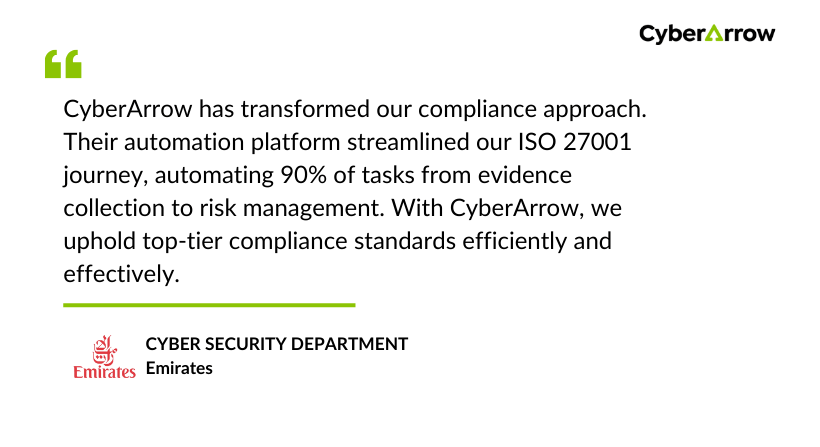
Read how Emirates enhanced Information Security by automating ISO 27001 with CyberArrow GRC.
See what Emirates has to say about CyberArrow GRC:
Conclusion
Manual third-party security vetting slows companies down and creates risk. As organizations grow, manual methods cannot keep up with new vendors, new tools, and new compliance requirements. A modern GRC program needs automation.
CyberArrow GRC provides everything organizations need to automate vendor vetting, reduce manual work, and stay audit-ready. It gives teams a clean, structured, and reliable way to manage third-party security throughout the year.
If your organization is tired of manual vendor vetting and wants a stronger GRC program, CyberArrow GRC is the best solution.
FAQs
Why is manual third-party security vetting a problem for companies?
Manual vetting is slow, unclear, and difficult to maintain. Teams must review documents by hand, manage large spreadsheets, and follow up through scattered emails. This creates delays, increases mistakes, and makes it hard to track vendor risk across the GRC program.
How does automation improve third-party security reviews?
Automation centralizes vendor data, speeds up risk scoring, and keeps documents organized in one system. It also sends reminders, guides teams through structured workflows, and gives real-time visibility into vendor risk. This helps companies stay compliant and reduce overall security risk.
How does CyberArrow GRC support automated third-party security vetting?
CyberArrow GRC provides automated questionnaires, guided workflows, real-time dashboards, and a full vendor history. It helps teams collect documents faster, score risks properly, and prepare for audits with ease. This makes third-party security strong, consistent, and easy to manage.
