

What is a GRC system? Why it’s a must-have for businesses
Every business today faces constant pressure to stay compliant, reduce risks, and build trust with customers. Regulations are becoming more complex, cyber threats are rising, and organizations must prove they operate responsibly. Relying on manual methods like spreadsheets or scattered documents is no longer enough.
A GRC system helps businesses manage governance, risk, and compliance in one integrated platform. It ensures companies stay on top of their obligations, reduce risks before they grow, and align processes with business goals.
In this blog, we will explain what a GRC system is, why businesses need it, the main features to look for, and why choosing the right solution like CyberArrow GRC can transform your compliance and risk management strategy.
What is a GRC system?
A GRC system is software that allows organizations to handle governance, risk management, and compliance in one central place. Instead of managing risks in one tool, compliance in another, and audits on spreadsheets, a GRC system combines everything into a single solution.
The three main pillars of a GRC system are:
- Governance: Setting rules, policies, and structures that guide how a business is run.
- Risk management: Identifying, assessing, and reducing risks that can harm the business.
- Compliance: Ensuring the organization follows laws, regulations, and internal policies.
By uniting these three areas, a GRC system helps companies work smarter, stay compliant, and reduce mistakes.
Why businesses need a GRC system
Modern organizations deal with endless challenges. Regulations change quickly, cyberattacks grow more advanced, and operational risks spread across supply chains. Without the right tools, it is easy to miss important details.
A GRC system is no longer a luxury but a necessity. Here are key reasons why:
1. Complexity of compliance
From GDPR to HIPAA to ISO standards, compliance requirements vary across industries and regions. A GRC system makes tracking these obligations easier.
2. Rising cyber security threats
Data breaches and ransomware attacks can cause huge damage. A GRC system helps detect, assess, and mitigate security risks.
3. Business reputation
Trust is everything. Customers and investors want assurance that businesses are secure, compliant, and responsible.
4. Efficiency and cost savings
Manual compliance takes time and often leads to errors. A GRC system automates repetitive work, saving resources while improving accuracy.
5. Audit readiness
Preparing for audits can be stressful. With a GRC system, all policies, controls, and evidence are available in one place, making audits faster and smoother.
Key features of a GRC system
When exploring different GRC solutions, businesses should look for these core features:
Risk management
- Identify and assess risks.
- Assign ownership to risks.
- Monitor risks with scoring and mitigation actions.
Compliance management
- Track regulatory requirements.
- Map compliance frameworks to internal controls.
- Receive alerts when compliance gaps appear.
Policy and document management
- Centralize policies in one system.
- Share updates with relevant teams.
- Track acknowledgment and training.
Audit management
- Plan, schedule, and execute audits.
- Collect evidence and generate reports.
- Reduce audit preparation time.
Reporting and dashboards
- Provide real-time visibility into risks and compliance.
- Show performance through charts and analytics.
- Help leadership make data-driven decisions.
How a GRC system works in practice
Let’s imagine a financial company using a GRC system.
- The company logs all regulatory requirements into the platform.
- Risks such as data leaks or market exposure are assessed and assigned to risk owners.
- The compliance team maps each control to laws like GDPR or PCI DSS.
- If a control fails, the system sends real-time alerts.
- During an audit, evidence is generated automatically from the platform.
Instead of wasting time on manual tracking, the company has everything under control in one system.
Benefits of implementing a GRC system
A GRC system provides several business advantages:
- Centralization: One place for governance, risk, and compliance activities.
- Accuracy: Automated tracking reduces human error.
- Faster response: Alerts highlight issues before they grow.
- Scalability: Works for startups, mid-sized businesses, and large enterprises.
- Better collaboration: Teams across departments work together in one platform.
Who needs a GRC system?
A GRC system is useful for organizations across industries:
- Banks and finance: To meet strict financial regulations and prevent fraud.
- Healthcare: To protect patient data and meet HIPAA compliance.
- Manufacturing: To manage safety and supply chain risks.
- Technology firms: To ensure compliance with GDPR, CCPA, and security standards.
- Retail: To manage customer data security and vendor risks.
In short, any organization that values compliance, security, and governance can benefit from a GRC system.
Choosing the right GRC system
When selecting the best GRC system for your business, consider:
- Ease of use: Simple design that all team members can understand.
- Automation: Reduces manual tasks and saves time.
- Integration: Works well with your existing IT and business systems.
- Scalability: Adapts as your company grows.
- Vendor support: Strong training and customer support from the provider.
CyberArrow GRC: The future of GRC systems
Among all solutions, CyberArrow GRC stands out as one of the most complete and user-friendly systems in 2025. It is built to help organizations of every size automate their GRC program with speed and simplicity.
CyberArrow GRC offers:
- Automation of compliance across multiple frameworks.
- Smart risk management workflows.
- Centralized policy and audit management.
- Real-time dashboards for visibility.
- Scalable design for small businesses, large enterprises, and everything in between.
Unlike traditional tools that are complex to set up, CyberArrow GRC is quick to deploy, making it easier for teams to get results immediately.
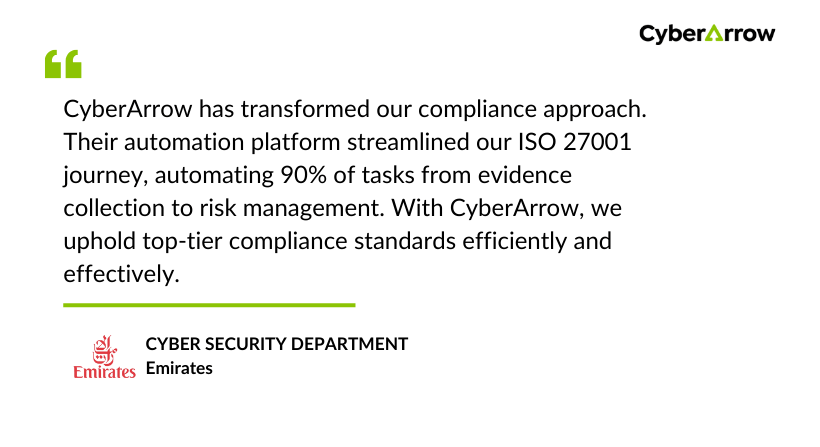
See what our customers have to say about CyberArrow GRC:
The future of GRC systems
Looking ahead, GRC systems will continue to evolve. We can expect:
- AI-driven risk analysis: Smarter tools that predict risks before they happen.
- Deeper automation: More compliance checks running automatically.
- Stronger cyber security integration: GRC tools aligning with advanced security platforms.
- Global standards: Better handling of cross-border compliance requirements.
Organizations that embrace modern systems like CyberArrow GRC will have a strong competitive edge.
Conclusion
A GRC system is not just a nice-to-have tool anymore. It is a must-have for businesses that want to stay compliant, manage risks, and build long-term trust with customers and regulators. By centralizing governance, risk, and compliance into one system, organizations can save time, reduce costs, and avoid costly errors.
If you are looking for the best solution to manage governance, risk, and compliance in 2025, CyberArrow GRC is the answer. It is designed to automate GRC programs for organizations of all types and sizes, making compliance simple, risk management smarter, and governance stronger.
FAQs
What does a GRC system do?
A GRC system helps businesses manage governance, risk, and compliance in one place. It centralizes processes, automates compliance, and makes audits easier.
Is a GRC system only for large companies?
No. Modern GRC systems like CyberArrow GRC are designed for small businesses, mid-sized companies, and large enterprises.
How does a GRC system improve efficiency?
It reduces manual work, automates compliance tracking, and provides real-time alerts to help teams respond quickly to issues.
