


What is the NIST AI Risk Management Framework? NIST AI RMF
Artificial Intelligence (AI) is changing the world. From hospitals to banking to education, AI systems help us do things faster and smarter. But with that power comes big responsibility. If we don’t manage AI risks properly, it can harm people, break laws, or damage trust.
To help organizations manage these risks, the National Institute of Standards and Technology (NIST) released the AI Risk Management Framework (AI RMF). This guide helps anyone building, using, or managing AI to do it in a safe, fair, and responsible way.
In this blog, we’ll explain what the NIST AI RMF is, why it matters, how to use it, and how tools like CyberArrow GRC can help automate compliance with the framework.
- What is the NIST AI Risk Management Framework (AI RMF)?
- Why did NIST create this framework?
- A quick history of the NIST AI RMF
- Who should use the NIST AI RMF?
- The four AI RMF functions
- How the AI RMF helps with trustworthy AI
- Profiles: Tailoring the framework
- Benefits of using the NIST AI RMF
- Is the NIST AI RMF mandatory?
- Common challenges with manual AI RMF compliance
- How CyberArrow GRC helps automate NIST AI RMF
- Final thoughts
- FAQs
What is the NIST AI Risk Management Framework (AI RMF)?
The NIST AI RMF is a guide created by NIST to help organizations manage the risks linked to Artificial Intelligence. It is not a law, but a voluntary framework. Any business, agency, or group that uses or builds AI can use it to reduce harm and increase trust.
The AI RMF is built on two main parts:
- The Core: This is a list of actions to manage AI risks.
- The Profiles: These are ways to tailor the Core to different use cases.
It works like a checklist that helps you ask the right questions at each step of your AI journey, from design to deployment.
Why did NIST create this framework?
AI is powerful, but it’s not perfect. If not designed well, AI systems can make biased decisions, leak personal data, or create safety risks. NIST built this framework to:
- Improve public trust in AI.
- Encourage ethical design and use of AI.
- Help organizations avoid legal, security, and ethical problems.
- Offer a common language for everyone working with AI.
The NIST AI RMF brings everyone from small startups to large governments onto the same page about AI risk.
A quick history of the NIST AI RMF
The development of the AI RMF started in 2021 after an executive order from the U.S. government. The goal was to create trustworthy AI systems in both public and private sectors.
After collecting feedback from researchers, businesses, and regulators, NIST released Version 1.0 of the AI RMF in January 2023.
It’s designed to be flexible and updated as technology changes. It’s not a strict rulebook but a helpful guide that grows with your AI program.
Who should use the NIST AI RMF?
The framework is designed for anyone involved with AI, including:
- AI developers and data scientists.
- Business leaders and policymakers.
- Legal, risk, and compliance teams.
- Third-party vendors and contractors.
- Government agencies.
- Startups and enterprise organizations.
Whether you’re building your first AI model or already have AI tools in production, the AI RMF helps keep your systems safe, lawful, and trusted.
The four AI RMF functions
The Core of the framework is made up of four main functions:
1. Map
This is about understanding how your AI system works and what it might affect. It includes:
- Who is using the AI?
- What is the system supposed to do?
- What risks could happen?
Mapping is the first step to being transparent about how AI decisions are made.
2. Measure
Here you test and evaluate the AI system. It includes:
- Checking for bias or fairness issues.
- Measuring how well the AI performs.
- Looking at data privacy and security.
This function helps you know if your system is safe and reliable.
3. Manage
Now you take action on the risks you found. This involves:
- Fixing problems.
- Updating processes.
- Training staff.
Managing risks means making changes and being responsible.
4. Govern
This part is about oversight. It ensures:
- Roles and duties are clear.
- Accountability is built into the AI lifecycle.
- Ethical standards are followed.
Governance is what makes your AI risk strategy real and sustainable.
How the AI RMF helps with trustworthy AI
The goal of the NIST AI RMF is not just to reduce risks, but to build trustworthy AI. According to NIST, a trustworthy AI system has these seven qualities:
- Valid and reliable.
- Safe.
- Secure and resilient.
- Accountable and transparent.
- Explainable and interpretable.
- Privacy-enhanced.
- Fair and with harmful bias managed.
The framework helps organizations make sure their AI systems meet these qualities.
Profiles: Tailoring the framework
The AI RMF includes Profiles that help organizations apply the Core functions in a way that fits their needs. For example:
- A hospital using AI for patient care may focus more on safety and privacy.
- A bank using AI for credit scoring may care more about fairness and explainability.
These Profiles allow you to adapt the AI RMF to your specific risk landscape.
Quick link: What is ISO 42001?
Benefits of using the NIST AI RMF
Using this framework helps organizations:
- Identify and manage AI risks early.
- Comply with current and future regulations.
- Build customer and stakeholder trust.
- Improve internal governance and documentation.
- Support ethical and responsible AI innovation.
It’s also helpful for teams preparing for external audits or working across multiple standards.
Is the NIST AI RMF mandatory?
No, it’s not mandatory. But it is strongly recommended by industry experts and government bodies. Over time, following the AI RMF may become a key factor in:
- Winning government contracts.
- Meeting international AI laws.
- Proving ethical AI use to clients.
Organizations that use the framework now are more likely to be ahead of future compliance rules.
Common challenges with manual AI RMF compliance
Applying the NIST AI RMF manually can be very time-consuming. Some common issues include:
- Keeping track of risks across multiple teams.
- Managing evidence and controls in spreadsheets.
- Creating reports for stakeholders or auditors.
- Aligning AI practices with ISO, NIST, GDPR, or local laws.
That’s why many organizations are now turning to automation.
How CyberArrow GRC helps automate NIST AI RMF
CyberArrow GRC is an enterprise-grade platform that helps businesses manage risk, compliance, and governance all in one place. For teams implementing the NIST AI RMF, CyberArrow can help by:
- Providing AI risk mapping templates.
- Automating documentation and control tracking.
- Centralizing policy and procedure management.
- Offering cross-mapping with standards like ISO 42001, NIST 800-53, and GDPR.
- Giving dashboards for real-time risk posture.
Whether you’re using AI for customer service, finance, healthcare, or education, CyberArrow helps you implement NIST AI RMF faster, with less effort.
You don’t need to manage separate tools or maintain spreadsheets. CyberArrow’s unified GRC platform keeps everything organized, traceable, and audit-ready.
Final thoughts
The NIST AI Risk Management Framework is a powerful tool for building safer, more ethical AI. As AI grows, so do the risks. Waiting to manage these risks can lead to real-world harm, legal trouble, or reputational damage.
By adopting the NIST AI RMF and automating it with a platform like CyberArrow GRC, your organization can stay ahead of threats, meet compliance expectations, and build trust in your AI systems.
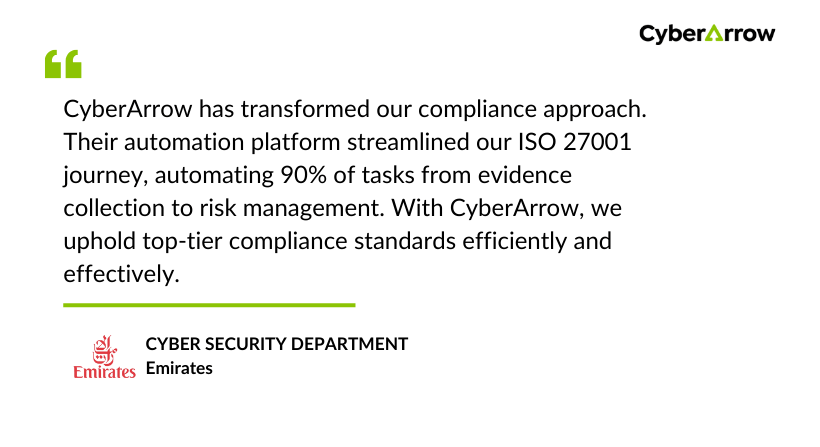
See what a global brand like Emirates has to say about CyberArrow GRC:
FAQs
What is the NIST AI RMF, and why is it important?
The NIST AI RMF is a guide created by the National Institute of Standards and Technology to help organizations manage the risks of using Artificial Intelligence. It is important because it helps build safe, fair, and trustworthy AI systems while protecting people, data, and businesses.
Is the NIST AI Risk Management Framework mandatory?
No, the NIST AI RMF is not required by law. It is a voluntary framework, but it is widely used and recommended. Many businesses follow it to stay ahead of future rules, build trust with users, and reduce AI risks.
Who should use the NIST AI RMF?
Any organization that builds, uses, or manages AI can use the framework. This includes developers, business leaders, IT teams, government agencies, and legal or compliance staff. It helps all teams speak the same language about AI risk.
