What is the EU AI Act? How to comply with it?
Artificial Intelligence (AI) is growing fast. From chatbots and automation to face recognition and hiring software, AI is now a big part of business and daily life. However, as AI systems become more powerful, so do the risks. That’s why the European Union (EU) created a new law to control how AI is built and used. This law is called the EU AI Act.
In this blog, we’ll help you understand what the EU AI Act is, who it affects, how it works, and how your business can stay compliant. We’ll also show you how CyberArrow GRC makes compliance simple and stress-free.
- What is the EU AI Act?
- Why was the EU AI Act created?
- Who needs to follow the EU AI Act?
- Key terms and definitions
- How the EU AI Act works
- Risk categories under the EU AI Act
- Steps to comply with the EU AI Act
- Penalties for not complying
- Common challenges businesses face
- How CyberArrow GRC helps you comply with the EU AI Act
- Conclusion
What is the EU AI Act?
The EU AI Act is a new law passed by the European Union to regulate Artificial Intelligence. It is the world’s first complete legal framework made to ensure AI systems are safe, fair, and trustworthy.
The law sets rules on how companies can use AI, based on how risky the system is. High-risk AI systems must follow strict rules. Some AI uses are banned completely. Others with low risk have fewer rules.
The goal is to protect people from harm, bias, or misuse while still allowing innovation.
Why was the EU AI Act created?
AI brings many benefits. It helps doctors find diseases early. It makes customer support faster. It can even help reduce fraud. But AI also has dangers.
AI can make unfair decisions, especially when it is trained on biased data. Some systems can be used to watch people without consent. Others may replace human jobs without clear rules or protections.
The EU wanted to make sure people stay safe. They also want to build trust in AI, so businesses and the public can use it with confidence. That’s why the EU AI Act was introduced.
Who needs to follow the EU AI Act?
The EU AI Act applies to any business or group that:
- Develops AI systems for use in the EU.
- Uses AI systems in the EU.
- Sells AI systems to EU customers.
- Imports AI systems into the EU.
This means even if your company is not based in the EU, the law still applies if your AI product is used inside the EU.
Whether you’re a startup, a global tech firm, or a government agency, you must follow the EU AI Act if you work with AI in Europe.
Key terms and definitions
Let’s look at some important terms from the EU AI Act:
- AI system: A machine-based system that makes decisions or predictions with little or no human help.
- Provider: A person or business that creates or develops an AI system.
- User: Someone who uses the AI system in their own work or product.
- Importer: A company that brings an AI system into the EU.
- Distributer: A person or group that sells or provides AI systems.
Understanding these roles is important because each has different responsibilities under the law.
How the EU AI Act works
The EU AI Act sorts AI systems into four levels of risk:
- Unacceptable risk: These are banned. For example, AI that manipulates children or uses social scoring.
- High risk: Allowed but under strict rules. Includes AI for hiring, healthcare, or credit scoring.
- Limited risk: Must follow simple transparency rules. For example, chatbots must tell users they are not human.
- Minimal risk: No special rules. Examples include AI in video games or spam filters.
The higher the risk, the more rules a system must follow.
Risk categories under the EU AI Act
Here’s a deeper look at what these risk levels mean:
1. Unacceptable risk
These systems are banned. They are considered too dangerous or harmful. Examples:
- AI that tricks people into making harmful choices.
- AI used for real-time biometric surveillance in public places.
- AI that scores people’s behavior for rewards or punishments.
2. High risk
These AI systems must follow strict rules. They must go through testing, record keeping, and risk management. They are used in critical areas like:
- Hiring and job decisions.
- Credit scoring.
- Healthcare diagnostics.
- Law enforcement.
- Border control.
- Education systems.
Before use, these systems must be listed in an EU database and meet all safety and fairness rules.
3. Limited risk
These systems are allowed but must inform users clearly. For example:
- Chatbots must state that they are bots.
- AI-generated content must be labeled as such.
Transparency is key for these systems.
4. Minimal risk
These systems can be used freely with no extra rules. Most AI in personal apps, games, or spam filters falls under this group.
Steps to comply with the EU AI Act
If you use or create AI systems in the EU, you’ll need to take some important steps:
Step 1: Identify your risk category
Figure out if your AI system is high-risk, limited risk, or minimal risk. This affects what rules apply.
Step 2: Keep records
You must document how your AI system works. That includes data sources, algorithms, testing results, and changes over time.
Step 3: Assess the risks
You need to perform risk assessments to find and fix any issues with bias, errors, or fairness.
Step 4: Use quality data
AI systems should be trained on high-quality and unbiased data to avoid unfair results.
Step 5: Test and monitor
You must test your AI system regularly. Make sure it behaves as expected and doesn’t harm users.
Step 6: Notify authorities
For high-risk systems, you need to register your AI system in a public EU database and get the needed certifications.
Step 7: Train your team
Make sure your employees know how the system works and how to use it safely and ethically.
Penalties for not complying
The EU AI Act has strong penalties. Fines can be as high as:
- €35 million or 7% of global revenue for using banned AI.
- €15 million or 3% of global revenue for other serious violations.
Ignoring the rules can lead to investigations, bans, and loss of trust. It’s better to comply early than to face these risks later.
Common challenges businesses face
Getting compliant with the EU AI Act is not always easy. Companies often struggle with:
- Understanding how their AI is classified.
- Collecting all the required documents.
- Keeping up with changes in rules.
- Training employees on compliance steps.
- Managing AI risks with limited staff or tools.
Manual compliance takes a lot of time and effort, especially if your business uses multiple frameworks like ISO, NIST, and GDPR.
How CyberArrow GRC helps you comply with the EU AI Act
CyberArrow is a powerful compliance automation platform that simplifies your journey to EU AI Act compliance. Whether you’re managing one AI tool or a full product suite, CyberArrow handles the heavy lifting.
Here’s how it works:
- Automated framework mapping: Instantly cross-map AI controls with other standards like ISO 42001, NIST, and GDPR.
- Evidence collection: Automatically gathers documents and proof for audits.
- Prebuilt templates: Use auditor-ready templates that cover EU AI Act requirements.
- Risk management: Preloaded with AI-specific risk registers and scoring tools.
- Real-time monitoring: Tracks compliance posture, alerts you on gaps, and suggests fixes.
- Team training tools: Make your staff ready with built-in awareness modules.
CyberArrow helps you cut down the time, cost, and confusion of compliance. Instead of dealing with manual spreadsheets or multiple tools, manage everything from one secure platform.
Conclusion
The EU AI Act marks a big step forward in how AI is controlled and used across Europe. It creates clear rules that protect people while letting innovation grow. But following the law can be hard without the right tools.
If your business uses AI, you must prepare for this new law now. The longer you wait, the harder and more costly it becomes.
With CyberArrow GRC, you can:
- Save hundreds of hours of manual work.
- Avoid risks and heavy penalties.
- Show customers you take AI safety seriously.
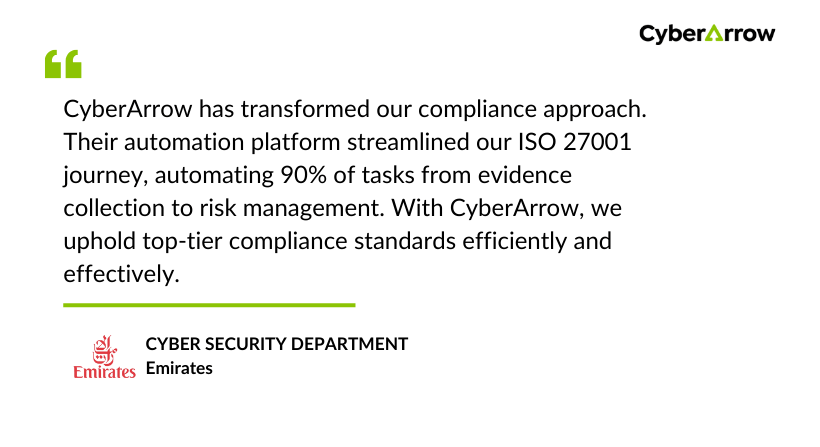
See what a global brand like Emirates has to say about CyberArrow GRC: