


Understanding the different types of audits: A complete guide
Audits are a key part of running a responsible and successful business. They help ensure that your company is following the rules, managing risks, and working efficiently. Whether you’re in finance, technology, healthcare, or manufacturing, audits are essential.
In this guide, we’ll explain the different types of audits, why they matter, and how you can prepare your organization for them without the stress. Let’s break it down in simple terms.
What is an audit?
An audit is a structured review of something, usually your company’s processes, data, or performance. Audits are often done by internal staff or external professionals. The goal is to check for accuracy, uncover risks, and ensure compliance with regulations.
Audits help answer questions like:
- Are our financial statements correct?
- Are we following security policies?
- Are we meeting legal or industry standards?
Why are audits important?
Audits give you and others (like investors, customers, or regulators) confidence that your organization is doing things the right way.
Here’s what audits can help you do:
- Identify and reduce risks.
- Avoid legal fines and penalties.
- Prove compliance with laws and standards.
- Improve internal processes.
- Build trust with stakeholders.
Now let’s dive into the types of audits your organization might face.
1. Financial audit
A financial audit is the most common type of audit. It checks your financial records, like income statements, balance sheets, and cash flow, to make sure everything is accurate and follows accepted accounting standards.
Key facts:
- Usually done by external auditors.
- Helps detect fraud or errors.
- Required by law for public companies.
- Builds trust with investors and banks.
2. Internal audit
An internal audit is done by a company’s own audit team. It looks at how well your internal controls, processes, and risk management practices are working.
Key facts:
- Focuses on business efficiency and risk.
- Ongoing process, not a one-time check.
- Reports directly to top management.
- Helps spot problems before they become serious.
3. External audit
An external audit is done by an outside firm or agency. It adds an extra layer of trust, especially when transparency is important.
Key facts:
- Often required by regulators or investors.
- Objective and independent.
- Common in financial, security, and compliance audits.
- Can result in official certifications or reports.
4. Compliance audit
A compliance audit checks if your company is following specific rules or standards. These could be government laws or industry frameworks like:
- ISO 27001 (Information Security)
- GDPR (Data Privacy)
- SOC 2 (Service Organization Controls)
- UAE PDPL or KSA’s SDAIA PDPL
Key facts:
- Focused on policies, processes, and documentation.
- Usually required in regulated industries.
- Failure can lead to fines or legal action.
- Often reviewed during contract negotiations or due diligence.
5. IT audit
An IT audit reviews your organization’s technology systems, including software, hardware, and data controls.
Key facts:
- Focus on cyber security, access controls, and data protection.
- Helps reduce technology-related risks.
- Essential for industries that handle sensitive data.
- Often linked with frameworks like NIST, ISO, and CIS Controls.
6. Operational audit
An operational audit looks at how well your business operations work. It focuses on efficiency, cost-effectiveness, and how well departments perform their tasks.
Key facts:
- Covers departments like HR, finance, sales, and logistics.
- Seeks ways to improve business processes.
- Usually conducted by internal teams.
- Not always required, but very valuable.
7. Environmental audit
This type of audit checks if your company is following environmental laws and sustainability practices.
Key facts:
- Common in manufacturing, energy, and construction.
- Looks at waste management, emissions, and energy use.
- Often required by government or industry regulations.
- Helps support ESG (Environmental, Social, Governance) goals.
8. Forensic audit
A forensic audit is done when there is suspicion of fraud, theft, or misconduct. These audits are very detailed and are often used in legal investigations.
Key facts:
- Focuses on tracing financial crimes or ethical violations.
- Can involve police or legal teams.
- Results may be used in court.
- Important for uncovering internal or external fraud.
9. Tax audit
A tax audit is done by a government tax authority to check if your business has reported its taxes correctly.
Key facts:
- Reviews income, expenses, and deductions.
- Can be triggered randomly or by red flags in returns.
- Failure can lead to penalties or extra taxes.
- Preparation is key to staying out of trouble.
10. Performance audit
A performance audit checks if a project or program is achieving its goals effectively. It’s often used in government and nonprofit organizations.
Key facts:
- Measures outcomes, results, and value.
- Helps improve budgeting and accountability.
- Encourages better resource use.
- May involve surveys, interviews, and data analysis.
How to prepare for any audit
No matter what type of audit you’re facing, preparation is key. Here are simple steps to follow:
1. Know the requirements
Understand what the audit will cover and which documents or records are needed.
2. Assign roles
Make sure your team knows who is responsible for providing what during the audit.
3. Keep documentation ready
Store policies, procedures, logs, and records in a centralized and organized place.
4. Perform regular internal reviews
Find and fix gaps before an external auditor does.
5. Automate your audit process
Manual prep takes too much time and increases the chance of errors. That’s why many businesses now use GRC platforms to simplify everything.
How CyberArrow GRC makes audits easier
CyberArrow GRC is an enterprise-grade platform that helps businesses automate governance, risk, and compliance tasks, including audit preparation.
Here’s how it helps with all types of audits:
One platform for multiple frameworks
CyberArrow supports ISO 27001, NIST, SOC 2, GDPR, UAE PDPL, SDAIA PDPL, and more, so you don’t need separate tools for each.
Cross-mapping controls
Map one control across different frameworks to avoid duplication and reduce effort by up to 90%.
Automated evidence collection
No more chasing emails or spreadsheets. CyberArrow stores and organizes all required documents in one place, ready for any audit.
Real-time dashboards
Track your audit readiness, control status, and open gaps at any time.
Alerts and task reminders
Get automatic notifications so nothing falls through the cracks before or during an audit.
Expert support
The CyberArrow Customer Success team helps guide you through every step, ensuring smooth implementation and fast results.
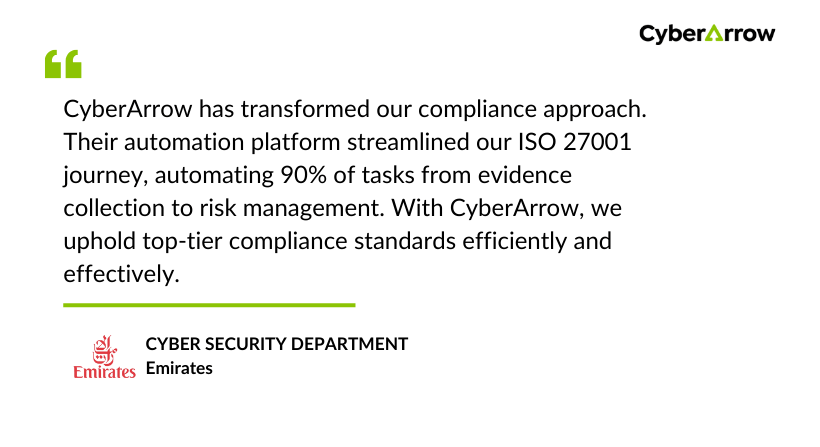
See what a global brand like Emirates has to say about CyberArrow GRC:
Final thoughts
Understanding the different types of audits helps your organization stay compliant, reduce risks, and run smoothly. Whether it’s a financial review, IT audit, or compliance check, being prepared is the best way to succeed.
By using automation tools like CyberArrow GRC, you can remove the stress and manual work from audits. You’ll save time, reduce errors, and stay ready for any review that comes your way.
