

Real-life examples of social engineering attacks
Cybercriminals do not always hack systems. Sometimes, they just trick people.
That’s what social engineering attacks are all about: manipulating human behavior to gain access to sensitive data or systems. These attacks are smart, sneaky, and sadly, very effective.
In this blog, you will learn what social engineering attacks are, real-life examples that caused serious damage, why businesses need to train their teams, and how the CyberArrow Awareness Platform helps build strong human firewalls.
Let’s begin.
What are social engineering attacks?
A social engineering attack is when a cybercriminal tricks someone into giving up private information or access to systems.
These attacks don’t rely on hacking software. Instead, they focus on:
- Trust
- Fear
- Urgency
- Curiosity
In simple words, the attacker hacks people, not computers.
Types of social engineering attacks
Here are the most common types:
- Phishing: fake emails pretending to be legitimate.
- Vishing: phone calls from fake support or banks.
- Smishing: fake text messages.
- Pretexting: pretending to be someone else (like HR or IT).
- Tailgating: physically following someone into a secure area.
- Baiting: leaving a USB or link that tricks someone into clicking.
Real-life examples of social engineering attacks
Let’s look at actual cases showing how dangerous and costly these attacks can be.
1. Twitter’s 2020 hack
What happened:
In July 2020, Twitter faced a major breach. High-profile accounts like Elon Musk, Barack Obama, and Apple were hacked.
How it worked:
The attackers used vishing (voice phishing). They called Twitter employees pretending to be from the IT department. The employees gave them access to internal tools. The attackers then posted fake tweets asking for Bitcoin.
Damage:
- $118,000 stolen in cryptocurrency.
- Huge damage to Twitter’s brand and trust.
- Global headlines for days.
Lesson:
Even the world’s top tech companies are vulnerable when employees are not trained to spot social engineering attacks.
2. Sony Pictures – 2014
What happened:
Sony Pictures was hit by a massive data breach. Personal emails, unreleased movies, and sensitive employee data were leaked.
How it worked:
The attack started with a simple phishing email. Once an employee clicked the fake link, malware entered the system and spread quickly.
Damage:
- Data from 100+ terabytes stolen.
- Internal emails made public.
- Huge financial loss and embarrassment.
Lesson:
One click from an untrained employee can shut down an entire organization.
3. Ubiquiti Networks – $46.7 Million Loss
What happened:
Ubiquiti, a tech company, lost $46.7 million in 2015 due to a fake email scam.
How it worked:
The attacker pretended to be a senior executive and emailed the finance department. The employee believed it and transferred funds to a fake bank account overseas.
Damage:
- Almost $47 million lost.
- Major blow to internal trust and security.
Lesson:
Social engineering attacks don’t always use viruses. Sometimes, a well-crafted email is enough.
4. Google and Facebook – $100 Million Scam
What happened:
Between 2013 and 2015, a scammer tricked both Google and Facebook into wiring over $100 million.
How it worked:
The attacker posed as a vendor (Quanta Computer) that worked with both companies. He sent fake invoices to the companies, and employees paid them without checking closely.
Damage:
- Over $100 million stolen.
- Global embarrassment for tech giants.
Lesson:
Even the most advanced tech companies are not safe from well-planned social engineering attacks.
5. RSA Security – 2011 Attack
What happened:
RSA is a cyber security company. In 2011, it suffered a sophisticated phishing attack.
How it worked:
An employee received an email with the subject: “2011 Recruitment Plan.” Inside was an Excel file with malware. Once opened, attackers got access to the company’s SecurID authentication tokens used by many global firms.
Damage:
- Several government and private clients were affected.
- Millions spent on fixing and replacing security tokens.
Lesson:
Even cyber security companies are at risk when employees don’t know how to handle suspicious emails.
Why social engineering works so well
You might wonder how people fall for these scams.
Here are the reasons:
- People trust too easily.
- Attackers sound confident and professional.
- The scams are very personalized.
- Victims feel pressured to act quickly.
In most cases, it’s not technology that fails, it’s human error. That’s why training your employees is your first and strongest line of defense.
The cost of social engineering attacks
According to IBM’s 2023 Data Breach Report:
- The average cost of a data breach is $4.45 million.
- Social engineering is one of the top causes of cyberattacks.
- 95% of breaches are caused by human mistakes.
Cybercriminals don’t need to break in. They just need to be invited in by someone who didn’t know better.
How to protect your organization
Here are a few simple steps to reduce risk:
- Train employees regularly: People are your best defense, but only if they are trained.
- Test with simulated attacks: Run fake phishing or vishing tests to see how employees respond.
- Promote a security-first culture: Make it normal to double-check emails, calls, and links.
- Use security tools: Tools like multi-factor authentication and email filters can help, but they are not enough on their own.
How CyberArrow Awareness Platform helps
The CyberArrow Awareness Platform is built to automate cyber security awareness training across your organization and protect you from social engineering attacks.
Here’s how it works:
1. Automated training for all employees
No more boring PowerPoints. CyberArrow offers:
- Easy-to-follow videos.
- Real-world examples.
- Quizzes and interactive modules.
- Short sessions that fit into busy workdays.
2. Realistic phishing simulations
You can run simulated phishing and vishing attacks to:
- Measure how employees respond.
- Identify high-risk users.
- Provide extra training where needed.
3. Smart dashboards and risk scoring
Managers get:
- Reports on training progress.
- Risk scores for teams or individuals.
- Insights on where to improve.
4. Builds a culture of cyber awareness
CyberArrow helps you go beyond training, it creates a culture where:
- Employees are alert.
- Mistakes are reported quickly.
- Security becomes a shared responsibility.
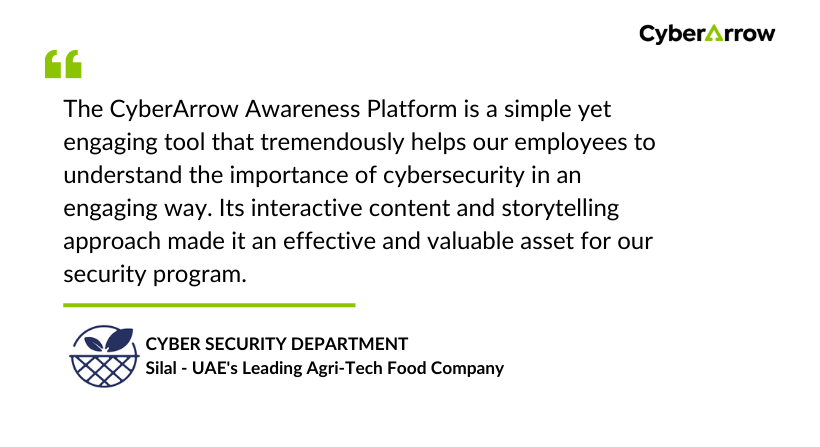
Read how CyberArrow awareness platform increased security awareness among Silal’s employees.
See what Silal has to say about CyberArrow Awareness Platform:
Final thoughts
Social engineering attacks are not going away. In fact, they are getting smarter every year. Cybercriminals are finding new ways to trick people, steal data, and damage companies.
Technology alone can’t protect you. Your people must be your strongest defense. That’s where the CyberArrow Awareness Platform helps organizations.
