(ADHICS) Abu Dhabi Healthcare Information and Cyber Security Standard: A complete guide
The healthcare sector in Abu Dhabi is rapidly evolving, with digital technologies playing a pivotal role in enhancing patient care and operational efficiency. However, this digital transformation brings significant challenges, particularly in safeguarding sensitive patient information against cyber threats. Recognizing the critical need for robust data protection measures, the Department of Health – Abu Dhabi (DoH) introduced the Abu Dhabi Healthcare Information and Cyber Security Standard (ADHICS).
This standard is a comprehensive framework designed to ensure the confidentiality, integrity, and availability of healthcare information across the Emirate.
In this guide, we will delve into the intricacies of ADHICS, its significance, core components, compliance strategies, and how solutions like CyberArrow GRC can facilitate seamless adherence to this standard.
What is ADHICS?
ADHICS, established by the DoH, sets forth mandatory requirements for all healthcare entities operating within Abu Dhabi. Its primary objective is to provide a structured approach to managing and protecting healthcare information, ensuring that patient data remains secure against unauthorized access and potential cyber threats. The standard is applicable to a broad spectrum of organizations, including hospitals, clinics, insurance providers, and any other entities that handle patient information.
The importance of ADHICS
Implementing ADHICS is crucial for several reasons:
- Enhancing patient trust: By adhering to stringent data protection protocols, healthcare providers can assure patients that their sensitive information is handled with the utmost care, thereby fostering trust and confidence.
- Regulatory compliance: Compliance with ADHICS ensures that healthcare organizations meet local regulatory requirements, mitigating the risk of legal repercussions and potential fines.
- Operational resilience: A robust cyber security framework enables healthcare entities to effectively respond to and recover from cyber incidents, minimizing disruptions to critical services.
- Facilitating digital transformation: Secure information systems are foundational to the successful implementation of digital health initiatives, such as telemedicine and electronic health records.
Core components of ADHICS
ADHICS encompasses several key areas aimed at establishing a comprehensive information security management system:
1. Information security governance
Establishing a governance framework that defines roles, responsibilities, and policies related to information security is fundamental. This includes the formation of an information security committee and the development of an overarching security policy.
2. Risk management
Conducting regular risk assessments to identify, evaluate, and mitigate information security risks is a critical component of ADHICS. This proactive approach helps in addressing vulnerabilities before they can be exploited.
3. Access control
Implementing strict access controls ensures that only authorized personnel have access to sensitive information. This involves user authentication mechanisms, role-based access controls, and regular reviews of access rights.
4. Data protection
Measures such as data encryption, secure storage solutions, and data masking techniques are employed to protect data both at rest and in transit.
5. Incident response and management
Developing and maintaining an incident response plan enables organizations to swiftly detect, respond to, and recover from security incidents, thereby minimizing potential damage.
6. Physical and environmental security
Protecting physical assets, such as servers and data centers, from environmental hazards and unauthorized access is essential to ensure the overall security of information systems.
7. Compliance monitoring and audit
Regular monitoring and auditing of information security practices help ensure ongoing compliance with ADHICS and identify areas for improvement.
Quick link: What is the Gramm-Leach-Bliley Act (GLBA)?
Steps to achieve ADHICS compliance
Achieving compliance with ADHICS involves a systematic approach:
- Gap analysis: Conduct a thorough assessment to identify discrepancies between current practices and ADHICS requirements.
- Develop an action plan: Based on the gap analysis, create a detailed plan outlining the steps needed to address identified gaps, assign responsibilities, and set timelines.
- Implement security controls: Deploy the necessary technical and organizational measures, such as firewalls, intrusion detection systems, and employee training programs, to meet ADHICS standards.
- Employee training and awareness: Regularly train staff on information security policies, procedures, and best practices to cultivate a security-conscious culture.
- Regular testing and monitoring: Continuously monitor information systems for vulnerabilities and conduct periodic security assessments to ensure the effectiveness of implemented controls.
- Documentation and record-keeping: Maintain comprehensive records of all security policies, procedures, incidents, and compliance efforts as evidence of adherence to ADHICS.
Challenges in implementing ADHICS
While the benefits of ADHICS are substantial, organizations may encounter challenges during implementation:
- Resource constraints: Allocating sufficient financial and human resources to implement and maintain the required security measures can be demanding.
- Complexity of requirements: Understanding and interpreting the detailed provisions of ADHICS may require specialized expertise.
- Integration with existing systems: Ensuring that new security measures are compatible with legacy systems can be complex and may necessitate system upgrades.
- Continuous compliance: Maintaining compliance is an ongoing process that requires regular reviews and updates to security practices in response to evolving threats.
Quick link: HIPAA business associate agreement (BAA)
How CyberArrow GRC helps with ADHICS compliance
CyberArrow GRC is designed to help healthcare institutions in Abu Dhabi meet and maintain compliance with ADHICS by automating much of the manual work involved in governance, risk, and compliance.
Here’s how CyberArrow can support your ADHICS journey:
1. Centralized compliance dashboard: Track the status of all compliance activities from one platform. CyberArrow gives healthcare entities visibility into their current compliance posture, upcoming tasks, and identified risks.
2. Automated risk assessments: CyberArrow GRC’s automated risk assessment engine helps you identify, score, and prioritize security risks. You’ll save time and avoid overlooking critical threats that manual assessments might miss.
3. Policy and document management: CyberArrow helps you create, manage, and distribute ADHICS-compliant security policies and procedures. It keeps all documents up-to-date, version-controlled, and easily accessible for audits.
4. Training and awareness: CyberArrow offers a built-in awareness module to help train employees on data protection, social engineering attacks, and ADHICS security practices—all within the same platform.
5. Continuous monitoring and alerts: Receive real-time alerts for suspicious activities or compliance gaps. The system ensures you’re always one step ahead and can respond quickly to risks.
6. Built-in audit trail: For ADHICS, maintaining detailed logs of all activities and decisions is essential. CyberArrow keeps a complete audit trail, making internal and external audits much simpler and faster.
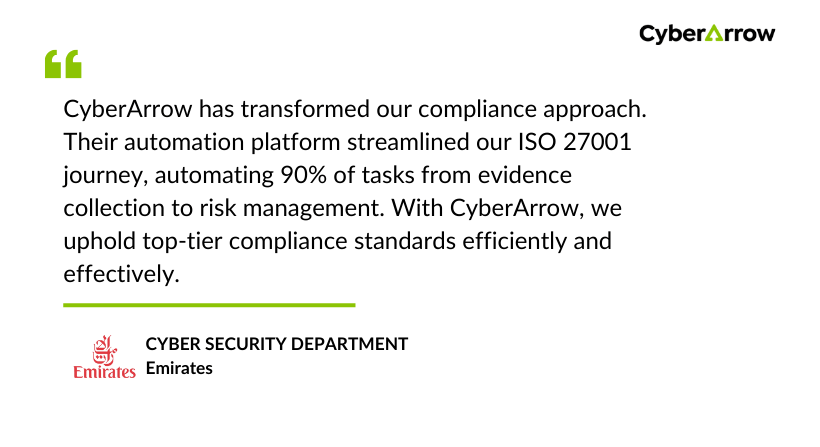
See what global brands like Emirates has to say about CyberArrow GRC: