


What is the Gramm-Leach-Bliley Act (GLBA)? A complete guide
Data privacy is a growing concern, especially in the financial sector, where institutions handle vast amounts of sensitive customer information. The Gramm-Leach-Bliley Act (GLBA) was enacted to protect consumer financial data and ensure that financial institutions follow strict security measures.
If your business deals with financial data, understanding and complying with GLBA is essential. Failure to meet GLBA requirements can result in heavy fines, legal penalties, and reputational damage.
This guide will cover everything you need to know about GLBA, including its requirements, compliance measures, and how CyberArrow GRC can help automate the compliance process.
What is the Gramm-Leach-Bliley Act (GLBA)?
The Gramm-Leach-Bliley Act (GLBA) is a U.S. federal law passed in 1999 to regulate how financial institutions handle consumer financial data. It mandates that these institutions must protect customer information and provide clear privacy notices.
GLBA applies to a wide range of organizations, including:
- Banks and credit unions
- Mortgage brokers
- Investment firms
- Insurance companies
- Debt collection agencies
The primary goal of GLBA is to ensure financial institutions handle customer data responsibly while giving consumers control over how their information is shared.
Key components of GLBA
GLBA consists of three main rules that financial institutions must follow:
1. The financial privacy rule
The financial privacy rule requires financial institutions to inform customers about:
- What personal data do they collect
- How they use the data
- Who do they share the data with
- How customers can opt out of data sharing
Under this rule, financial institutions must provide a clear privacy notice at the beginning of a customer relationship and update it regularly.
2. The safeguards rule
The safeguards rule mandates that financial institutions develop, implement, and maintain a comprehensive security program to protect consumer data.
This program must include:
- Risk assessments to identify security threats
- Employee training on data protection
- Access controls to restrict data usage
- Incident response plans to handle breaches
3. The pretexting protection rule
The pretexting protection rule prevents unauthorized access to personal financial information through social engineering attacks. It requires institutions to:
- Educate employees on detecting fraudulent activities
- Implement strict identity verification processes
- Prevent unauthorized sharing of financial data
Who must comply with GLBA?
Any business that provides financial services or handles consumer financial information must comply with GLBA. This includes:
- Banks and savings institutions
- Credit unions
- Mortgage lenders and brokers
- Investment firms and financial advisors
- Insurance providers
- Tax preparation services
Even third-party service providers that work with financial institutions must comply with GLBA if they have access to sensitive financial data.
Quick link: What is Information Assurance (IA)?
Steps to achieve GLBA compliance
1. Conduct a risk assessment
Identify potential risks to consumer financial data, such as unauthorized access, data breaches, or insider threats. This helps in implementing security measures to protect data.
2. Implement strong security policies
Financial institutions must develop written security policies covering data encryption, access controls, and employee responsibilities in handling customer information.
3. Train employees on GLBA requirements
Since human error is a leading cause of data breaches, organizations must provide regular security awareness training to employees. This ensures staff understands how to handle customer data securely.
4. Limit access to sensitive information
Only authorized personnel should have access to sensitive financial data. Role-based access control (RBAC) should be used to prevent unauthorized users from accessing confidential information.
5. Develop an incident response plan
Organizations must have a breach response plan in place to:
- Detect and contain data breaches
- Notify affected customers
- Report breaches to regulatory authorities
6. Regularly audit and monitor compliance
Conduct periodic audits to ensure all GLBA requirements are met. Continuous monitoring and compliance tracking help prevent security lapses.
Penalties for GLBA non-compliance
Failure to comply with GLBA can lead to:
- Fines of up to $100,000 per violation for financial institutions
- Individual penalties of up to $10,000 for officers and directors
- Imprisonment for up to 5 years for severe violations
- Reputation damage and loss of customer trust
How CyberArrow GRC helps with GLBA compliance
Complying with GLBA manually can be time-consuming and complex. CyberArrow GRC simplifies the process through:
1. Automated risk management
- Conducts risk assessments to identify potential threats to consumer financial data.
- Helps organizations prioritize risk mitigation efforts with a structured approach.
2. Cross-standard compliance mapping
- Maps GLBA requirements with other frameworks like ISO 27001, SOC 2, and NIST.
- Reduces duplicate compliance efforts by aligning security controls across multiple regulations.
3. Continuous compliance monitoring
- Tracks compliance status in real-time to detect any non-compliance issues.
- Provides automated reports to keep organizations audit-ready at all times.
4. Pre-built GLBA compliance templates
- Offers pre-approved policies and templates for financial institutions.
- Ensures quick implementation of GLBA requirements without starting from scratch.
5. Access control & data security
- Helps organizations implement strong access controls to prevent unauthorized access to financial data.
- Ensures compliance with GLBA’s safeguards rule by enforcing security best practices.
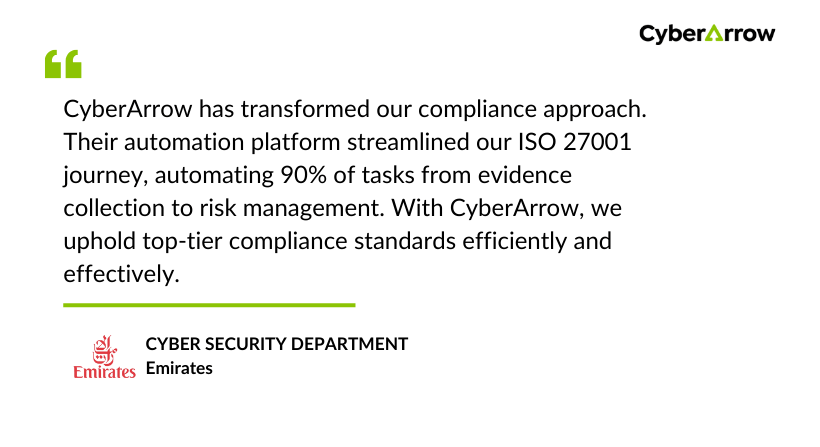
See what a global brand like Emirates has to say about CyberArrow GRC:
Conclusion
The Gramm-Leach-Bliley Act (GLBA) is a crucial regulation that protects consumer financial data. Financial institutions must comply with GLBA’s Financial Privacy Rule, Safeguards Rule, and Pretexting Protection Rule to avoid legal penalties and security risks.
CyberArrow GRC makes GLBA compliance effortless by automating risk assessments, compliance tracking, and security monitoring. By using CyberArrow GRC, financial institutions can:
- Ensure continuous compliance with GLBA and other security frameworks.
- Reduce manual work through automation.
- Protect sensitive financial data with strong security controls.
