


ISO 27001 vs ISO 20000: Key differences and why they matter
In today’s digital world, businesses must ensure strong cyber security and efficient IT service management. Two important standards that help achieve this are ISO 27001 and ISO 20000.
- ISO 27001 focuses on information security management to protect data from cyber threats.
- ISO 20000 focuses on IT service management (ITSM) to ensure high-quality IT services.
Both standards play a crucial role in business operations, risk management, and compliance. But how do they differ? Which one should your organization follow?
In this guide, we will compare ISO 27001 vs ISO 20000, explaining:
- The purpose and scope of each standard.
- Key differences and similarities.
- How organizations can achieve compliance.
- How CyberArrow GRC automates compliance for both standards.
By the end, you will know which standard suits your business needs and how to simplify compliance management.
What is ISO 27001?
ISO 27001 is an international standard for information security management. It helps organizations establish an Information Security Management System (ISMS) to protect sensitive data from threats like hacking, phishing, and insider attacks.
Key objectives of ISO 27001
- Protect sensitive data from cyber threats and unauthorized access.
- Ensure confidentiality, integrity, and availability (CIA) of information.
- Identify, assess, and mitigate security risks.
- Meet regulatory and legal compliance requirements.
- Enhance customer trust in data security.
Organizations that follow ISO 27001 implement strict security controls, risk assessments, and incident response plans to prevent data breaches.
Who needs ISO 27001?
ISO 27001 is essential for businesses handling sensitive information, such as:
- IT companies
- Financial institutions
- Healthcare organizations
- E-commerce platforms
- Government agencies
Any organization that wants to protect customer data, prevent cyberattacks, and improve security governance should adopt ISO 27001.
What is ISO 20000?
ISO 20000 is the international standard for IT service management (ITSM). It ensures that IT services are efficient, reliable, and aligned with business needs.
Key objectives of ISO 20000
- Improve IT service quality and customer satisfaction.
- Reduce downtime and service disruptions.
- Ensure smooth incident, problem, and change management.
- Align IT services with business goals.
- Continuously improve IT service performance.
ISO 20000 helps organizations establish an IT Service Management System (SMS) to ensure structured IT operations.
Quick link: What is ISO 27017 compliance?
Who needs ISO 20000?
ISO 20000 is useful for organizations that provide IT services, including:
- Managed Service Providers (MSPs)
- IT consulting firms
- Cloud service providers
- Large enterprises with in-house IT teams
Any company that wants to standardize IT processes, enhance service efficiency, and meet customer expectations should consider ISO 20000.
ISO 27001 vs ISO 20000: Key differences
While ISO 27001 and ISO 20000 are both related to IT operations, they serve different purposes.
Comparison table: ISO 27001 vs ISO 20000
| Feature | ISO 27001 | ISO 20000 |
| Focus | Information Security Management | IT Service Management |
| Main Goal | Protecting data and preventing cyber threats | Improving IT service quality and efficiency |
| Management System | Information Security Management System (ISMS) | Service Management System (SMS) |
| Key Processes | Risk management, security policies, access control, incident response | IT service planning, incident management, change control, service reporting |
| Who Needs It? | Companies handling sensitive data (e.g., finance, healthcare, IT) | Organizations providing IT services (e.g., MSPs, cloud providers) |
| Compliance Benefits | Prevents data breaches, ensures regulatory compliance, improves customer trust | Reduces downtime, enhances IT service delivery, increases operational efficiency |
Main differences
- ISO 27001 focuses on security, while ISO 20000 focuses on service quality.
- ISO 27001 helps prevent cyber threats, while ISO 20000 ensures efficient IT service delivery.
- ISO 27001 applies to all industries, while ISO 20000 is mainly for IT service providers.
ISO 27001 vs ISO 20000: Similarities
Despite their differences, ISO 27001 and ISO 20000 share some common principles:
- Both require a structured management system (ISMS for ISO 27001, SMS for ISO 20000).
- Both emphasize risk management to identify and mitigate threats.
- Both require continuous improvement to maintain compliance.
- Both involve regular audits and monitoring to ensure effectiveness.
Organizations can benefit from implementing both standards together to strengthen security while improving IT service efficiency.
How to achieve ISO 27001 and ISO 20000 compliance
Achieving compliance with ISO 27001 and ISO 20000 requires a structured approach:
Steps to implement ISO 27001 compliance
- Establish an Information Security Management System (ISMS).
- Conduct a risk assessment and identify security threats.
- Implement security controls (e.g., encryption, access control).
- Train employees on cyber security best practices.
- Monitor security incidents and conduct internal audits.
- Get certified through an independent audit.
Steps to implement ISO 20000 compliance
- Develop an IT Service Management System (SMS).
- Define service management policies and procedures.
- Ensure effective incident, change, and problem management.
- Monitor IT service performance and customer feedback.
- Conduct internal audits and prepare for certification.
Manually managing compliance for both ISO 27001 and ISO 20000 can be complex and time-consuming. That’s why compliance automation solutions are essential.
Quick link: Healthcare cyber security compliance
Automate ISO 27001 and ISO 20000 compliance with CyberArrow GRC
CyberArrow GRC is a powerful compliance automation platform that helps organizations achieve ISO 27001, ISO 20000, and other cyber security standards with ease.
How CyberArrow GRC helps with compliance
- Automates up to 90% of compliance tasks: Saves time and effort.
- Provides pre-built templates for ISO 27001 and ISO 20000 policies: Simplifies documentation.
- Continuously monitors compliance status: Detects security and service management gaps.
- Integrates with 80+ IT tools: Ensures seamless compliance tracking.
- Automates risk assessments and audit reporting: Reduces manual work.
- Supports multiple cyber security standards: Covers ISO 27001, ISO 20000, ISO 27035, ISO 22301, and more.
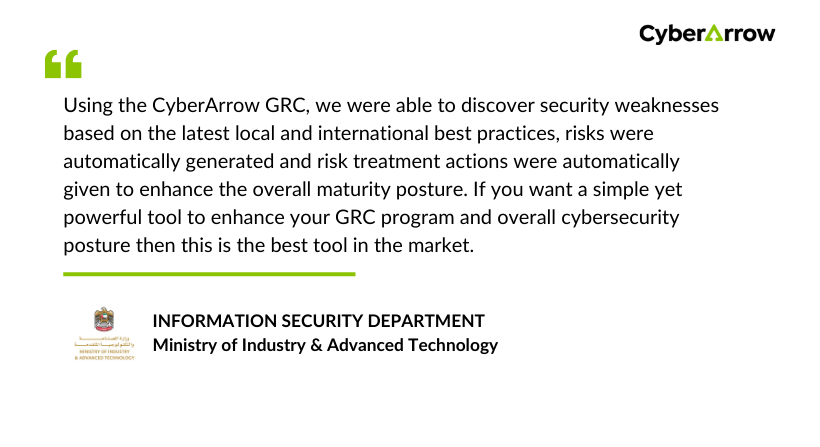
See what MOIAT has to say about CyberArrow GRC:
Conclusion: Which standard is right for your business?
- If your goal is to protect sensitive data and prevent cyber threats, choose ISO 27001.
- If you want to improve IT service quality and efficiency, go for ISO 20000.
- If your organization deals with both cyber security and IT service management, implementing both standards provides maximum benefits.
Achieving and maintaining compliance manually can be complex and time-consuming. That’s why businesses rely on CyberArrow GRC to automate ISO 27001, ISO 20000, and other cyber security standards.
If you want to simplify compliance, enhance security, and improve IT service management, CyberArrow GRC is the solution.
