NIST 800-171 controls: Everything you need to know
NIST 800-171 controls are a set of cyber security requirements that organizations must follow to protect Controlled Unclassified Information (CUI). If your business works with the U.S. government, Department of Defense (DoD), or other federal agencies, you must comply with NIST 800-171 to ensure sensitive data remains secure.
These controls are designed to prevent unauthorized access, protect sensitive information, and reduce cyber security risks. Failure to comply can result in contract loss, security breaches, and legal penalties.
This guide will explain what NIST 800-171 controls are, why they matter, and how businesses can implement them. By the end, you’ll know how to achieve compliance and simplify the process using automation tools like CyberArrow GRC.
- What are NIST 800-171 controls?
- Why are NIST 800-171 controls important?
- Breakdown of NIST 800-171 controls
- 1. Access control
- 2. Awareness and training
- 3. Audit and accountability
- 4. Configuration management
- 5. Identification and authentication
- 6. Incident response
- 7. Maintenance
- 8. Media protection
- 9. Personnel security
- 10. Physical security
- 11. Risk assessment
- 12. Security assessment
- 13. System and communications protection
- 14. System and information integrity
- Steps to achieve NIST 800-171 compliance
- Simplify NIST 800-171 compliance with CyberArrow GRC
What are NIST 800-171 controls?
NIST 800-171 controls are security measures that organizations must apply to protect CUI. These controls are listed in the NIST Special Publication (SP) 800-171, created by the National Institute of Standards and Technology (NIST).
The framework was designed for non-federal organizations that store, process, or transmit government data. The goal is to prevent unauthorized access to sensitive but unclassified information that could impact national security if leaked.
The controls are divided into 14 security families, covering areas like access control, risk management, and incident response. Each control has specific requirements that businesses must follow to stay compliant.
Why are NIST 800-171 controls important?
NIST 800-171 compliance is mandatory for government contractors, subcontractors, and any company handling CUI. These security controls help:
- Protect government data from cyber threats.
- Prevent data breaches and unauthorized access.
- Ensure compliance with federal regulations.
- Improve cyber security standards across industries.
Organizations that fail to follow NIST 800-171 controls may lose contracts, face legal issues, or suffer financial losses due to security failures.
Breakdown of NIST 800-171 controls
NIST 800-171 includes 110 security requirements organized into 14 control families. These families cover different areas of cyber security. Below is an overview of each control category and its key requirements.
1. Access control
Organizations must restrict access to CUI to authorized users only. This includes:
- Limiting user access based on job roles.
- Implementing multi-factor authentication (MFA).
- Preventing unauthorized data sharing.
2. Awareness and training
Employees must be trained on security best practices to prevent human errors that could expose CUI. Training should cover:
- Recognizing phishing and cyber threats.
- Secure password management.
- Proper handling of sensitive information.
3. Audit and accountability
Organizations must track and monitor user activities to detect security risks. This involves:
- Keeping audit logs of system access and changes.
- Detecting and reporting security incidents.
- Reviewing logs regularly for suspicious activity.
4. Configuration management
Security settings must be properly configured and updated to prevent vulnerabilities. This includes:
- Applying software patches and updates.
- Controlling system changes to avoid security gaps.
- Removing unused software and services.
5. Identification and authentication
Organizations must verify the identity of users accessing CUI. Security measures should include:
- Strong password policies.
- Biometric authentication or security tokens.
- Preventing unauthorized access attempts.
6. Incident response
A response plan must be in place for detecting, reporting, and managing security incidents. Businesses should:
- Establish a formal incident response team.
- Document and test incident response procedures.
- Report cyber security events promptly.
7. Maintenance
Systems handling CUI must be regularly maintained to ensure security. This involves:
- Performing regular system updates.
- Monitoring security performance.
- Ensuring third-party vendors follow security policies.
8. Media protection
All storage devices containing CUI must be protected from unauthorized access. This includes:
- Encrypting sensitive data stored on media.
- Controlling access to physical and digital storage.
- Securely disposing of old storage devices.
9. Personnel security
Organizations must ensure that employees handling CUI are trustworthy. This involves:
- Conducting background checks.
- Enforcing security policies for employees and contractors.
- Restricting access after employment termination.
10. Physical security
Physical locations storing CUI must be secured to prevent unauthorized access. Security measures should include:
- Restricted entry to secure areas.
- Surveillance cameras and security personnel.
- Locking storage cabinets and workstations.
11. Risk assessment
Regular risk assessments help businesses identify and address security threats. This process includes:
- Conducting cyber security risk assessments.
- Implementing corrective actions.
- Monitoring security threats continuously.
12. Security assessment
Organizations must evaluate their security controls to ensure compliance. This requires:
- Internal and external security audits.
- Continuous improvement of security policies.
- Documenting security control performance.
13. System and communications protection
Data transmission must be secure to prevent unauthorized interception. Organizations should:
- Use encryption for data in transit and at rest.
- Secure email and communication channels.
- Implement firewall and network protection.
14. System and information integrity
Businesses must protect their systems from malware, viruses, and cyberattacks. This includes:
- Installing antivirus and anti-malware tools.
- Monitoring systems for security vulnerabilities.
- Patching security flaws quickly.
By implementing these NIST 800-171 controls, businesses can reduce cyber security risks and ensure regulatory compliance.
Quick link: What is NIST 800-53 compliance?
Steps to achieve NIST 800-171 compliance
Following NIST 800-171 controls requires a structured approach. Here’s how organizations can meet compliance requirements:
- Identify CUI – Determine which data falls under NIST 800-171.
- Assess security gaps – Conduct an internal audit to compare current security measures with NIST 800-171 controls.
- Develop a security plan – Document how your business will implement security controls.
- Implement security controls – Apply necessary protections, such as encryption, access control, and monitoring tools.
- Monitor compliance continuously – Regularly update security measures, train employees, and conduct security audits.
Meeting these requirements manually can be difficult and time-consuming. Automating compliance can make this process faster and more efficient.
Simplify NIST 800-171 compliance with CyberArrow GRC
Achieving NIST 800-171 compliance can be complex, especially for businesses managing multiple security controls. CyberArrow GRC provides an automated solution to help organizations meet compliance requirements easily.
With CyberArrow GRC, businesses can:
- Automate compliance tracking to ensure all NIST 800-171 controls are met.
- Perform security risk assessments to identify vulnerabilities in real-time.
- Generate compliance reports to prepare for audits.
- Centralize security management to avoid manual errors.
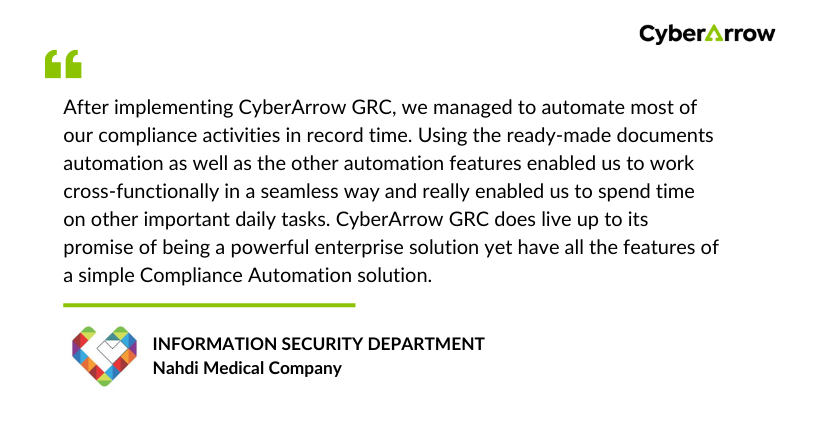
Read how CyberArrow GRC streamlined NIST compliance for Nahdi Medical Company.
See what Nahdi Medical Company has to say about CyberArrow GRC: