


Spoofing vs phishing: Understanding the differences
Cybercriminals use many tricks to steal personal information and money. Two common cyber threats are spoofing and phishing. Many people confuse these terms because both involve deception. However, there are different types of attacks with unique methods and goals.
Spoofing is when a hacker pretends to be someone else, such as a company, person, or website, to trick you. For example, they might send an email from what looks like your bank or create a fake website to steal your login details.
Phishing is when attackers try to make you reveal sensitive information, such as passwords or credit card details. This is usually done through emails, messages, or fake websites that trick you into clicking harmful links or entering your data.
Both spoofing and phishing can cause financial loss, identity theft, and security breaches. That’s why companies must train employees to recognize these threats. With CyberArrow Awareness Platform, businesses can automate employee security training and run real-time phishing simulations to strengthen cyber security.
This article will explain spoofing and phishing, their differences, and how companies can protect themselves.
What is spoofing?
Spoofing happens when hackers pretend to be someone or something they are not. The goal is to gain trust and deceive victims into taking action. Cybercriminals may use spoofing to install malware, steal sensitive data, or commit fraud.
Types of spoofing
- Email spoofing: Attackers send emails that appear to come from a trusted source, such as a bank or colleague. The email may contain malicious links or ask for sensitive information.
- Caller ID spoofing: Scammers fake phone numbers to appear as legitimate callers, such as a government agency or customer support.
- Website spoofing: Cybercriminals create fake websites that look identical to real ones, such as banking or social media sites.
- IP spoofing: Hackers disguise their IP addresses to bypass security systems or launch attacks on networks.
- DNS spoofing: This attack redirects users from a legitimate website to a fraudulent one without their knowledge.
Spoofing is often the first step in a larger attack, such as phishing or malware distribution.
What is phishing?
Phishing is a social engineering attack where hackers trick people into revealing confidential data. These attacks often use fake emails, messages, or websites to manipulate victims into clicking harmful links, downloading malware, or entering login credentials.
Common types of phishing
- Email phishing: Fraudulent emails impersonate banks, online services, or business contacts to steal sensitive information.
- Spear phishing: Targeted phishing attacks focus on specific individuals or companies using personalized messages.
- Smishing (SMS phishing): Fake text messages try to convince victims to click on malicious links or provide private information.
- Vishing (Voice phishing): Scammers call victims, pretending to be from trusted organizations, and ask for confidential data.
- Whaling: A high-level phishing attack targeting executives or senior employees to access corporate data.
Phishing attacks create a sense of urgency, making victims act quickly without verifying the source.
Spoofing vs phishing: What’s the difference?
Both spoofing and phishing rely on deception, but they serve different purposes.
| Feature | Spoofing | Phishing |
| Main goal | Pretend to be a trusted source | Trick victims into revealing sensitive data |
| Method | Fakes email addresses, phone numbers, or websites | Uses fake emails, messages, or calls to steal information |
| Example | An email appears to come from your bank but is actually from a hacker | An email says your account has been hacked and asks you to reset your password on a fake site |
| Result | Confuses victims and builds trust | Directly steals passwords, money, or confidential data |
In many cases, spoofing is used to make phishing attacks more believable. A spoofed email address or website increases the chances that a victim will fall for the scam.
How to protect against spoofing and phishing
For individuals
- Verify before you click: Check the sender’s email, hover over links before clicking, and confirm phone calls from unknown numbers.
- Use strong passwords: Create unique passwords for different accounts and enable two-factor authentication (2FA).
- Stay alert for urgent messages: Attackers often create a sense of urgency to make victims act quickly.
- Keep software updated: Security updates help fix vulnerabilities that attackers exploit.
For Businesses
- Train employees regularly: Security awareness training helps staff recognize spoofing and phishing attempts.
- Enable multi-factor authentication (MFA): Even if an attacker steals a password, MFA adds another layer of protection.
- Use anti-phishing tools: Email security filters can detect and block suspicious messages.
- Run phishing simulations: Testing employees with simulated phishing attacks helps improve awareness.
Automating security awareness with CyberArrow
Employee mistakes are one of the biggest risks in cyber security. Businesses need continuous training to prevent phishing and spoofing attacks. CyberArrow Awareness Platform makes this easy by automating security training and running phishing simulations.
Why choose CyberArrow Awareness Platform?
- Automated employee training: Employees receive regular awareness training without manual effort.
- Real-time phishing simulations: Companies can test employee awareness by sending fake phishing emails to measure their response.
- Detailed reporting: Businesses can track employee performance and identify weak areas.
- User-friendly dashboard: Easy-to-use interface for managing security training and monitoring progress.
With CyberArrow Awareness Platform, businesses can build a human firewall against cyber threats. Prevent phishing attacks before they happen!
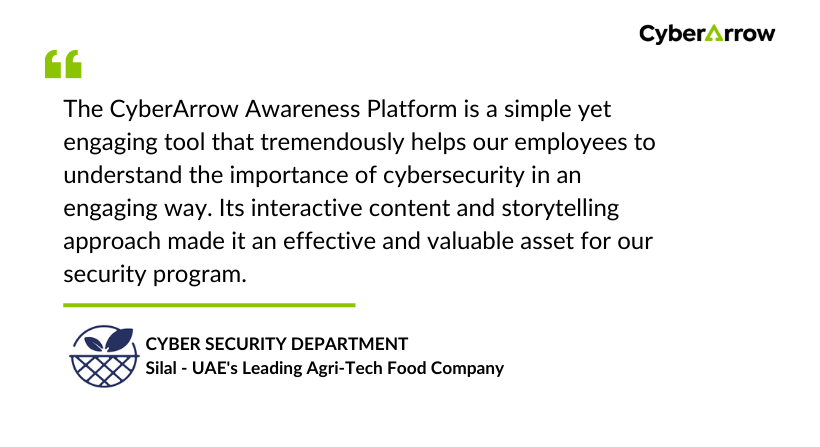
Read how CyberArrow awareness platform increased security awareness among Silal’s employees.
See what Silal has to say about CyberArrow Awareness Platform:
Final thoughts
Spoofing and phishing are major threats in today’s digital world. While spoofing focuses on faking identities to gain trust, phishing is about stealing sensitive information through deception. Both can cause serious harm to individuals and businesses.
The best defense is awareness and training. Organizations must educate employees, use security tools, and test their defenses with phishing simulations.
CyberArrow Awareness Platform helps businesses automate training and improve security with real-time phishing simulations.
