Smishing vs phishing: Understanding the difference
Cybercriminals are always finding new ways to trick people into giving away personal or company information. Two of the most common cyber threats today are smishing and phishing. Both are types of social engineering attacks that target individuals through fake messages. However, they use different methods to deceive victims.
If your employees do not know how to recognize these attacks, your organization could face data breaches, financial losses, and reputational damage. That is why it is important to train your staff to identify and avoid smishing and phishing attacks.
In this article, we will explore what smishing and phishing are, how they work, their key differences, and how you can protect your organization from these threats. We will also discuss how the CyberArrow Awareness Platform can help automate security awareness training and phishing simulations to keep your employees alert.
What is phishing?
Phishing is a cyber attack where hackers send fake emails to trick people into revealing sensitive information, such as passwords, credit card details, or company data. These emails often appear to come from a trusted source, like a bank, a government agency, or even your own company.
How does phishing work?
A phishing attack usually follows these steps:
- The attacker creates a fake email – The email looks real and may include logos, official-sounding language, and urgent messages.
- The victim receives the email – The email might claim there is an issue with their account, a package delivery, or an urgent security update.
- The email contains a malicious link or attachment – The victim is tricked into clicking on a link that leads to a fake website or downloading a harmful file.
- The victim enters sensitive information – If they enter their login details, hackers can steal their credentials and access important systems.
Examples of phishing attacks
- Fake bank emails – Attackers send emails that look like they are from a bank, asking the victim to verify their account.
- CEO fraud – Hackers pretend to be high-level executives and request an urgent money transfer from employees.
- Delivery scams – The victim receives an email saying their package is delayed, with a fake link to “track” it.
Phishing attacks can cause financial losses, data theft, and even complete account takeovers. But phishing is not just limited to emails there’s another type of attack called smishing that is equally dangerous.
What is smishing?
Smishing (SMS phishing) is a cyber attack that uses text messages instead of emails to trick victims into revealing sensitive information. These messages often include a fake link or a request for personal data.
How does smishing work?
- The attacker sends a fake text message – The message looks like it is from a bank, delivery service, or government agency.
- The message includes a malicious link or request – It may ask the victim to click a link to update account details or call a phone number.
- The victim enters sensitive information – If they enter personal details, the attacker can steal passwords, financial data, or access company systems.
Examples of smishing attacks
- Bank fraud alerts – A fake text claims there is suspicious activity on the victim’s bank account and asks them to confirm details.
- Fake package delivery notices – The message says a package could not be delivered and provides a link to reschedule.
- Government scams – Attackers send texts pretending to be tax authorities or law enforcement, asking for payment.
Smishing attacks exploit people’s trust in text messages since many users believe SMS is safer than email. However, smishing can be just as harmful as phishing.
Smishing vs phishing: What’s the difference?
| Feature | Phishing | Smishing |
| Attack Method | Fake emails | Fake text messages (SMS) |
| Common Targets | Employees, individuals, organizations | Smartphone users |
| Delivery Platform | Mobile SMS | |
| Links & Attachments | Links to fake websites, harmful email attachments | Fake links in SMS, fraudulent phone numbers |
| Main Goal | Steal sensitive data (passwords, financial info) | Trick victims into revealing personal or financial information |
| Perceived Security | Many users are aware of phishing emails | Users often trust text messages more than emails |
Even though smishing and phishing use different communication channels, they both aim to steal information and gain access to sensitive accounts. That is why cyber awareness training is essential for employees to recognize and report these attacks.
Quick link: Spam vs phishing
How to protect your organization from smishing and phishing
Organizations must take proactive steps to protect themselves from smishing and phishing attacks. Here are some best practices to follow:
1. Educate employees through security awareness training
Employees are often the first target of cyber attacks. Training them on how to recognize phishing and smishing attempts can help prevent security breaches.
2. Use Multi-Factor Authentication (MFA)
Even if an employee falls for an attack, MFA adds an extra layer of security by requiring a second verification step, such as a phone code or biometric scan.
3. Never click on suspicious links
Teach employees to hover over links in emails and texts before clicking. If the link looks suspicious, they should report it.
4. Verify requests before taking action
If an email or text message asks for sensitive information, confirm the request directly with the sender through official channels.
5. Implement a phishing simulation program
Regular phishing and smishing simulations help employees recognize real threats and stay alert against cyber attacks.
How CyberArrow Awareness Platform helps protect your organization
Keeping employees trained on cyber security risks can be difficult, especially when attacks evolve over time. That’s where the CyberArrow Awareness Platform comes in.
CyberArrow offers an automated awareness training program that helps businesses educate employees on phishing, smishing, and other cyber threats.
Key features of CyberArrow Awareness Platform:
- Automated training programs: Employees receive interactive cyber security training on recognizing phishing and smishing attacks.
- Real-time phishing simulations: CyberArrow includes a phishing simulation module that tests employees and helps them learn from real-world attack scenarios.
- Easy reporting and tracking: The platform provides detailed insights into how employees respond to simulated phishing attempts.
- Compliance with security standards: Helps organizations stay compliant with frameworks like NIST, ISO 27001, and SOC 2.
With CyberArrow Awareness Platform, organizations can build a strong cyber security culture and reduce the risk of phishing and smishing attacks.
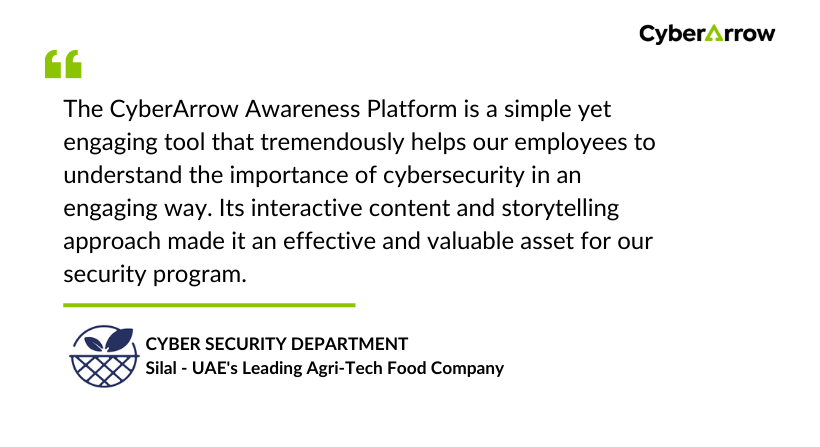
Read how CyberArrow awareness platform increased security awareness among Silal’s employees.
See what Silal has to say about CyberArrow Awareness Platform: