


What is NIST certification? How to achieve it?
Cyber threats are growing, and organizations must take strong measures to protect their systems, data, and customers. Many businesses turn to NIST certification to prove their cyber security readiness and meet regulatory requirements.
But what exactly is NIST certification? How does it differ from NIST compliance, and why should businesses care about it?
In this guide, we’ll explain what NIST certification means, its benefits, and how organizations can achieve it. We’ll also discuss how CyberArrow GRC can simplify and automate the process, ensuring businesses stay compliant without the manual burden.
What is NIST certification?
The National Institute of Standards and Technology (NIST) is a U.S. government agency that develops cyber security frameworks and guidelines to help businesses manage risks.
However, unlike certifications like ISO 27001, NIST itself does not issue a formal “NIST Certification.” Instead, organizations follow NIST frameworks, and third-party auditors assess compliance.
Key NIST frameworks used for certification
Organizations seeking NIST certification typically follow one or more of the following:
- NIST 800-53 – Focuses on security and privacy controls for federal agencies and contractors.
- NIST 800-171 – Designed for businesses handling Controlled Unclassified Information (CUI).
- NIST Cybersecurity Framework (CSF) – A voluntary framework for improving cyber security risk management.
While these frameworks do not offer direct certification, businesses can undergo third-party assessments to verify compliance.
Who needs NIST certification?
- Government contractors working with federal agencies.
- Defense contractors handling sensitive military data.
- Businesses managing customer data that want to strengthen cyber security.
- Healthcare, finance, and tech companies needing strong security controls.
Even if NIST certification is not required, many organizations choose to follow these guidelines to improve security and build customer trust.
NIST certification vs. NIST compliance
Many organizations confuse NIST certification with NIST compliance, but they are different.
- NIST compliance: Businesses follow NIST frameworks to improve cyber security but do not receive a formal certification.
- NIST certification: A third-party auditor assesses the organization’s security practices and issues a certification proving compliance with NIST guidelines.
For example, companies aiming for CMMC (Cybersecurity Maturity Model Certification) must comply with NIST 800-171 requirements and pass an official assessment.
Quick link: CyberArrow partners with RiskRecon by MasterCard to enhance third-party risk management.
Benefits of achieving NIST certification
1. Stronger cyber security
NIST frameworks help businesses build a strong security posture, reducing risks from cyberattacks.
2. Competitive advantage
Companies with NIST certification stand out in the market, proving their commitment to security.
3. Compliance with regulations
Many industries and government contracts require businesses to follow NIST standards.
4. Improved customer trust
Clients prefer companies that follow best security practices and protect sensitive data.
5. Reduced risk of fines and penalties
Meeting NIST compliance helps businesses avoid legal troubles related to data breaches.
Steps to achieve NIST certification
Step 1: Identify the relevant NIST framework
The first step is to determine which NIST standard applies to your business.
- If you handle federal data, you may need NIST 800-171 compliance.
- If you want to improve overall security, the NIST Cybersecurity Framework (CSF) is a good choice.
Step 2: Conduct a risk assessment
Assess your current security posture by:
- Identifying critical assets and sensitive data.
- Evaluating vulnerabilities and potential threats.
- Understanding compliance gaps.
Step 3: Implement security controls
Based on the chosen NIST framework, businesses must implement key security measures, such as:
- Access control – Restrict access to sensitive data.
- Data encryption – Secure information from unauthorized access.
- Incident response plan – Prepare for cyber threats and breaches.
- Employee training – Educate staff on cyber security best practices.
Step 4: Document policies and procedures
Proper documentation is essential for NIST certification. Organizations should:
- Develop a cyber security policy outlining security controls.
- Maintain records of security practices and risk assessments.
- Create an incident response plan for handling security breaches.
Step 5: Conduct an internal audit
Before applying for NIST certification, businesses should:
- Perform self-assessments to find and fix gaps.
- Use cyber security tools to automate risk management.
- Test security controls through penetration testing.
Step 6: Get assessed by a third-party auditor
To receive NIST certification, businesses must pass an audit by a certified assessor. The process includes:
- Reviewing security policies and procedures.
- Verifying compliance with NIST standards.
- Testing cyber security measures for effectiveness.
If the organization meets all requirements, it receives NIST certification, proving its compliance.
Step 7: Maintain compliance with continuous monitoring
NIST compliance is an ongoing process. Organizations must:
- Regularly update security policies.
- Monitor systems for new threats.
- Conduct annual audits to ensure compliance.
Challenges in achieving NIST certification
Many organizations struggle with NIST compliance due to:
- Complex security requirements
- Lack of cyber security expertise
- Time-consuming manual compliance tracking
- Difficulty in mapping existing controls to NIST frameworks
To overcome these challenges, businesses should use automation tools to simplify compliance efforts.
Automating NIST certification with CyberArrow GRC
Manually managing NIST certification is time-consuming and prone to errors. CyberArrow GRC streamlines compliance by automating key processes and reducing manual effort.
How CyberArrow GRC helps with NIST certification
- Automated risk assessments: Identify security gaps and vulnerabilities quickly.
- Pre-built compliance frameworks: Easily map existing controls to NIST standards.
- Real-time security monitoring: Detect and respond to threats instantly.
- Centralized compliance management: Store and manage policies, audits, and security reports in one place.
- Audit-ready compliance reports: Generate reports with a single click for easy certification.
Why choose CyberArrow GRC?
- Saves time and eliminates manual compliance tracking.
- Ensures continuous NIST compliance with real-time monitoring.
- Simplifies the certification process with automated reporting.
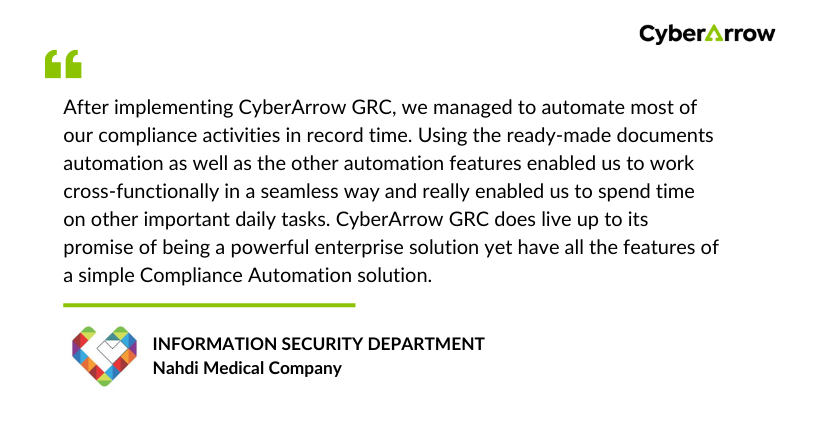
See what Nahdi has to say about CyberArrow GRC:
Conclusion
NIST certification helps businesses strengthen cyber security, meet regulatory requirements, and gain customer trust. While NIST does not issue official certifications, organizations can follow its frameworks and get certified through third-party audits.
Achieving NIST certification manually can be challenging, but with CyberArrow GRC, businesses can automate compliance, reduce errors, and stay ahead of cyber threats.
