What is the Protection of Personal Information Act (POPI Act) – POPIA?
Data privacy is no longer just a concern for tech companies or legal teams—it affects everyone. The Protection of Personal Information Act (POPIA) is South Africa’s response to growing concerns over data misuse, breaches, and privacy violations. Designed to give individuals more control over their personal information, POPIA holds businesses accountable for how they collect, store, and use data.
But what exactly does POPIA cover?
How does it impact businesses and individuals?
And what happens if organizations fail to comply?
This article breaks down everything you need to know about South Africa’s data protection law.
- What is POPIA, and why does it matter?
- Who must comply with POPIA?
- Conditions for lawful data processing under POPIA
- Rights of individuals under POPIA
- Security and data breach requirements
- Cross-border data transfers
- Penalties for non-compliance
- How businesses can ensure POPIA compliance
- Simplify POPIA compliance with CyberArrow
What is POPIA, and why does it matter?
POPIA was enacted in 2013 but came into full effect on July 1, 2021. The law protects individuals’ personal information by setting strict requirements on how organizations collect, process, store, and share data. It applies to both public and private sector organizations operating in South Africa.
With data breaches and privacy concerns becoming more frequent, organizations must take data protection seriously. Non-compliance with POPIA can lead to hefty fines, reputational damage, and criminal liability.
Quick read: Business resilience vs. business continuity explained
Key definitions under POPIA
Understanding POPIA starts with knowing its key definitions:
- Personal Information – Any information related to an identifiable individual, including names, addresses, phone numbers, ID numbers, email addresses, biometric data, and online identifiers.
- Data Subject – The person to whom the personal information belongs.
- Responsible Party – The organization or entity that determines how and why personal data is processed.
- Operator – A third-party service provider that processes personal data on behalf of the responsible party.
- Processing – Any operation performed on personal data, such as collecting, storing, modifying, or sharing it.
Who must comply with POPIA?
POPIA applies to anyone processing personal data in South Africa, including:
- Businesses – Any company handling customer, employee, or supplier data.
- Government institutions – Public entities that process personal data.
- Nonprofits and educational institutions – Organizations collecting donor, student, or member information.
- Third-party service providers – Cloud services, payroll processors, and marketing firms handling data on behalf of other organizations.
Even businesses outside South Africa must comply if they process the personal information of South African residents.
Conditions for lawful data processing under POPIA
POPIA outlines eight conditions that organizations must follow when processing personal data:
- Accountability – Organizations must take responsibility for ensuring regulatory compliance.
- Processing limitation – Data must be collected lawfully, with minimal intrusiveness.
- Purpose specification – Personal information should only be collected for a specific, clearly defined purpose.
- Further processing limitation – Data cannot be used for any other purpose unless it aligns with the original intent.
- Information quality – Organizations must ensure that personal data is accurate, complete, and up to date.
- Openness – Individuals must be informed when their data is collected and how it will be used.
- Security safeguards – Organizations must implement measures to prevent unauthorized access, loss, or data breaches.
- Data subject participation – Individuals have the right to access, correct, or delete their personal information.
Rights of individuals under POPIA
POPIA grants individuals several rights over their personal data, including:
- Right to access – Individuals can request a copy of the personal information an organization holds about them.
- Right to correction – They can request corrections to inaccurate or outdated data.
- Right to object – They can object to processing their data for direct marketing or other specific purposes.
- Right to deletion – Under certain conditions, individuals can request that their data be deleted.
- Right to be informed – Organizations must provide clear and transparent information about data collection and usage.
Quick read: A guide to Europe’s cyber security compliance standards
Security and data breach requirements
Organizations must implement strong security measures to protect personal data. This includes:
- Encryption and access controls – Ensuring only authorized personnel can access sensitive data.
- Regular security audits – Assessing vulnerabilities and strengthening defenses.
- Incident response plans – Having procedures in place for handling data breaches.
If a data breach occurs, organizations must:
- Notify the Information Regulator as soon as possible.
- Inform affected individuals if their personal information is compromised.
Failure to report breaches can lead to severe penalties.
Cross-border data transfers
Transferring personal data outside South Africa is only allowed if:
- The recipient country has adequate data protection laws.
- The individual has given explicit consent.
- There is a legally binding data protection agreement in place.
This aligns with global best practices, ensuring that South African data remains protected even when processed abroad.
Penalties for non-compliance
Non-compliance with POPIA can lead to:
- Fines of up to R10 million (USD 550,000).
- Criminal charges for serious offenses, including imprisonment of up to 10 years.
- Reputational damage, leading to loss of customer trust and business opportunities.
The Information Regulator is responsible for enforcing POPIA and has the power to investigate complaints, conduct audits, and issue fines.
How businesses can ensure POPIA compliance
Businesses should take proactive steps to comply with POPIA, including:
1. Conduct a data audit
Identify what personal data is collected, where it’s stored, and who has access. This helps businesses understand data flows, minimize risks, and ensure compliance with lawful processing principles.
2. Update privacy policies
Privacy policies should clearly outline what data is collected, why it’s needed, how it will be used, and individuals’ rights. These policies must be transparent, accessible, and regularly updated to align with POPIA requirements.
3. Obtain valid consent
Businesses must ensure individuals explicitly agree to data collection and processing. Consent should be clear, voluntary, and easy to withdraw. Avoid pre-checked boxes or vague terms that assume consent.
4. Implement security measures
Personal data must be protected from breaches, leaks, and unauthorized access. Essential security measures include:
- Encryption to secure sensitive information.
- Access controls to restrict data access to authorized personnel.
- Regular security audits to detect and fix vulnerabilities.
5. Train employees
Human error is one of the biggest risks to data security. Regular training helps employees understand POPIA requirements, cyber security risks, and proper data handling practices to prevent accidental breaches.
6. Appoint an Information Officer
Every business must designate an Information Officer responsible for ensuring POPIA compliance. Their duties include overseeing data protection, handling complaints, and reporting any data breaches to the Information Regulator.
Simplify POPIA compliance with CyberArrow
CyberArrow GRC helps businesses streamline their POPIA compliance efforts. With features like automated risk assessments, policy management, employee training, and real-time monitoring, CyberArrow ensures you stay compliant without the hassle of manual processes.
With CyberArrow, you can:
- Automate compliance tasks and documentation.
- Get real-time insights into your compliance status.
- Ensure employees are trained on compliance best practices.
- Simplify audits and regulatory reporting.
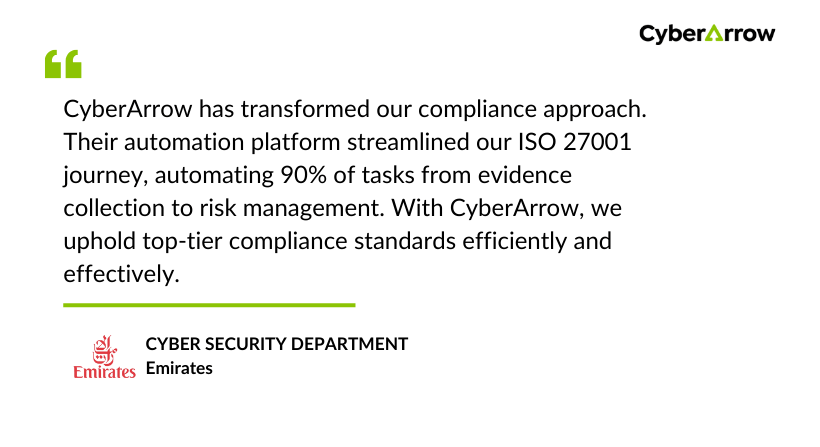
See what companies like Emirates say about CyberArrow: